XCore HFT / Trading Lab
PULSE: Trading risk includes the machinery
Quantitative execution, market-microstructure, and risk-control research from XTRSK.
What this problem really is
In an electronic market every order is a token that lives inside a price‑time priority queue. The token carries three distinct economic components: the expected spread capture if the order is filled, the adverse‑selection cost that accrues while the order waits, and the optionality of retaining a place in line. When a trader’s system believes an order is “alive”, the venue may have already removed it, may have already filled it, or may still be holding it in the queue. The discrepancy between the system’s internal view and the venue’s reality is the essence of “machinery risk”. It is not a model‑risk problem – the pricing model may correctly predict the expected profit of a limit order – but a systems‑risk problem that can turn a theoretically profitable strategy into a losing one.
If the internal state diverges, the system can unintentionally submit a duplicate order, leave a stale order that continues to bleed execution fees, or fail to recover a partially filled position after a crash. Each of these outcomes erodes the expected P&L that the model supplied. The risk is amplified on a prop desk where capital is allocated to many parallel strategies, each submitting dozens of orders per second. A single duplicated order that doubles exposure on a volatile instrument can wipe out the daily profit target.
The root cause is a lack of synchronisation between the order‑submission pipeline, the market data feed, and the persistence layer that records the event trail. When any component lags, loses messages, or restarts without a clean state hand‑over, the system’s perception of “what is on the book” becomes stale. In practice this manifests as three common failure modes: duplicated execution, orphaned orders that linger after a strategy has moved on, and unrecoverable partial fills that leave the desk exposed to market moves.
How the mechanism works, step by step
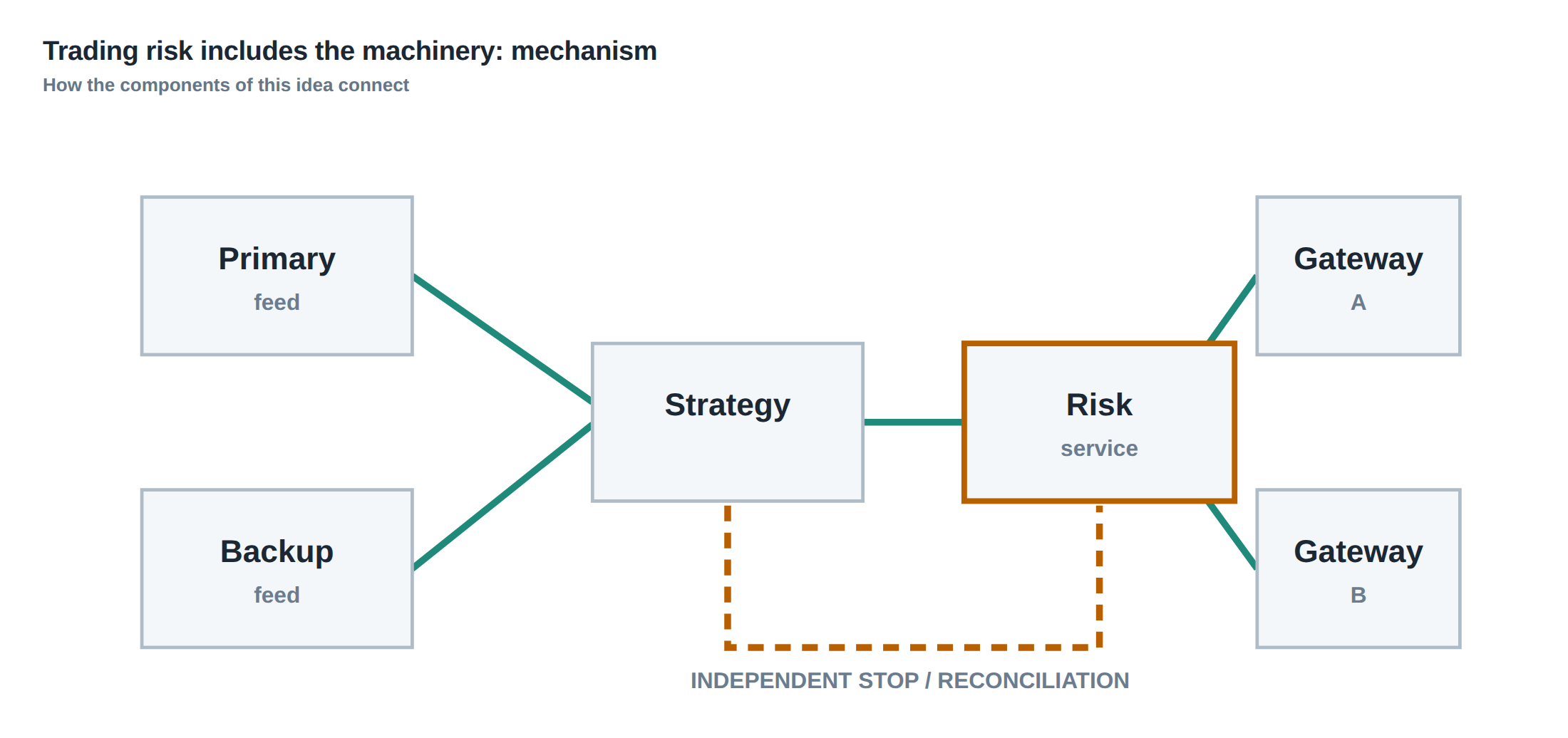
The first step in any electronic execution chain is to receive a market‑data snapshot that defines the current best bid and ask, the depth of the queue at those prices, and any recent trades that may indicate a shift in adverse‑selection risk. The snapshot is timestamped, stored in an immutable log, and used to calculate the theoretical spread capture for the next limit order.
Next, the order‑generation module creates an order object that contains a unique, deterministic identifier, the side, price, size, and a timestamp. The identifier is generated from a hash of the strategy ID, the intended execution time, and a monotonic sequence number, ensuring that a retry of the same logical order will produce the same identifier – the essence of idempotent submission.
The order object is then passed to the gateway, which translates it into the venue‑specific protocol and sends it over a TCP socket. The gateway records the outbound message in the immutable event trail before awaiting an acknowledgement. The acknowledgement – a “new order accepted” or a “rejected” – is matched against the stored identifier. If the acknowledgement does not arrive within a configurable latency window, the gateway re‑issues the order using the same identifier, confident that the venue will treat it as a duplicate and ignore the second execution.
Simultaneously, a state‑reconciliation service consumes the venue’s execution reports, order‑status messages, and cancels. It updates an internal order‑book that mirrors the venue’s queue position. The service continuously compares the internal book with the latest market‑data snapshot, adjusting the expected spread capture and adverse‑selection cost in real time. When the service detects that the venue’s view diverges – for example, an order that the internal book believes is active has been cancelled by the exchange – it issues a corrective action, such as a cancel‑replace or a strategy‑level alarm.
Failover is handled by a hot‑standby gateway that shares the immutable event log via a write‑ahead log. If the primary gateway crashes, the standby reads the log from the last committed offset, reconstructs the exact internal order state, and resumes submission without generating new identifiers. Because the identifiers are deterministic, the standby can safely resume without risking a double execution.
A worked example with real numbers
Consider a market‑making strategy on a liquid futures contract where the model predicts a 0.5 % spread capture for a 10‑tick limit order placed 2 ticks inside the best bid. The strategy decides to post a sell limit order of 5 contracts at 2 ticks above the current best bid, which is 12,500 USD. The order identifier is generated as “STRAT‑A‑20261009‑001”.
At 09:30:12.345 UTC the gateway sends the order to the exchange. The exchange acknowledges the order at 09:30:12.382 UTC, confirming that the order is now in the queue at price 12,520 USD with a queue position of 3. The internal order‑book records the acknowledgement, and the immutable log contains the event: “NEW‑ORDER‑ACK, ID=STRAT‑A‑20261009‑001, PRICE=12,520, SIZE=5, POS=3”.
Five seconds later the gateway experiences a hard crash and restarts. The restart script reads the event log up to offset 12,345, which includes the NEW‑ORDER‑ACK but does not yet contain any fill or cancel messages. The standby gateway reconstructs the internal state and believes the order is still pending. Because the system is configured to re‑submit any order that lacks a fill after a 3‑second silence, it issues a duplicate submission at 09:30:17.010 UTC, using the same identifier “STRAT‑A‑20261009‑001”.
The exchange receives the duplicate request. Since the identifier already exists in its order table, the exchange treats the second request as a no‑op and returns a “DUPLICATE‑ORDER‑IGNORED” acknowledgement at 09:30:17.025 UTC. No second execution occurs, and the internal state remains consistent.
Now introduce a subtle variation: the restart script fails to replay the event log past offset 12,340, missing the original NEW‑ORDER‑ACK. The standby therefore believes the order never reached the venue and issues a fresh order with a new identifier “STRAT‑A‑20261009‑002”. The exchange accepts this as a distinct order, placing it also at 12,520 USD, now with queue position 1 because the original order has already been filled partially at price 12,520 USD for 2 contracts. The desk now holds two live orders for a total of 7 contracts, whereas the model only accounted for 5.
When the market moves against the desk and the price drops to 12,480 USD, both orders are executed, resulting in an unexpected short exposure of 7 contracts instead of the intended 5. The extra 2 contracts generate an additional loss of 40 USD each (0.32 % of the contract value), turning a projected 62 USD profit into a 18 USD net loss. The duplication arose solely from a failure to restore live order state during a gateway restart – a classic machinery‑risk event.
Where it breaks in live markets
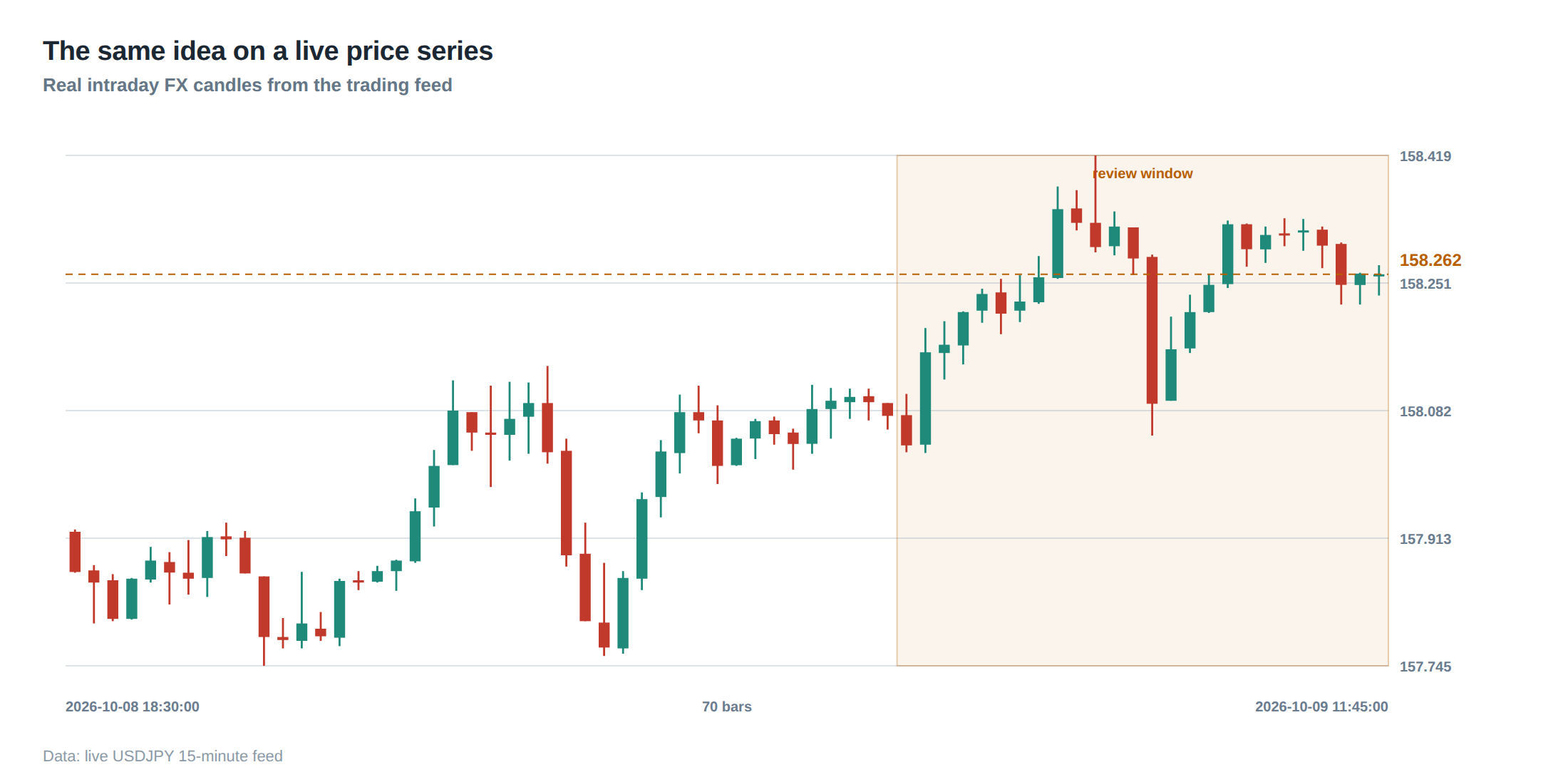
In production environments the failure points are rarely isolated. Network partitions can delay acknowledgements, causing the gateway to believe an order was never received and to resend it. If the venue’s duplicate‑order handling is imperfect – for example, some exchanges silently accept a second order with a new internal identifier when the client’s identifier is not recognised – the system can end up with two active legs.
Stale market‑data feeds exacerbate the problem. A feed that lags by 200 ms may present a price that is already out of the queue, meaning the expected spread capture has evaporated while the system still believes the order will be filled. The adverse‑selection cost rises sharply as the queue position deteriorates, yet the strategy continues to keep the order alive because its internal timer has not expired.
Failover mechanisms that simply restart the gateway without a deterministic hand‑over of the order‑book can create “orphaned” orders. The venue may have already cancelled the order due to a timeout, but the desk’s internal state still marks it as live, prompting a needless cancel‑replace that incurs a cancellation fee.
Finally, high reject rates from the venue – often triggered by regulatory checks or risk limits – can flood the event log with error messages. If the system does not differentiate between transient rejects (e.g., “price out of band”) and permanent ones (e.g., “exceeds position limit”), it may repeatedly attempt to resend the same order, each time generating a new identifier and multiplying exposure.
The operating path, stage by stage
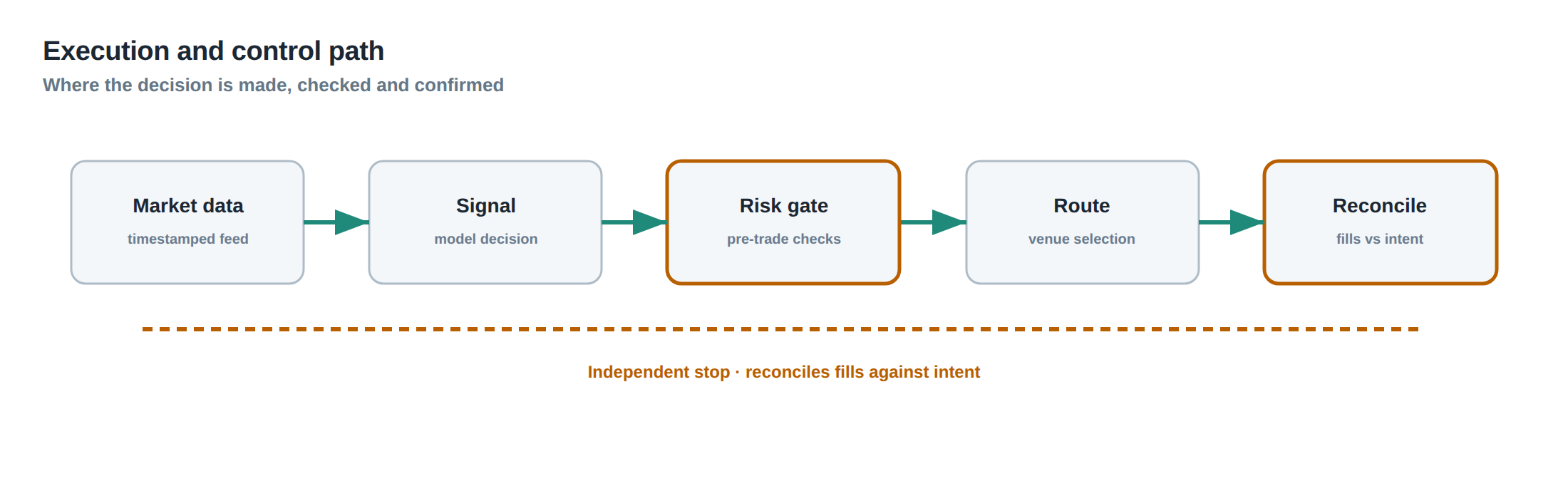
The first stage is ingestion: market data arrives via a multicast feed, is timestamped, and written to an append‑only log. The second stage is calculation: the pricing model consumes the latest snapshot, produces a target price and size, and hands the order request to the order‑manager. The third stage is identification: the order‑manager deterministically derives a unique identifier from the strategy ID, the target execution time, and a monotonically increasing sequence.
The fourth stage is transmission: the gateway serialises the order, attaches the identifier, and sends it to the venue. It records the outbound message in the immutable log before awaiting an acknowledgement. The fifth stage is acknowledgement handling: on receipt of a “new order accepted” or “rejected” message, the gateway updates the internal order‑book and marks the identifier as “in‑flight”. If no acknowledgement arrives within the latency window, the gateway re‑issues the same order using the same identifier.
The sixth stage is reconciliation: a dedicated service consumes execution reports and order‑status updates, matches them to identifiers, and updates the mirrored venue order‑book. It also monitors queue depth and feed age, recomputing the expected spread capture and adverse‑selection cost each millisecond. The seventh stage is risk‑control: if the recomputed expected profit falls below a threshold, the service automatically cancels the order.
The eighth stage is persistence: every inbound and outbound message, every state transition, and every computed metric is written to an immutable event trail that is replicated across three data‑centres. The ninth stage is failover: a hot‑standby gateway watches the log, mirrors the in‑flight identifiers, and can take over instantaneously without generating new identifiers. The final stage is degraded‑mode operation: if the market‑data feed degrades beyond a configurable age, the system switches to a “listen‑only” mode, halting new submissions while still processing fills for existing orders.
Controls that act before the damage
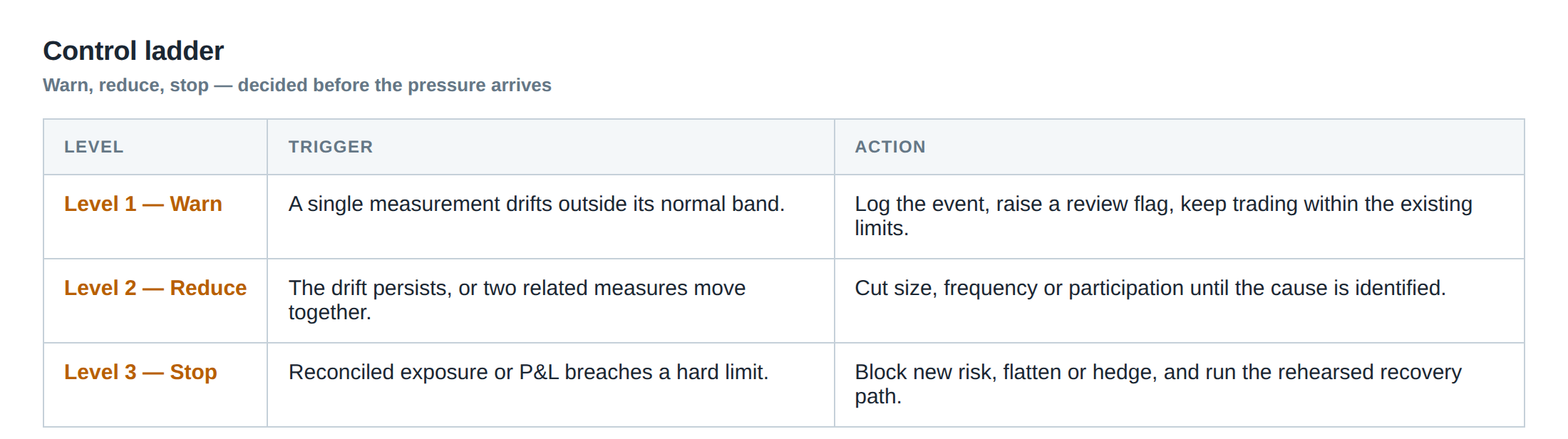
The first line of defence is idempotent order submission. By deriving the identifier from deterministic inputs, the system guarantees that any retry of the same logical order will be recognised as a duplicate by the venue, preventing double execution.
Continuous reconciliation is the second control. The internal order‑book is constantly compared with the venue’s order‑status stream; any mismatch triggers an immediate corrective action, such as a cancel‑replace or an alarm that escalates to the desk manager.
Failover design that re‑plays the immutable event log up to the last committed offset ensures that a standby gateway resumes with an exact snapshot of live orders. Because the identifiers are immutable, the standby does not need to generate new identifiers, eliminating the risk of duplicate exposure.
Monitoring feed age, queue depth, and reject rate constitutes the third control layer. If the market‑data feed exceeds a 100 ms age threshold, the system pauses new order generation. If queue depth falls below a minimum that would make the expected spread capture unprofitable, the order is cancelled pre‑emptively. A reject‑rate exceeding 2 % for a single venue triggers a temporary routing shift to an alternative venue.
Recording an immutable event trail provides forensic capability. Every state change is time‑stamped and signed, allowing post‑mortem analysis to pinpoint the exact moment the internal view diverged from the venue. This trail also supports regulatory audit requirements.
Practising degraded‑mode operation in simulation and in a dedicated “shadow” environment builds confidence that the system can survive prolonged data outages without generating stray orders. In degraded mode the gateway only processes inbound fills and cancels, never submits new orders, thereby limiting exposure while the desk works to restore full connectivity.
How to measure whether it is working
Effectiveness is measured by the proportion of orders that close the lifecycle without a state mismatch. A key metric is the “duplicate‑order incidence rate”, defined as the number of executions that exceed the intended size divided by total executions. A healthy system maintains this rate below 0.01 %.
Another indicator is the “reconciliation latency”, the time between a venue‑sent execution report and the internal order‑book update. Benchmarks should keep this latency under 5 ms on average; any sustained increase suggests a bottleneck in the event‑processing pipeline.
The “feed‑age compliance ratio” tracks the percentage of market‑data snapshots that arrive within the acceptable age window (e.g., 100 ms). A ratio above 99.5 % signals that the feed monitoring is effective.
Failover drills are quantified by “recovery‑to‑steady‑state time”. After a simulated gateway crash, the system should resume normal order submission within 200 ms, with zero duplicate identifiers generated.
Finally, the “reject‑rate per venue” is logged continuously. A sustained reject‑rate above the configured threshold triggers a control that automatically throttles order flow to that venue, preventing a cascade of rejections that could fill the event log and mask genuine anomalies.
The portfolio view
From a portfolio perspective, machinery risk is a hidden cost that can erode the Sharpe ratio of an otherwise well‑modelled strategy. When duplicated orders inflate exposure, the realised volatility of the P&L series spikes, reducing risk‑adjusted returns. Conversely, timely cancellation of stale orders preserves capital and limits adverse‑selection losses, directly improving the strategy’s edge.
Aggregating the control metrics across all strategies provides a desk‑wide health dashboard. If the duplicate‑order incidence rises on a particular venue, the desk can rebalance traffic to alternative venues, thereby smoothing execution quality across the portfolio. Similarly, a rise in feed‑age violations on a specific asset class may prompt the allocation of additional bandwidth or a switch to a more reliable data provider.
Because the immutable event trail is shared across all strategies, post‑trade analysis can attribute P&L deviations to specific machinery events, such as a gateway restart that generated a duplicate identifier. This attribution enables precise capital allocation adjustments, ensuring that the desk does not inadvertently over‑expose a strategy that appears profitable on model forecasts but is fragile in its operational implementation.
In practice, the desk should treat machinery risk as a quantifiable component of total risk, alongside market risk, credit risk, and model risk. By integrating the control metrics into the same risk‑budget framework used for position sizing, the desk can allocate a small portion of capital to “operational buffers” that absorb the occasional loss from a machinery failure, while keeping the majority of capital deployed to strategies whose execution pipelines have demonstrably low duplication and stale‑order rates.
Do you have a systematic process to verify that every order identifier remains unique across restarts, and can you quantify the impact on your P&L if that guarantee were to slip?
About the research behind this lesson
The seminar frames electronic markets as price-time-priority queues. It separates queue value into spread capture versus adverse-selection cost and the option value of retaining a place in line.
Applied to this lesson: An order lifetime therefore cannot be based on elapsed time alone: the system must reassess whether its queue position, expected spread and adverse-selection risk still justify keeping the order alive.
Explore PULSE: System details
PULSE live account: Verify the live account on FX Blue
Live chat and updates: Telegram @xtrskhft
Source: High-Frequency Trading and Modern Market Microstructure
Educational content only. Trading leveraged products involves risk.
Chat with XTRSK
Chat ready
Start a chat and the XTRSK team will be notified immediately.