XTRSK
The Unthrottled Price Feed: XCore and the XTRSK PULSE FIX Stack
XTRSK market notes, system updates, and trading-focused reports.
Why feed quality decides the outcome in high-speed trading
In high-speed quantitative trading, the price feed is not a supporting detail. As far as the strategy is concerned, the feed is the market. Every trigger, every exit, and every risk decision is computed from the stream of prices the system receives — and a system can only be as fast and as accurate as the data in front of it.
XTRSK PULSE is a fast-trigger scalping system for XAUUSD and EURUSD. It is built to act on sharp movement and close with discipline, measuring tick activity and momentum in very short decision windows. For a system of this type, the quality and completeness of the price stream is the single most important input.
Why an unthrottled feed is critical for HFT applications
Many retail price feeds are throttled or aggregated: instead of forwarding every tick, the platform batches or filters updates and delivers a sampled stream. For a position trader this hardly matters. For a high-frequency application it is decisive:
- Distorted trigger timing. A momentum burst can begin and complete inside a single throttle window. A system watching a throttled feed sees the move late — or not at all.
- Worse entries and exits. Sampled quotes are stale or averaged quotes. Orders computed from them are priced against a market that has already moved on.
- Hidden micro-structure. Tick density, spread oscillation, and quote flicker are the raw material of high-speed signals. A filtered feed simply never delivers them.
- Markup opacity. A raw stream with zero broker markup means the prices the system evaluates are the prices liquidity providers actually quote — not a padded retail spread.
An unthrottled feed removes all four distortions. The system sees every tick, as it prints, at the true quoted price.
XCore FIX API liquidity routing
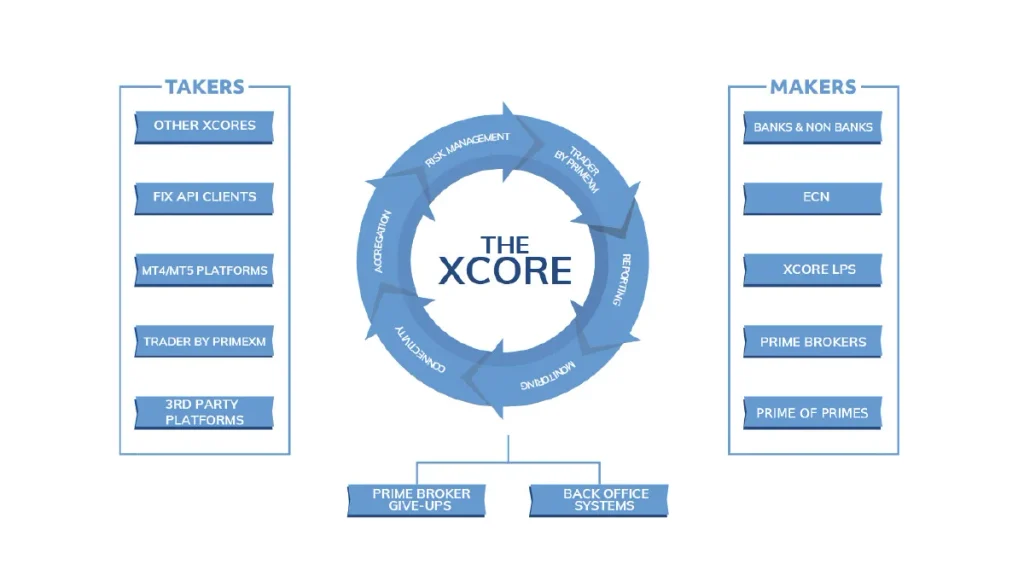
PrimeXM XCore engine connects directly to offer unthrottled FIX API access. Rather than passing client flow through a retail platform bridge, the XCore layer aggregates liquidity at the infrastructure level and streams raw price ticks to connected systems with zero broker markup. For a FIX-connected application such as PULSE, this means the session receives the full, unsampled tick stream directly from the aggregation engine. Institutional brokers offering TRUE FIX-APi operate on Xcore or parallele direct market backend. VARIANSE as a broker offers Prime Xcore for its PRIME account FIX-API clients.
Equinix LD4 co-location
The XCore aggregation engine sits physically inside the Equinix LD4 data center in London and is cross-connected directly into tier-1 bank and dark pool liquidity providers. LD4 is where a large share of institutional foreign-exchange liquidity is matched; hosting the aggregation engine in the same facility removes network hops between the liquidity providers and the feed. For example VARIANSE reports execution speeds starting at 1 millisecond on this infrastructure.
Institutional white-label distribution
For institutional clients and hedge funds, VARIANSE uses the same technology to distribute customizable, plug-and-play price feeds and institutional white-label setups. The underlying point for end clients is the same: the feed and execution route is institutional infrastructure, not a retail add-on.
What this means for PULSE clients
PULSE FIX access runs on exactly this route: an unthrottled, zero-markup tick stream from the XCore aggregation engine in Equinix LD4, delivered over FIX API. The system’s tick-density logic, fast triggers, and disciplined exits are designed around — and depend on — precisely this quality of market data. This is why broker route, infrastructure, and execution conditions are reviewed before any PULSE onboarding.
Trading leveraged products involves significant risk. Past performance does not guarantee future results.
Chat with XTRSK
Chat ready
Start a chat and the XTRSK team will be notified immediately.