XCore HFT / Trading Lab
PULSE: Every fast order needs a lifetime
Quantitative execution, market-microstructure, and risk-control research from XTRSK.
What this problem really is
The modern electronic market is a high‑speed queue where each limit order occupies a precise position in time‑price priority. A trading signal is generated, an order is injected, and the order begins to travel through a chain of software, network, and exchange gateway components before it finally reaches the exchange matching engine. The moment the signal is created, its informational content begins to decay; price moves, order‑book dynamics shift, and the expected profit of the original idea erodes. If the order has not yet been acknowledged by the venue when the signal becomes stale, the trader is exposed to a hidden risk: the order may be executed at a price that no longer reflects the original edge, or it may sit in the book while the market moves against it, turning a potential gain into a loss.
The core of the problem is the temporal mismatch between the lifespan of the signal and the latency of the order‑handling pipeline. A signal that is only valid for a few tens of milliseconds can remain “alive” in the system for seconds if the cancellation request is delayed or if the exchange is slow to acknowledge the removal. In that interval the order is effectively orphaned – it no longer represents a rational decision but still consumes capital, margin, and market risk. The phenomenon is often invisible because most monitoring systems only track elapsed wall‑clock time from order entry, not the age of the originating signal or the state of the cancellation acknowledgement.
Understanding this mismatch requires separating three concepts that are frequently conflated: the age of the signal, the age of the order as it sits in the exchange queue, and the age of the cancellation request as it propagates back to the originating system. When any of these ages exceeds the pre‑defined maximum that the strategy deems acceptable, the order should be considered dead, regardless of whether it is still technically “working” on the exchange. The failure to enforce such a rule creates a blind spot that can erode the expected Sharpe ratio of even the most sophisticated statistical arbitrage strategies.
How the mechanism works, step by step
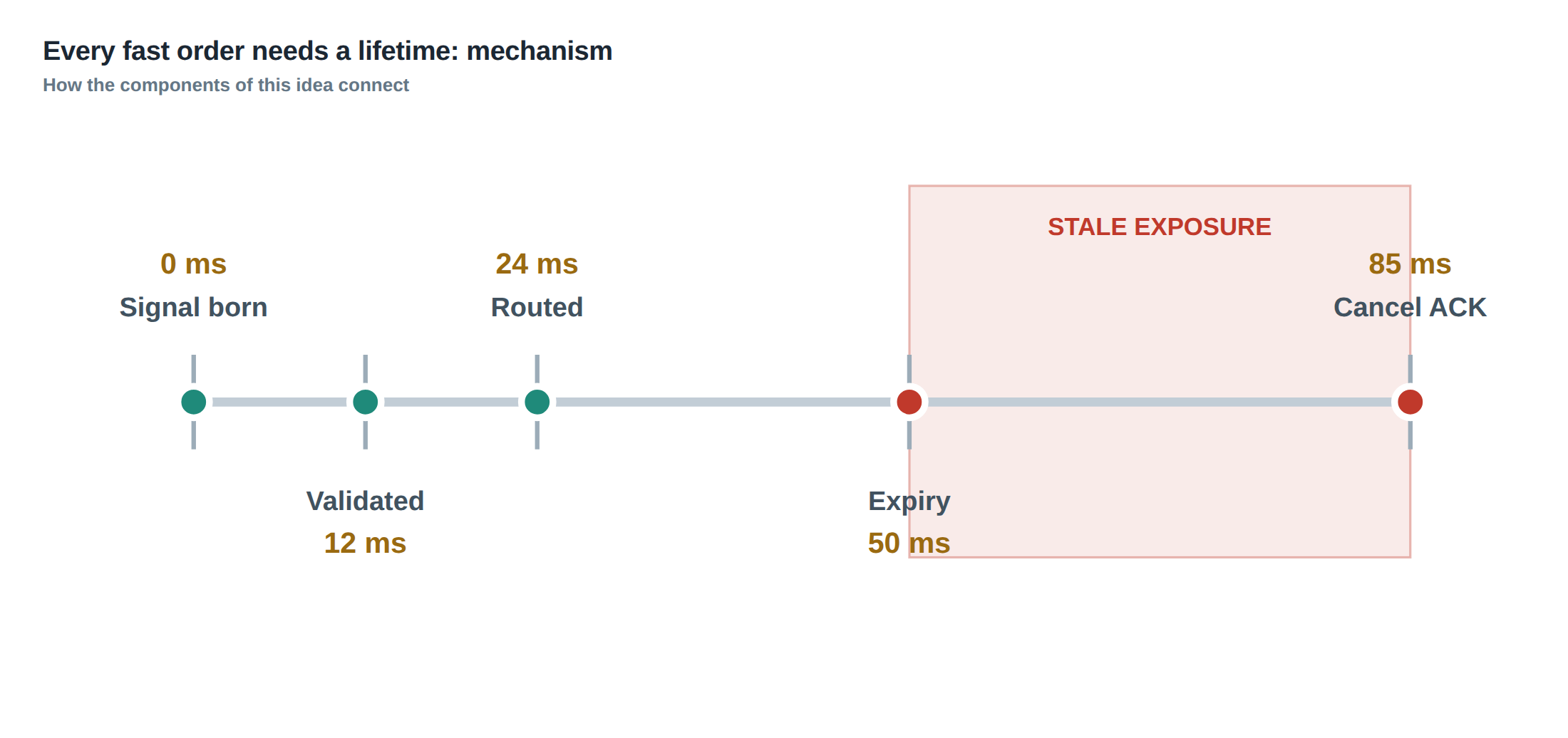
When a signal is produced, the algorithm stamps it with a timestamp and attaches a maximum‑age parameter – for example, 50 ms for a micro‑structure‑driven scalping signal. The order‑generation module packages the signal, the price level, and the maximum age into a request that is handed to the order router. The router forwards the request over a low‑latency network link to the gateway, which then passes it to the exchange’s matching engine. At this point the order is placed in the limit‑order book, receiving a queue position that is a function of price and the time of arrival.
If the market moves unfavourably, the strategy may decide to cancel the order. The cancel request is generated with the same maximum‑age constraint, but it now follows a different path: from the algorithm back through the router, across the same network, to the exchange. The exchange must acknowledge the cancellation before the order can be considered truly dead. Until that acknowledgement is received, the order remains executable, and the exchange may fill it at any price that matches the order’s limit.
Because the cancel path shares the same physical infrastructure as the original order path, congestion, packet loss, or temporary throttling at the gateway can introduce a delay of several milliseconds to tens of milliseconds. In the worst case, a cancellation can be queued behind a flood of other messages, extending the effective lifetime of the order far beyond the signal’s intended horizon. The system therefore needs a mechanism to recognise when the cancellation acknowledgement has not arrived within the allowed window and to take remedial action – typically by issuing a higher‑priority “force‑cancel” or by temporarily disabling the strategy’s ability to send further orders until the orphaned order is cleared.
The final piece of the mechanism is the exposure measurement. While the order is in this limbo state, the trader’s capital is at risk. The exposure can be quantified as the product of the order size, the distance between the order price and the current mid‑price, and the time the order has been idle beyond its signal age. This metric provides a real‑time gauge of how much “dead” capital is lingering in the system and can be used to trigger automated safeguards.
A worked example with real numbers
Consider a high‑frequency market‑making strategy that looks for a fleeting 0.2 % spread between the best bid and best ask on a liquid equity. The algorithm detects the spread at 09:30:12.345 678 UTC and generates a signal with a maximum age of 50 ms. It immediately sends a buy limit order for 10 000 shares at the current best bid of £100.00 and a sell limit order for the same size at the ask of £100.20.
The buy order reaches the exchange after 12 ms, taking a queue position at the top of the book. Within 30 ms the market moves: a large hidden order lifts the ask to £100.25, eroding the spread. The algorithm decides to cancel the buy order because the anticipated capture has vanished. The cancel request is transmitted at 09:30:12.395 UTC, 45 ms after the original signal. Under normal conditions the exchange would acknowledge the cancellation within another 5 ms, and the order would be removed at 09:30:12.400 UTC, well inside the 50 ms window.
In the live environment, however, the gateway experiences a brief congestion spike. The cancel request is delayed in the outbound queue for an additional 30 ms. The exchange finally receives the request at 09:30:12.425 UTC and acknowledges it at 09:30:12.428 UTC. By that time 78 ms have elapsed since the signal, more than the 50 ms maximum. During the extra 28 ms the order remained executable and was filled for 2 000 shares at £100.01, a price that now represents an adverse‑selection loss of £0.19 per share relative to the mid‑price of £100.10. The realised loss on the accidental fill is £380, a material hit for a strategy that expects to earn only a few basis points per trade.
If the system had attached a hard expiry of 50 ms to the order and automatically forced a “kill‑all” when the cancel acknowledgement failed to arrive, the orphaned order would have been purged before the fill occurred. The example illustrates why the signal’s lifetime must dominate the order’s life, not the other way round.
Where it breaks in live markets
In practice the breakdown occurs at the interfaces that are taken for granted as “instantaneous”. Network jitter, especially on public or shared data‑centre links, can add a stochastic component to every millisecond. Gateways that enforce per‑second message caps during peak periods will queue outbound cancels behind inbound market data, creating a hidden backlog.
Another source of failure is the internal order‑book management of the exchange. Some venues expose a “soft‑cancel” where the order is flagged for removal but remains matchable until the next price‑level update. If the market is quiet, the order can linger for several seconds, far beyond the signal horizon. The algorithm, seeing only a “cancel‑sent” flag, assumes safety, while the exchange still honours the order.
Finally, the software stack on the trading desk can introduce latency. A risk‑engine that checks the signal age after the order has been sent may already be too late; the order may have been placed for 30 ms before the engine even reads the timestamp. If the engine then decides to cancel, the cancel request is already behind the order in the pipeline, and the order’s effective lifetime is extended unintentionally.
These failure modes are rarely captured by simple latency metrics that report average round‑trip times. They manifest as outliers – occasional “replacement storms” where a flurry of cancels and re‑submits pile up, and as “ghost fills” where an order is executed after the strategy has moved on. Detecting them requires a more granular view of the signal‑to‑order lifecycle.
The operating path, stage by stage
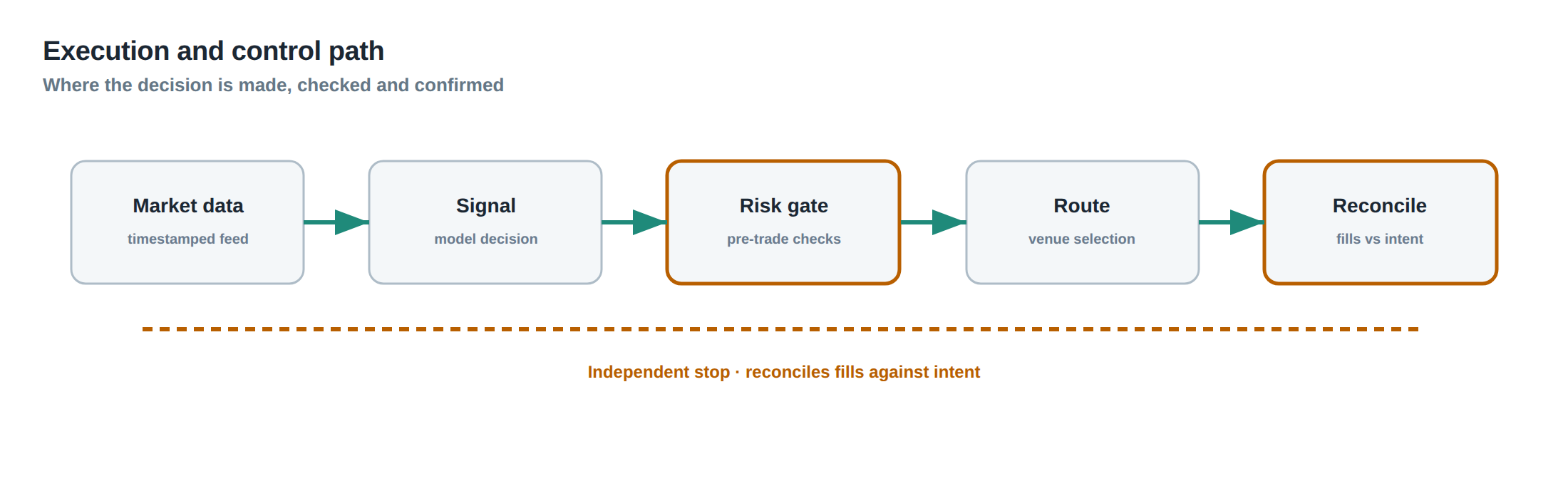
The first stage is signal creation. The algorithm timestamps the event, tags it with a maximum‑age field, and pushes it into a lock‑free queue that feeds the order router. The second stage is order dispatch. The router adds a sequence number, forwards the message over a dedicated low‑latency link, and records the outbound timestamp. The third stage is exchange receipt, where the order is entered into the limit‑order book and assigned a queue position.
If the market moves, the fourth stage is cancel generation. The algorithm again timestamps the cancel request, inherits the original signal’s maximum‑age, and sends the request through the same router. The fifth stage is cancel propagation, which mirrors the dispatch path but may be subject to different congestion controls, especially if the exchange throttles inbound cancels more aggressively than new orders. The sixth stage is exchange acknowledgement, where the venue sends a confirmation that the order has been removed from the book.
Only after the acknowledgement arrives does the seventh stage – order finalisation – occur. At this point the system can safely de‑allocate resources tied to the order and update the position book. If any of the intermediate stages exceed the pre‑defined age, the pipeline must trigger an exception path that either escalates the cancel request, temporarily blocks further order entry, or forces a “hard‑kill” by sending a higher‑priority message that bypasses normal throttling.
Controls that act before the damage
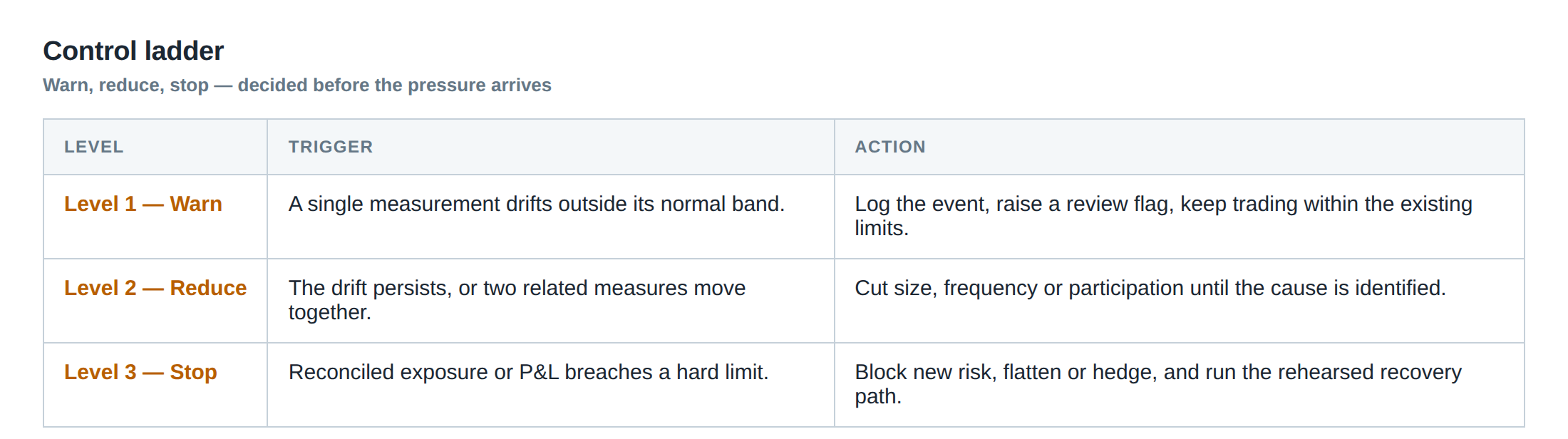
A robust defence starts with a hard‑coded expiry field that is enforced at the router level. When the router receives an order, it stores the expiry timestamp and refuses to forward any further messages for that order once the deadline passes, regardless of the order’s current state on the exchange.
The next control is a cancel‑acknowledgement watchdog. The risk engine subscribes to the acknowledgement stream and, if a confirmation has not been received within, say, 80 % of the signal’s maximum age, it raises a high‑severity alert and automatically issues a “force‑cancel” with elevated priority. This watchdog runs on a separate thread to avoid being blocked by the main order‑processing loop.
A third safeguard is the “replacement‑storm limiter”. When a series of cancels and re‑submits for the same signal are detected within a short window, the system imposes a back‑off timer that forces a pause before any further modifications are allowed. This prevents the scenario where a congested gateway repeatedly accepts new orders while the original cancel is still pending, effectively creating a queue of stale orders.
Finally, exposure caps are applied at the portfolio level. The system calculates the cumulative notional of all orders whose signal age has exceeded a configurable threshold and, if the sum surpasses a predefined limit, it automatically disables the offending strategy until the stale orders are cleared. This ensures that a single pathological signal cannot jeopardise the entire desk’s capital.
How to measure whether it is working
Measurement begins with a timestamp audit trail that records four key moments for each order: signal creation, order dispatch, cancel request, and cancel acknowledgement. By computing the differences between these timestamps, the desk can derive the signal‑age, order‑age, and cancel‑age distributions.
The primary KPI is the “signal‑age breach ratio”, the proportion of orders whose signal‑age exceeds the maximum‑age parameter at the moment of execution or cancellation. A low ratio – ideally below one percent – indicates that the expiry controls are effective. A secondary KPI is the “orphan‑fill loss”, the realised P&L attributable to fills that occurred after the signal had become stale. This figure should be tracked both in absolute terms and as a percentage of total strategy profit.
Another useful metric is the “acknowledgement latency tail”. By plotting the 99th‑percentile of cancel‑acknowledgement times, the desk can spot periods where the network or exchange is under stress. If the tail exceeds the configured safety margin, the watchdog thresholds should be tightened.
Finally, the exposure cap utilisation should be monitored in real time. When the sum of stale‑order notional approaches the cap, the system must trigger an automatic strategy pause. Logging the frequency and duration of such pauses provides feedback on whether the caps are set at appropriate levels.
The portfolio view
From a portfolio perspective, each signal’s lifetime is a micro‑option: the trader pays a premium – the capital tied up while the order sits in the queue – for the right to capture the spread. If the option expires before the market moves in the desired direction, the premium is lost but no adverse execution occurs. When the option expires after the market has moved, the premium becomes a loss because the order is filled at an unfavourable price.
Aggregating across all strategies, the desk’s overall risk is the sum of these micro‑options. By enforcing a strict expiry policy, the desk converts a potentially unbounded exposure into a bounded one, similar to buying a series of short‑dated options that expire automatically. The cost is a modest reduction in fill rate, as some orders will be killed before they can be executed, but the benefit is a tighter control of adverse‑selection risk and a clearer attribution of P&L to genuine signal performance rather than to “stale‑order luck”.
When the expiry controls are correctly calibrated, the portfolio’s realised Sharpe ratio aligns more closely with the theoretical Sharpe ratio derived from back‑tested signal performance. The variance contributed by orphaned fills shrinks, and the tail risk – the probability of a large unexpected loss from a single stale order – drops dramatically. This alignment is essential for capital allocation decisions, as risk‑adjusted returns become more predictable and the desk can justify higher leverage or larger position sizes with confidence.
Do you currently enforce a hard expiry on every order, or does your system rely solely on wall‑clock time to decide when an order should be cancelled?
About the research behind this lesson
The seminar frames electronic markets as price-time-priority queues. It separates queue value into spread capture versus adverse-selection cost and the option value of retaining a place in line.
Applied to this lesson: An order lifetime therefore cannot be based on elapsed time alone: the system must reassess whether its queue position, expected spread and adverse-selection risk still justify keeping the order alive.
Explore PULSE: System details
PULSE live account: Verify the live account on FX Blue
Live chat and updates: Telegram @xtrskhft
Source: High-Frequency Trading and Modern Market Microstructure
Educational content only. Trading leveraged products involves risk.
Chat with XTRSK
Chat ready
Start a chat and the XTRSK team will be notified immediately.