Institutional high-frequency trading engine
PULSE-X System
PULSE is a high-frequency trading engine built on the XCore infrastructure — a co-located FIX-API execution pipeline at Equinix LD4 London, delivering sub-20 millisecond round-trip order routing. It is designed to capture mispriced ticks in XAUUSD and EURUSD before the broader market can reprice, executing with FILL-OR-KILL precision at institutional speed.
Quant Engine
PULSE’s signal layer maps tick-density distributions, momentum clustering, and micro-structure anomalies in real time — identifying edges that only exist for milliseconds.
HFT Engine
The high-frequency execution core compresses decision-to-fill latency below 20 ms, using FILL-OR-KILL orders to lock a pulse the moment it appears in the tick stream.
XCore Execution Engine
PrimeXM XCore at LD4 aggregates tier-1 bank and dark-pool liquidity, streaming raw unthrottled ticks with zero broker markup — the infrastructure that makes sub-20 ms routing possible.
Three-engine architecture
How PULSE operates
PULSE is not a single script or a simple EA. It is a three-layer system where each engine handles a specific function — signal generation, execution timing, and order routing — so the entire pipeline can operate at institutional speed.
Engine 01
Quant Engine
The quant layer runs continuously, mapping how ticks cluster around price levels and identifying where the distribution stretches to an extreme. When tick density compresses and then expands away from the mean zone, that is the signal — a fleeting mispricing that only exists for a few hundred milliseconds.
PULSE does not forecast direction or predict macro moves. It reads the statistical shape of the tick stream in real time and identifies the exact moment when a micro-edge appears — the “pulse” the system is named after.
Engine 02
HFT Execution Engine
Once the quant engine identifies an edge, the HFT engine compresses the decision-to-fill cycle below 20 milliseconds. It places FILL-OR-KILL orders — not limit orders that sit on the book, but aggressive orders that demand immediate fill at the quoted price or cancel.
This is what separates PULSE from retail execution: the system does not wait for the market to come to it. It reaches into the order book and locks the fill the moment the pulse appears. If the fill does not happen instantly, the order is cancelled — no exposure, no slippage, no partial fills.
Engine 03
XCore Execution Infrastructure
The XCore aggregation engine sits physically inside the Equinix LD4 data centre in London and connects directly to tier-1 bank and dark-pool liquidity providers. There is no retail platform bridge, no throttle, and no broker markup on the price stream.
The FIX-API session delivers the full, unsampled tick stream directly from the aggregation engine. Varianse, the recommended broker for PULSE clients, reports execution speeds starting at 1 millisecond on this infrastructure — making sub-20 ms round-trip routing achievable.
The quant signal
Price levels are not single prints
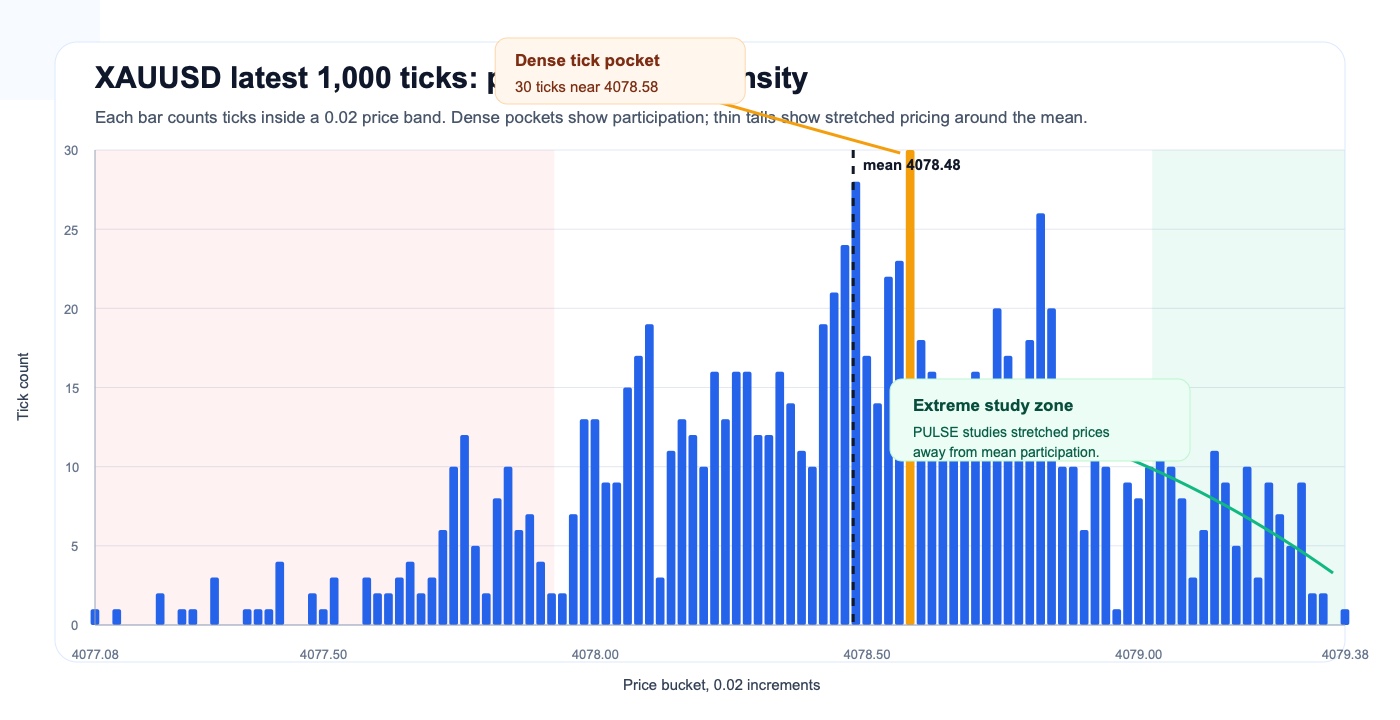
Tick volume at a price level shows how much real market activity is taking place around that exact zone. Gold may trade around a level such as 4054.15, but the market is not a single fixed print. It breathes around a small spread: some ticks may print at 4054.15, others at 4054.16 or 4054.17, while a few stretch slightly above or below the mean.
When thousands of ticks cluster around a narrow level, that area becomes a meaningful liquidity zone rather than just a price on the chart. PULSE studies this distribution instead of treating price as a single line. If the mean tick zone is heavy but price stretches to the upper or lower edge of the local tick cloud, those extremes can become higher-value decision areas.
The system is not simply reacting to price touching a level. It reads how price behaves when tick density expands, compresses, and then pushes away from the center of activity — and it acts within milliseconds, before the broader market can reprice.
Speed advantage
Ahead of the retail crowd
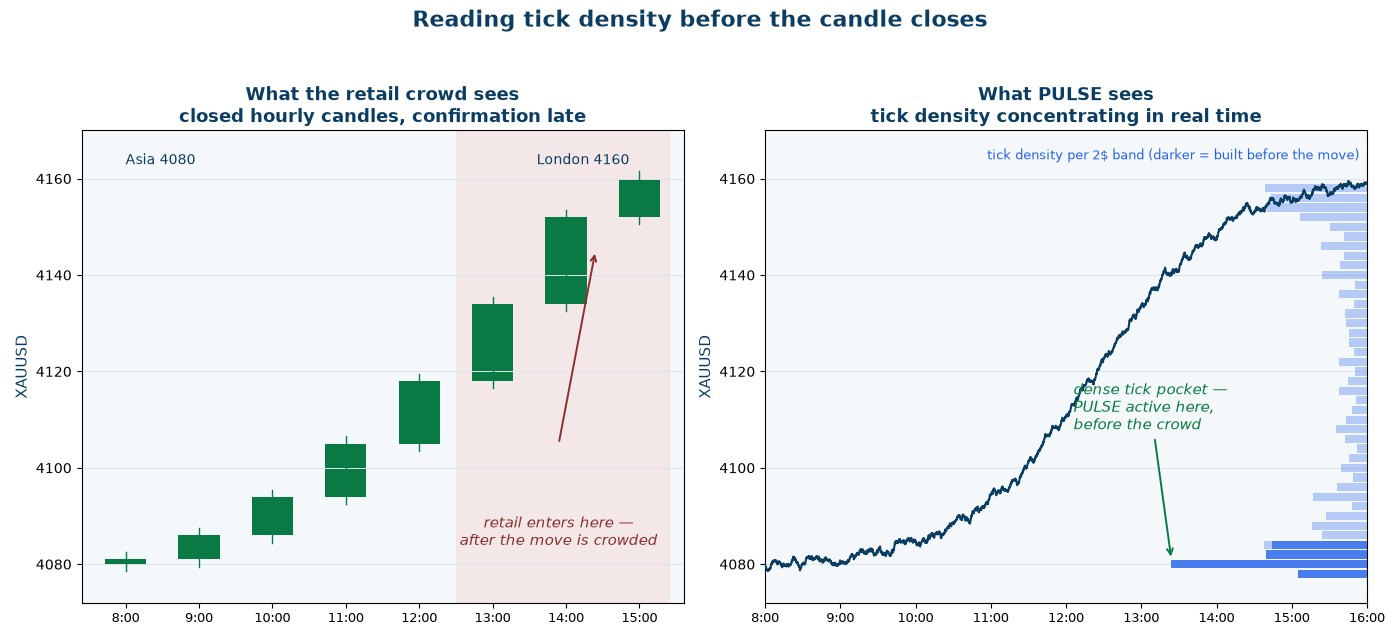
Most retail traders trade candles. They wait for a candle to close, an indicator to confirm, a pattern to complete — and by then the move is already crowded and the easy part is gone. PULSE works one level deeper and one layer faster. When thousands of ticks cluster tightly around a price zone, real participation is concentrating there before any candle confirms it. Reading that build-up lets the system position with the informed flow instead of chasing it — entering where the crowd will arrive, not where it has already been.
This is what separates an institutional-grade HFT system from a retail EA: the edge is not a better indicator or a slower confirmation. The edge is sub-20 millisecond execution on an unthrottled tick stream, capturing the fleeting moments where price has not yet adjusted to the real flow — and closing before the market catches up.
Research timeline
Backtesting research result
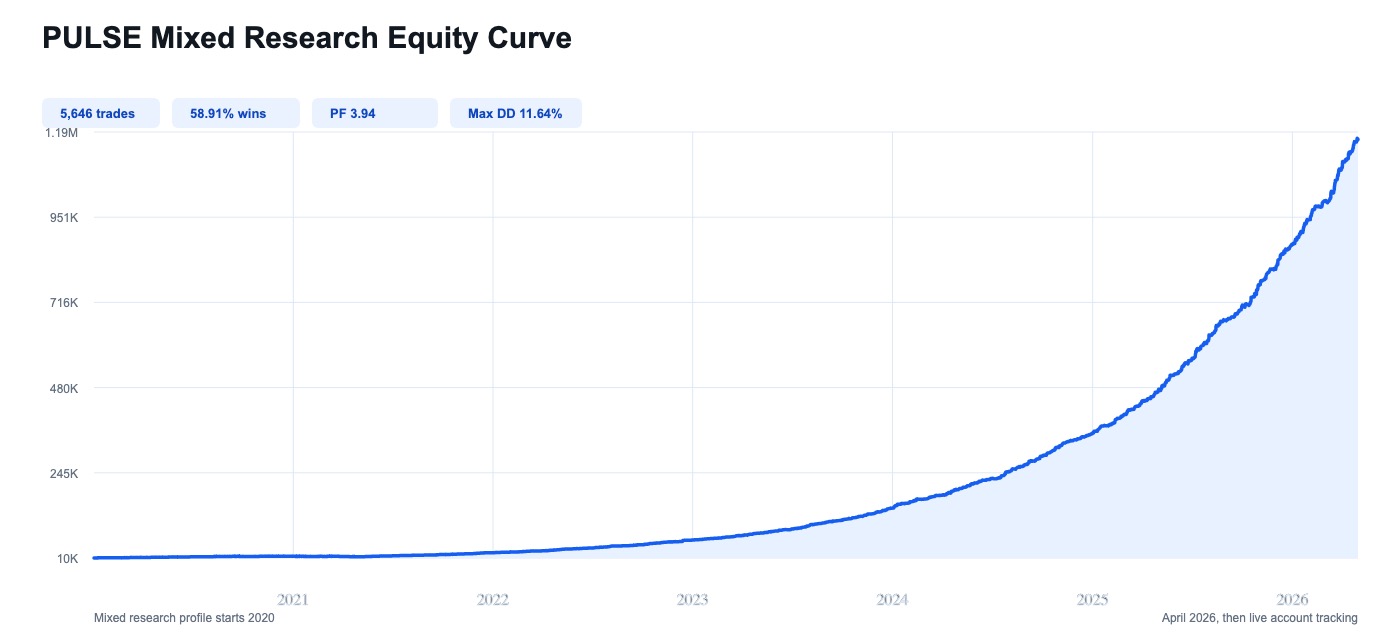
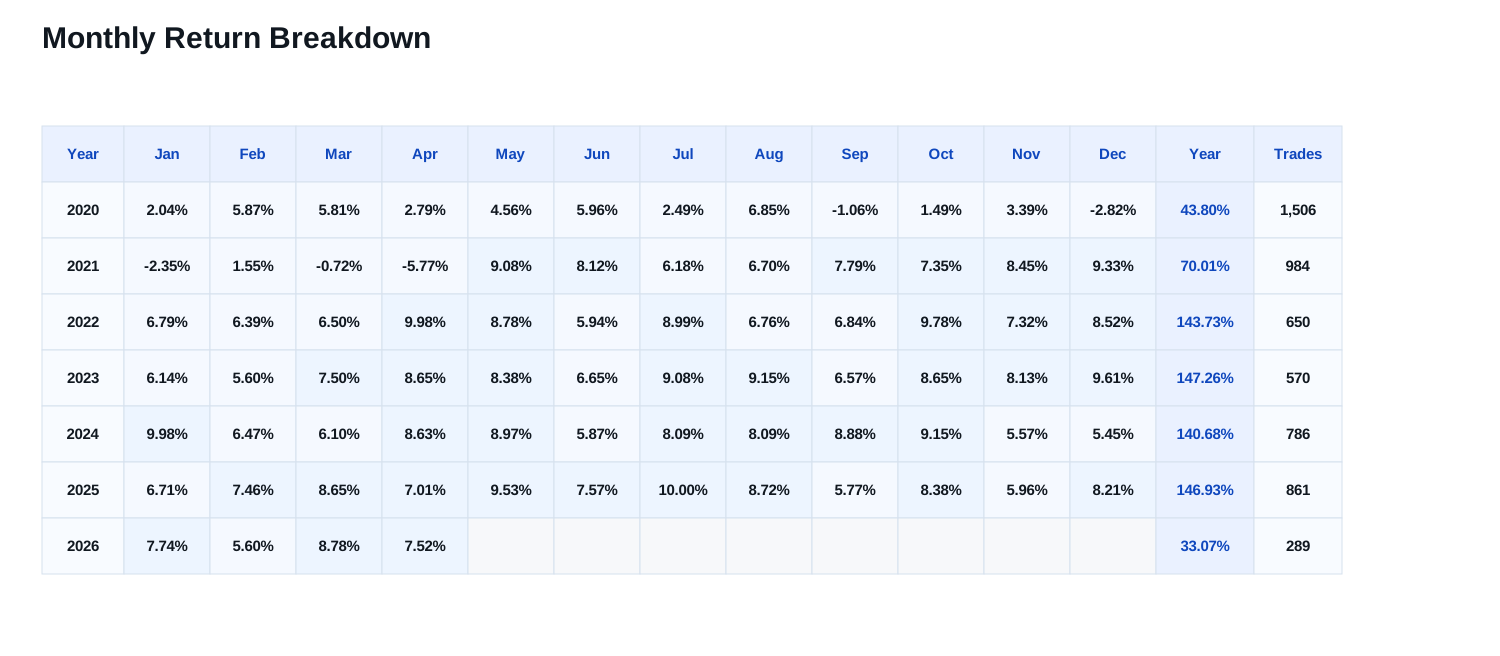
The PULSE research profile shown here covers January 2020 through April 2026 and is used to study fast-trigger entries, sharp exits, drawdown sensitivity, and sub-20 millisecond execution behaviour.
Historical XAUUSD tick data was used to map fast-move behavior, stop order, time cuts, target capture, and drawdown behavior at institutional execution speeds.
The profile closes the research window with 5,646 trades, 58.91% win rate, profit factor 3.94, and 11.64% maximum drawdown — all validated under sub-20 ms execution conditions.
After April 2026 the focus moves from historical research to live account tracking on the XCore infrastructure, broker execution, and real reporting.
What the research shows
The historical research window is designed around the same investor point as PULSE: fast-trigger gold exposure on the XCore infrastructure, controlled exits, trailing behavior, sub-20 millisecond execution conditions, and a controlled grid that runs with an outer stop. From May 2026 onward, the relevant review is the live account, because the system is no longer being discussed only as a historical research profile.
Trade review
Single fast-closed XAUUSD trades
The trades below are useful because they are not basket examples. They are individual closed positions from the live report, and they show the operating style clearly: PULSE waits for a fast trigger, takes the active movement, and exits before a scalp becomes a long exposure — all within the sub-20 millisecond execution window.
For investors, the important point is not only that the trades closed in profit. The important point is how the profit was taken. The system is built around speed, confirmation, and controlled exit behavior on the XCore infrastructure. It does not depend on grid recovery, martingale sizing, or averaging into weak trades.
Entry around 4,091.60 and exit around 4,096.73. This is the cleanest example from the group: the market moved with force, the trigger opened the trade, and the exit captured the move while momentum was still available. It is the type of gold movement PULSE is designed to monetise on the XCore infrastructure.
Fast trigger entry
Entry around 4,062.44 and exit around 4,060.59. The short trade shows the same logic on the downside. PULSE does not need a directional bias to work; it needs a fast, tradable impulse and enough liquidity to close cleanly after the move extends — delivered by the XCore aggregation engine at LD4.
Sharp exit
Entry around 4,091.60 and exit around 4,092.65. Not every scalp is expected to become a large run. This trade shows the system taking a smaller burst and closing it, rather than waiting for a perfect extension and giving back the movement.
Measured capture
Entry around 4,082.72 and exit around 4,083.35. This is a modest trade, but it matters because it shows discipline. A fast system should be comfortable taking what the market gives, especially when gold movement starts to slow after the first push.
Disciplined close
Rule-based trade protection
Risk management built into every order
PULSE is designed to operate within a defined risk-management framework. Every order is governed by multiple independent controls covering price risk, time in market, profit eligibility and the protection of favourable movement. The objective is to keep each trade inside known operating boundaries rather than depend on a single exit or a discretionary decision.
The controls below are part of the PULSE operating design. They do not make trading risk-free and they are not a claim of regulatory certification. Fast markets can still introduce slippage, spread expansion, rejected orders, partial fills and connectivity risk.
Control priority: the immediate stop and per-order time limit remain hard protection mechanisms. Minimum-profit and minimum-pip settings govern normal profit-taking; they never disable the loss controls. PULSE does not use grid, martingale, a recovery ladder or averaging to rescue a weak entry.
Live account history is a review tool, not a promise. Market conditions, liquidity, execution quality, account size and volatility can all affect future results.
Chat with XTRSK
Chat ready
Start a chat and the XTRSK team will be notified immediately.