XCore HFT / Trading Lab
PULSE: Order type is a risk decision
Quantitative execution, market-microstructure, and risk-control research from XTRSK.
What this problem really is
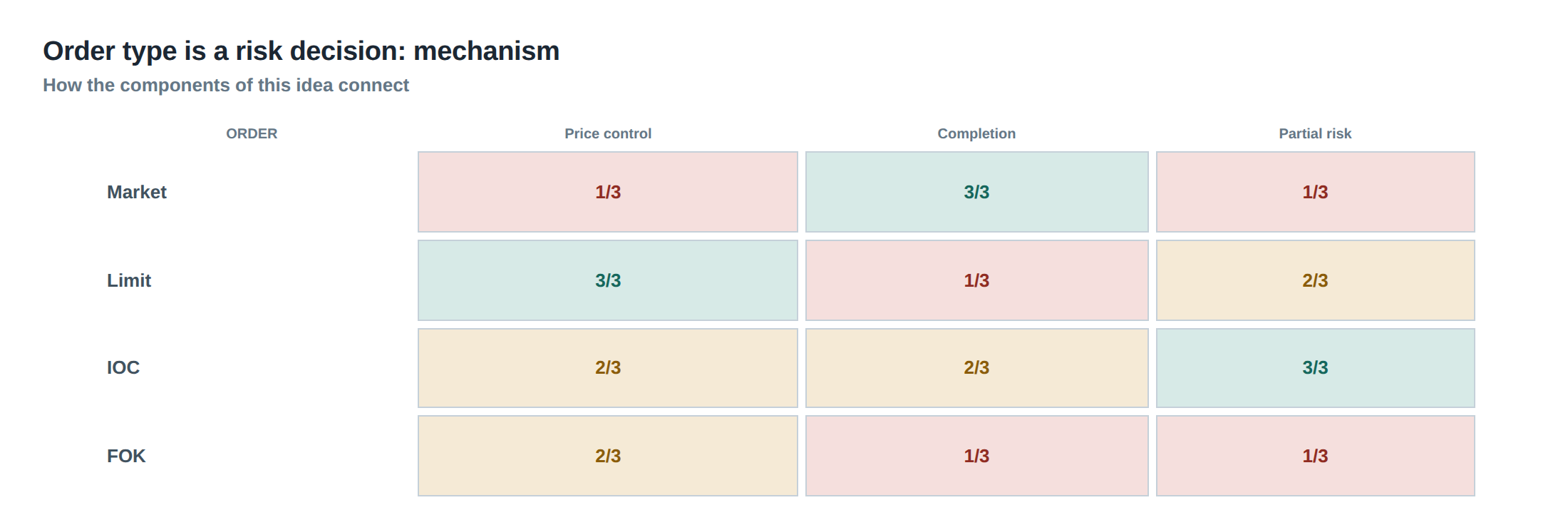
In electronic equity and futures markets every order is a decision about risk as much as it is a decision about price. A market order guarantees execution but gives up any control over the transaction price and instantly reveals the trader’s intent to the whole order‑book. A limit order protects the price but may sit idle for an indeterminate period, exposing the strategy to adverse‑selection – the probability that the market moves away while the order remains in the queue. Immediate‑or‑Cancel (IOC) and Fill‑or‑Kill (FOK) instructions sit between these extremes: they trade a higher probability of completion for a lower probability of full execution, and they limit the amount of information that leaks into the market because the order disappears as soon as the matching engine cannot satisfy the request.
The core tension is therefore a three‑way trade‑off: certainty of completion, price quality, and information leakage. Selecting the wrong instruction can either leave capital idle (missed‑trade cost) or generate slippage that erodes the expected edge. The problem is not simply “which order type should we use?” but “what combination of signal urgency, depth availability and acceptable partial‑fill behaviour justifies a particular instruction at a particular moment?”
How the mechanism works, step by step
When a signal is generated the execution engine first evaluates urgency. Urgency is quantified by the expected decay of the signal’s alpha – for example a statistical arbitrage spread that reverts on a 200 ms half‑life is far more time‑sensitive than a macro‑driven trend that persists for several seconds. The engine then probes the depth of the relevant venue: it reads the top‑of‑book and, where permissible, the first few depth levels to estimate the volume that can be taken at the quoted price.
If the available volume at the best price exceeds the required size, a market order will usually be the cheapest way to capture the alpha, because the price impact of a small market order is negligible and the execution certainty is maximal. When the depth is insufficient, the engine must decide whether to accept a partial fill, to wait for more liquidity, or to request a more aggressive price. This is where IOC and FOK become useful. An IOC order will take whatever is immediately available and cancel the remainder, preserving the signal’s timing while limiting exposure to further price movement. An FOK order, by contrast, will only execute if the entire size can be filled instantly; otherwise it is rejected, protecting the portfolio from an incomplete position that would require a costly hedge later.
The final step is to encode the acceptable partial‑fill behaviour in the order’s parameters. Some strategies permit a 20 % shortfall that can be topped up later; others require the full size to avoid imbalance. The execution policy therefore contains a matrix that maps signal urgency, depth, and partial‑fill tolerance to a concrete instruction (market, limit, IOC, FOK). This matrix is revisited on every tick because market conditions evolve faster than the typical order‑lifetime.
A worked example with real numbers
Consider a statistical‑arbitrage signal that recommends buying 10 000 shares of XYZ at the best ask. The signal’s half‑life is 150 ms, so the expected decay of the edge after 100 ms is roughly 30 %. The order‑book snapshot at the moment of generation shows:
4 000 shares at 100.05 (best ask) 2 000 shares at 100.07 (second level) * 5 000 shares at 100.10 (third level)
The execution engine first checks whether a market order would fill the whole 10 000 shares. It would need to walk three price levels, incurring a realised slippage of (4 000 × 0 + 2 000 × 0.02 + 4 000 × 0.05) / 10 000 = 0.032 ≈ 3.2 bps, which translates into a cost of 3.2 bps × 10 000 × 100.05 ≈ £32. Given the signal’s expected edge of 5 bps, the net profit would shrink to only 1.8 bps – a marginal return that may not justify the execution risk.
The engine therefore evaluates an IOC order for 6 000 shares at 100.05. The IOC will instantly take the 4 000 shares at the best ask and the remaining 2 000 shares at 100.07, leaving 4 000 shares unfilled. The realised slippage on the filled portion is (4 000 × 0 + 2 000 × 0.02) / 6 000 = 0.0067 ≈ 0.67 bps, costing roughly £4. The unfilled 4 000 shares are cancelled, preserving the signal’s timing for a possible re‑submission.
If instead an FOK order for the full 10 000 shares is sent, the matching engine will reject it because the total volume at or better than 100.10 is only 11 000 shares, but the price improvement required to stay within a 2 bps slippage ceiling is unavailable. The order is therefore rejected, and the signal is forced to wait for fresh depth. Assuming the market moves 1 bp unfavourably during the 50 ms wait, the missed‑trade cost is 1 bp × 10 000 × 100.05 ≈ £10, plus the opportunity cost of the decayed edge.
The comparison shows that the IOC captures a substantial portion of the expected profit with limited slippage and no residual exposure, whereas the FOK preserves the “all‑or‑nothing” discipline but may reject a profitable partial fill. The choice hinges on the strategy’s tolerance for partial positions and the measured cost of missed trades.
Where it breaks in live markets
In theory the matrix described above yields a deterministic instruction for every signal. In practice several failure modes appear. First, depth information can become stale within a few microseconds; a limit order placed based on a snapshot may be filled at a price that was never quoted, exposing the trader to adverse‑selection that the model did not anticipate. Second, the market’s microstructure may introduce hidden liquidity or iceberg orders that are invisible to the depth query, causing an IOC to appear to fill a large volume while the visible slice is actually consumed by a larger hidden order, again leaking information about the trader’s intent.
Third, the binary nature of IOC and FOK can lead to “all‑or‑nothing” rejections that cascade into a cascade of re‑submissions, each adding latency and increasing the probability that the signal’s edge has vanished. Finally, the cost of missed trades is often under‑estimated because it is not captured in the fill‑rate metric; a strategy that repeatedly cancels large portions of its intended size may look efficient on a per‑trade basis while systematically under‑executing its alpha. These breakdowns are amplified in high‑frequency regimes where the signal half‑life is comparable to the round‑trip latency of the order‑type decision engine.
The operating path, stage by stage
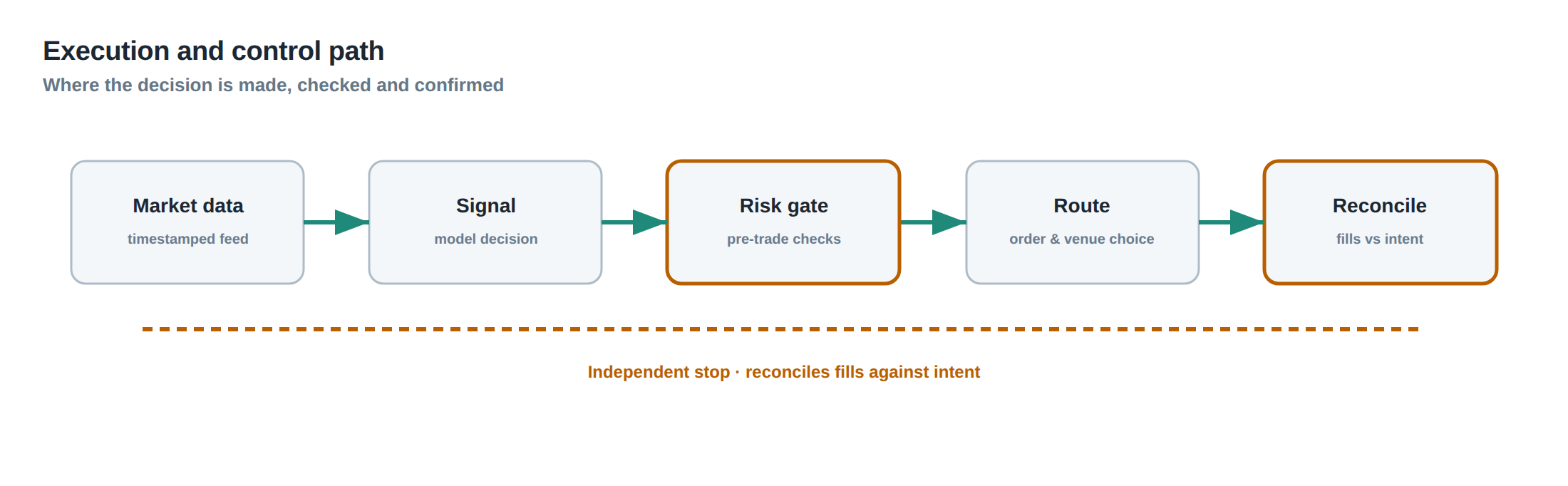
The execution pipeline can be visualised as a series of deterministic stages. Stage 1 is signal generation, where the statistical model produces a size, side and urgency score. Stage 2 is market‑state acquisition: the engine polls the order‑book, measures recent trade flow, and estimates the probability of a full fill at each price level. Stage 3 is instruction selection, where the urgency‑depth‑partial‑fill matrix outputs a concrete order type and any associated price limits. Stage 4 is risk‑control validation, which checks position limits, credit exposure and the acceptable partial‑fill tolerance for the current portfolio. Stage 5 is order transmission, where the instruction is sent to the venue’s gateway with a timestamp. Stage 6 is real‑time monitoring; the engine watches for acknowledgements, fills, partial fills, rejects and cancellations. Stage 7 is post‑trade reconciliation, where the realised slippage, fill ratio and any reject or cancel codes are logged for later analysis.
If at any stage the decision fails a check – for example, the depth estimate falls below the threshold after the order is transmitted – the engine may issue a cancellation and restart the process with an updated instruction. This loop continues until either a fill is achieved, the signal decays below a profitability floor, or a hard timeout is reached. The architecture must therefore support sub‑millisecond decision cycles and deterministic state transitions to avoid race conditions that could cause the order‑type matrix to be applied to stale data.
Controls that act before the damage
Preventative controls are placed at the front‑end of the pipeline to reduce the likelihood of costly mis‑executions. The first control is a dynamic order‑type matrix that is periodically re‑optimised using recent fill‑rate and slippage statistics; this ensures that the mapping from urgency to instruction reflects the current market microstructure. A second control is a latency‑budget filter: if the measured round‑trip latency for a venue exceeds a configurable fraction of the signal’s half‑life, the engine automatically upgrades the instruction to a more aggressive type (e.g., from limit to IOC) or aborts the trade entirely.
A third control is a partial‑fill guardrail. Before an IOC is issued, the engine calculates the minimum acceptable fill percentage based on the strategy’s exposure limits; if the expected fill falls below this threshold, the order is either sent as a market order with a price cap or deferred. Fourth, an information‑leakage detector monitors the frequency of order cancellations and the proportion of trades that are rejected at the exchange; a sudden rise in these metrics can indicate that the market is detecting the trader’s pattern, prompting a temporary switch to more opaque venues or to iceberg order wrappers.
Finally, a “cost‑of‑missed‑trade” estimator runs in parallel, projecting the expected P&L loss if the order is not filled within the signal’s decay window. This estimator feeds back into the urgency score, nudging the matrix towards more certain execution when the projected loss exceeds a pre‑set threshold. Together these controls act before the order reaches the exchange, reducing the probability of adverse outcomes that would otherwise require remedial action downstream.
How to measure whether it is working
Measurement must be multidimensional. The primary metric is the realised fill‑rate per instruction type, expressed as the ratio of executed quantity to intended quantity. Complementary to this is the reject‑rate, captured from exchange reject codes, and the cancel‑rate, which records the proportion of orders that the engine voluntarily withdrew before a full fill. A second‑order metric is the average slippage per filled share, calculated against the mid‑price at the moment of signal generation.
To capture the cost of missed trades, the engine logs the theoretical P&L of each signal (edge × size × mid‑price) and subtracts the realised P&L after execution; the residual is the missed‑trade cost. By aggregating this residual across all signals that were partially filled or cancelled, a firm can quantify how much profit is being left on the table by an overly conservative order‑type policy.
A further diagnostic is the “queue‑value decay” – the change in expected spread capture as the order ages in the book. This is measured by periodically re‑sampling the depth at the order’s price level while the order is alive; a rapid decay indicates that the order is losing its position value and should have been cancelled earlier.
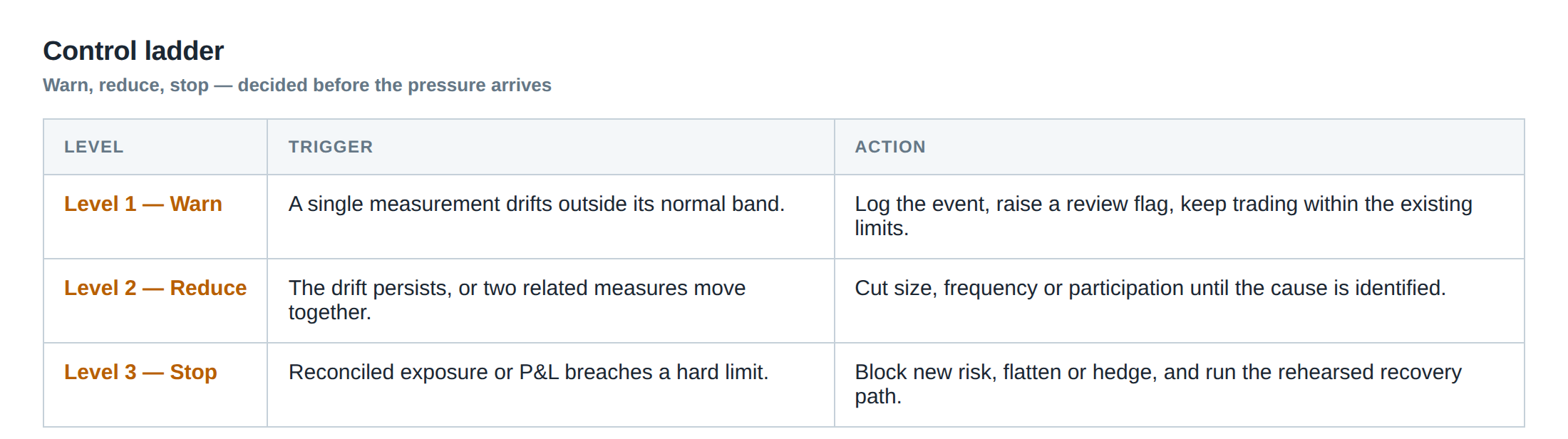
Statistical significance of these metrics is assessed over rolling windows (e.g., 15‑minute blocks) to smooth out the noise inherent in high‑frequency data. Alerts are generated when any metric breaches a pre‑defined control limit, prompting a review of the order‑type matrix or the latency budget.
The portfolio view
From a portfolio perspective the choice of order type is a risk allocation decision. Each instruction type contributes a distinct risk profile to the overall P&L distribution. Market orders add execution certainty but increase tail risk through price impact; limit orders add upside capture of spread but introduce left‑tail risk from missed‑trade cost; IOC orders sit in the centre, offering a balance of execution probability and limited slippage; FOK orders provide a binary outcome that can protect against partial‑position exposure but may increase the frequency of zero‑fill events.
When aggregating across many signals, the portfolio’s realised Sharpe ratio will be a function of the weighted mix of these instruction types. A useful visualisation is a “risk‑return ladder” where each rung corresponds to an order type and the height reflects the contribution to net alpha after accounting for execution cost, slippage, and missed‑trade loss. Optimising the ladder involves adjusting the matrix thresholds so that the marginal benefit of moving a signal from a limit to an IOC (or vice‑versa) equals the marginal increase in execution risk.
The portfolio manager must also monitor the correlation between execution outcomes and market regimes. In periods of high volatility, the cost of missed trades rises sharply, favouring more aggressive instructions; in calm markets, the spread capture from limit orders becomes more valuable, justifying a higher proportion of passive orders. By continuously re‑balancing the instruction mix in line with regime‑specific risk‑return profiles, the desk can sustain a stable edge while keeping information leakage under control.
—
Do you currently map signal urgency and depth to a dynamic order‑type matrix, or are you still relying on a single default instruction across all market regimes?
About the research behind this lesson
The seminar frames electronic markets as price-time-priority queues. It separates queue value into spread capture versus adverse-selection cost and the option value of retaining a place in line.
Applied to this lesson: An order lifetime therefore cannot be based on elapsed time alone: the system must reassess whether its queue position, expected spread and adverse-selection risk still justify keeping the order alive.
Explore PULSE: System details
PULSE live account: Verify the live account on FX Blue
Live chat and updates: Telegram @xtrskhft
Source: High-Frequency Trading and Modern Market Microstructure
Educational content only. Trading leveraged products involves risk.
Chat with XTRSK
Chat ready
Start a chat and the XTRSK team will be notified immediately.