XCore HFT / Trading Lab
Order type is a risk decision
Quantitative execution, market-microstructure, and risk-control research from XTRSK.
What this problem really is
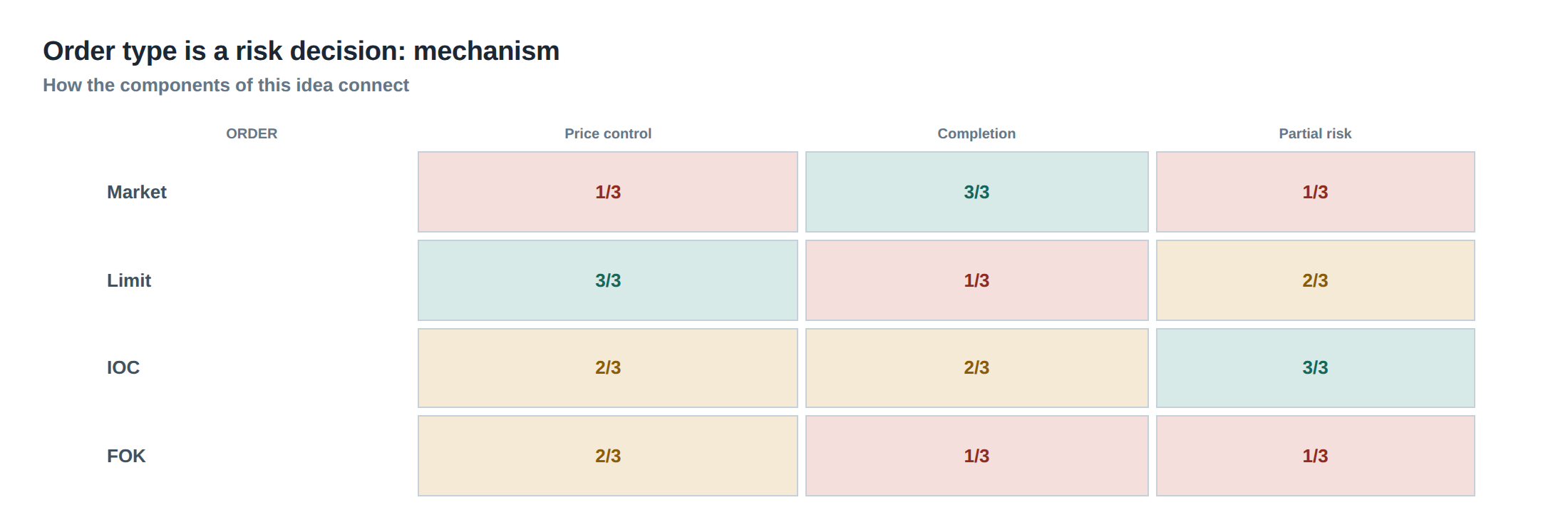
The decision of which order instruction to attach to a trading signal is, at its core, a risk‑management problem. A market order guarantees execution but sacrifices price certainty and can broadcast intent to the whole market. A limit order protects the price but may sit idle, exposing the strategy to opportunity cost and to adverse‑selection pressure from faster participants. Immediate‑or‑Cancel (IOC) and Fill‑or‑Kill (FOK) sit between the two extremes: they demand a degree of certainty about execution speed while still allowing a trader to limit exposure to unfavourable price moves. In practice the choice of instruction is a trade‑off between three dimensions – completion certainty, price impact, and information leakage – and each dimension is a function of the underlying market microstructure: depth, queue position, and the volatility of the price‑time priority queue.
The problem is compounded by the fact that electronic markets are not static. Queue depth fluctuates second‑by‑second, and the probability that a limit order will be filled at the quoted price decays as the order ages. The moment a trader decides to send a signal, the system must decide not only if the order should be sent, but how it should be sent. Selecting a market order for a low‑urgency signal wastes price, while sending a limit order for a high‑urgency signal may result in a missed trade that the strategy cannot afford to lose. The decision therefore belongs to the risk‑control layer rather than to the pure alpha‑generation layer.
How the mechanism works, step by step
The first step is to evaluate signal urgency. Urgency is quantified by the expected decay of the alpha’s edge over the next few milliseconds to seconds. If the edge is projected to halve within 200 ms, the instruction must prioritise speed; otherwise the instruction can afford to be more price‑conservative. The second step is to scan the order‑book depth at the relevant price level. Depth provides the maximum quantity that can be taken without moving the price, and it also indicates the size of the queue ahead of the incoming order.
With urgency and depth quantified, the system maps the pair onto a decision matrix. High urgency + shallow depth leads to a market or FOK order, because the probability of a full fill at the limit price is low and the cost of waiting exceeds the price risk. Low urgency + deep depth favours a limit order with a reasonable time‑to‑live (TTL). Intermediate cases trigger IOC: the order attempts to capture the displayed depth but will cancel any remainder instantly, thereby limiting exposure to adverse‑selection while still preserving some execution certainty.
The final step is to define the acceptable partial‑fill behaviour. For strategies that can scale down linearly, a 30 % partial fill may be acceptable; for those that require a minimum lot size, any partial fill is a rejection. The system therefore records a “partial‑fill threshold” per signal, which is consulted before the order is transmitted. If the threshold is not met by the available depth, the instruction is automatically upgraded to IOC or FOK, depending on the urgency level.
A worked example with real numbers
Consider a mean‑reversion signal on a liquid equity that predicts a 0.25 % price move over the next 500 ms. The signal size is 10 000 shares. The current best ask contains 4 000 shares at \$100.20, the next price level holds 12 000 shares at \$100.25. The queue ahead of the best ask is estimated at 2 000 shares based on recent order‑flow data.
A naïve trader might submit a limit order for the full 10 000 shares at \$100.20, expecting the depth to fill the order. In reality the order would be placed behind the 2 000‑share queue, leaving only 2 000 shares of the displayed depth available. The order would sit partially filled for at least 300 ms before the price moves, exposing the trader to adverse selection. The cost of the residual 8 000‑share unfilled quantity is the missed alpha: 0.25 % of \$100.20 × 10 000 ≈ \$250.
If the system instead chooses an FOK instruction, the order is rejected instantly because the visible depth (2 000 + 12 000) does not satisfy the full 10 000‑share requirement at the target price. The trader loses the opportunity entirely, but the rejection is known immediately and the capital can be redeployed to the next signal. The cost of the missed trade is again the full \$250, but the execution risk is zero.
An IOC instruction offers a middle ground. The order is sent for 10 000 shares at \$100.20 with an IOC flag. The exchange attempts to fill as much as possible at the quoted price and cancels any remainder instantly. In this scenario the order would capture the 2 000 shares behind the queue and the 4 000 shares displayed, for a total of 6 000 shares, and the remaining 4 000 shares are cancelled. The realised profit is 0.25 % × \$100.20 × 6 000 ≈ \$150, while the unreached 4 000 shares represent a partial missed‑trade cost of \$100. The IOC therefore reduces the total opportunity cost from \$250 (full miss) to \$100, at the expense of a smaller realised profit and a modest information leak (the market sees a 6 000‑share aggressive order).
The example illustrates how the instruction type directly controls the balance between residual quantity, reject cost, and leakage. By quantifying each outcome, the risk engine can choose the instruction that minimises the expected loss given the signal’s urgency and the observed depth.
Where it breaks in live markets
In a live order‑book, depth is a fleeting illusion. Hidden liquidity, iceberg orders, and rapid order‑cancellation cycles mean that the displayed quantity can evaporate in a few microseconds. An IOC that appears to have sufficient depth at the moment of submission may find the exchange unable to allocate the requested quantity, resulting in a partial fill that is smaller than the system’s threshold. The consequence is a higher than expected rejection rate, which can cascade into a series of missed signals if the strategy does not adapt its urgency assessment quickly enough.
Another failure mode is the “queue‑position trap”. A limit order placed with a long TTL may retain a favourable price, but the queue ahead can grow faster than the order can be filled, especially during bursts of high‑frequency activity. The order’s expected execution probability decays non‑linearly with time, and a naïve TTL based on elapsed wall‑clock time will over‑estimate the chance of a full fill. When the order finally executes, it may do so after the alpha has already decayed, turning a theoretically profitable signal into a loss.
Information leakage is also a hidden risk. Market participants monitor order‑book changes and can infer the presence of a large IOC or FOK order from the rapid appearance and disappearance of depth. In a thinly traded instrument, such inference can move the price against the trader before the order is even placed, eroding the expected spread capture. The risk of leakage is therefore higher for large IOC orders that are close to the market depth.
The operating path, stage by stage
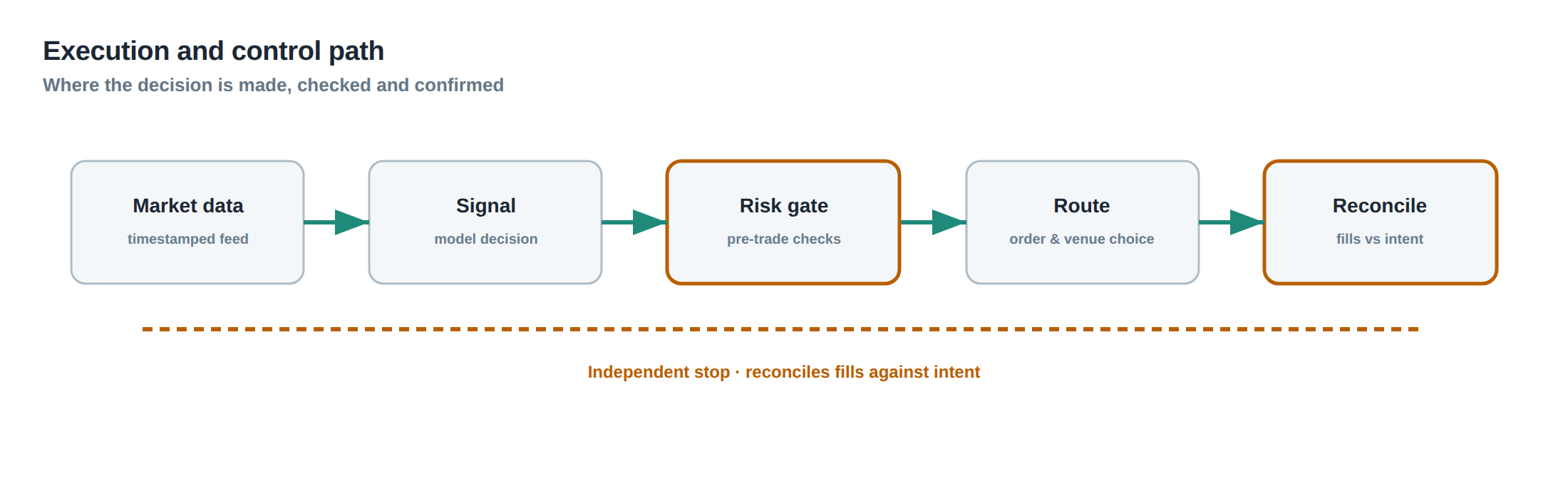
The first stage is signal ingestion, where the raw alpha is timestamped and its decay curve estimated. The second stage is market‑state acquisition, which pulls the best‑bid/ask, displayed depth, and recent queue‑position metrics from the gateway. The third stage is the decision engine, which applies the urgency‑depth matrix, checks the partial‑fill threshold, and selects the instruction type. The fourth stage is order construction, where the chosen instruction is encoded into the FIX/ITCH message together with a TTL that reflects the expected queue‑position decay rather than a fixed clock time. The fifth stage is transmission and acknowledgement, where the exchange returns either a fill, a partial fill, a reject, or a cancel. The final stage is post‑trade analytics, which logs the outcome, updates the queue‑position model, and feeds back into the signal‑decay estimator for the next cycle.
Each stage must be instrumented with latency counters and sanity checks. For example, if the market‑state acquisition takes longer than the signal’s half‑life, the system should abort the order and treat the signal as stale. Similarly, if the decision engine selects an instruction that conflicts with the partial‑fill threshold, an automatic downgrade to a more aggressive instruction (IOC → FOK) should be triggered before transmission.
Controls that act before the damage
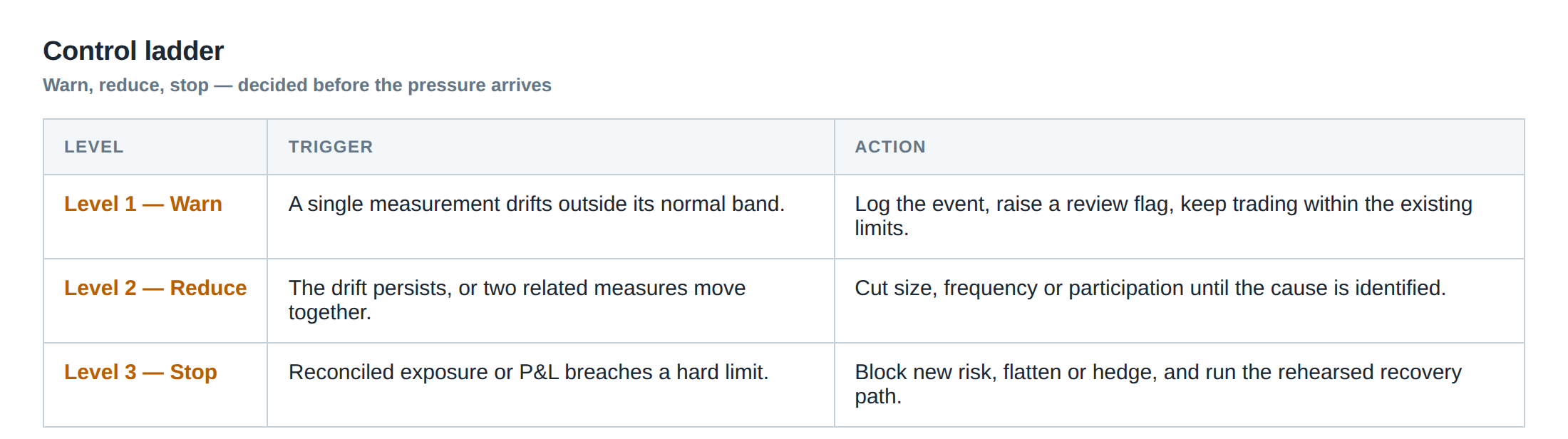
A pre‑trade control ladder begins with a hard‑stop on signal age: any signal older than its half‑life is discarded. The next rung verifies that the displayed depth at the target price meets at least the partial‑fill threshold; if not, the instruction is escalated to IOC or FOK. A third control checks the queue‑position estimate against a maximum acceptable wait‑time; exceeding this limit forces the system to replace a limit order with an IOC. Fourth, a price‑impact guard monitors the expected market impact of the order size relative to recent volume; if the impact exceeds a pre‑defined fraction of the expected alpha, the order size is scaled down or the instruction is changed to a market order for a smaller quantity.
The final rung of the ladder is a reject‑rate monitor. If the exchange rejects more than a configured percentage of FOK orders over a rolling window, the system automatically raises the urgency threshold, causing future signals to favour IOC or market orders. This dynamic adaptation prevents a cascade of missed trades when market conditions change abruptly, such as during a news release or a sudden liquidity vacuum.
How to measure whether it is working
Performance measurement must separate three cost components: execution cost, opportunity cost, and leakage cost. Execution cost is the difference between the achieved fill price and the theoretical price implied by the signal, multiplied by the filled quantity. Opportunity cost is the expected profit from the unfilled portion of the order, calculated as the signal’s edge times the unfilled quantity. Leakage cost is estimated by the adverse price movement that occurs in the milliseconds after the order is placed, conditional on the order’s size and instruction type, and can be inferred from the change in mid‑price relative to a control window with no order.
These components are aggregated per instruction type and compared against a baseline where all orders are sent as market orders. A reduction in total cost, even if execution cost rises, indicates that the instruction selection is adding value. Additionally, the reject‑to‑fill ratio for FOK orders and the partial‑fill‑to‑cancel ratio for IOC orders are tracked; stable ratios suggest that the depth‑assessment model remains calibrated. Any drift beyond a tolerance band triggers a review of the depth‑estimation parameters or the urgency‑decay curve.
The portfolio view
When the instruction‑selection framework is applied across a portfolio of strategies, the aggregate effect on risk metrics becomes visible. The realised Sharpe ratio may improve not because each trade is more profitable, but because the variance of execution outcomes is reduced: fewer extreme slippages from forced market orders and fewer large unfilled positions that generate tail‑risk. The portfolio’s drawdown profile also benefits, as the system avoids large residual positions that could be amplified by adverse‑selection events.
From a capital‑allocation perspective, the framework enables more precise sizing. Since the expected residual exposure of each order is known, the risk engine can allocate a higher proportion of capital to signals that historically achieve high fill rates with low leakage, while scaling down exposure to signals that often result in IOC partial fills that leave a sizeable unfilled tail. Over time, the portfolio converges to a state where the distribution of instruction types mirrors the underlying market microstructure: in deep, stable markets limit orders dominate; in volatile, thin markets IOC and FOK become the norm.
The key is to treat the order instruction as a dynamic risk lever rather than a static implementation detail. By continuously measuring fill, reject, and cancel outcomes, and by feeding those measurements back into the urgency‑depth decision matrix, a prop‑trading desk can maintain a disciplined balance between execution certainty, price protection, and information leakage.
Do you currently evaluate the instruction type of each signal against real‑time depth and urgency, or do you rely on a single default order type across all market regimes?
About the research behind this lesson
The seminar frames electronic markets as price-time-priority queues. It separates queue value into spread capture versus adverse-selection cost and the option value of retaining a place in line.
Applied to this lesson: An order lifetime therefore cannot be based on elapsed time alone: the system must reassess whether its queue position, expected spread and adverse-selection risk still justify keeping the order alive.
Two live systems, one desk
PULSE-X — power-packed HFT: high-frequency momentum on XAUUSD and EURUSD. System details · Live account
NIC-X — ultra-low drawdown: displaced-print arbitrage for large capital. System details · Live account
Start now: leave your email and request a free trial — we will send the pricing, the connection route and the trial terms. Pricing
Join the market discussion: Telegram @squawklive
Source: High-Frequency Trading and Modern Market Microstructure
Educational content only. Trading leveraged products involves risk.
Chat with XTRSK
Chat ready
Start a chat and the XTRSK team will be notified immediately.