XCore HFT / Trading Lab
Every fast order needs a lifetime
Quantitative execution, market-microstructure, and risk-control research from XTRSK.
What this problem really is
The moment a trading signal is generated it is assumed to be actionable until the order that represents it is either filled or deliberately withdrawn. In high‑frequency environments that assumption is fragile because the signal’s informational relevance decays on the order‑to‑exchange latency scale. By the time the order reaches the venue, sits in the limit‑order book, or is waiting for a cancellation acknowledgement, the market may have moved enough that the original edge has evaporated. The consequence is that the order can become a source of adverse selection, capturing the spread on the wrong side of the market or, worse, triggering a cascade of unwanted fills that were never part of the original intent.
The core of the problem is the mismatch between the signal lifetime – the window in which the statistical edge is expected to hold – and the order lifetime – the period during which the order is physically present in the venue’s queue. When those two windows diverge, the trader is exposed to risk that is not captured by standard latency‑adjusted slippage models. The exposure is not merely a function of elapsed clock time; it is a function of the order’s queue position, the evolving spread, and the probability that an adverse‑selection event will occur before the order is cancelled or filled.
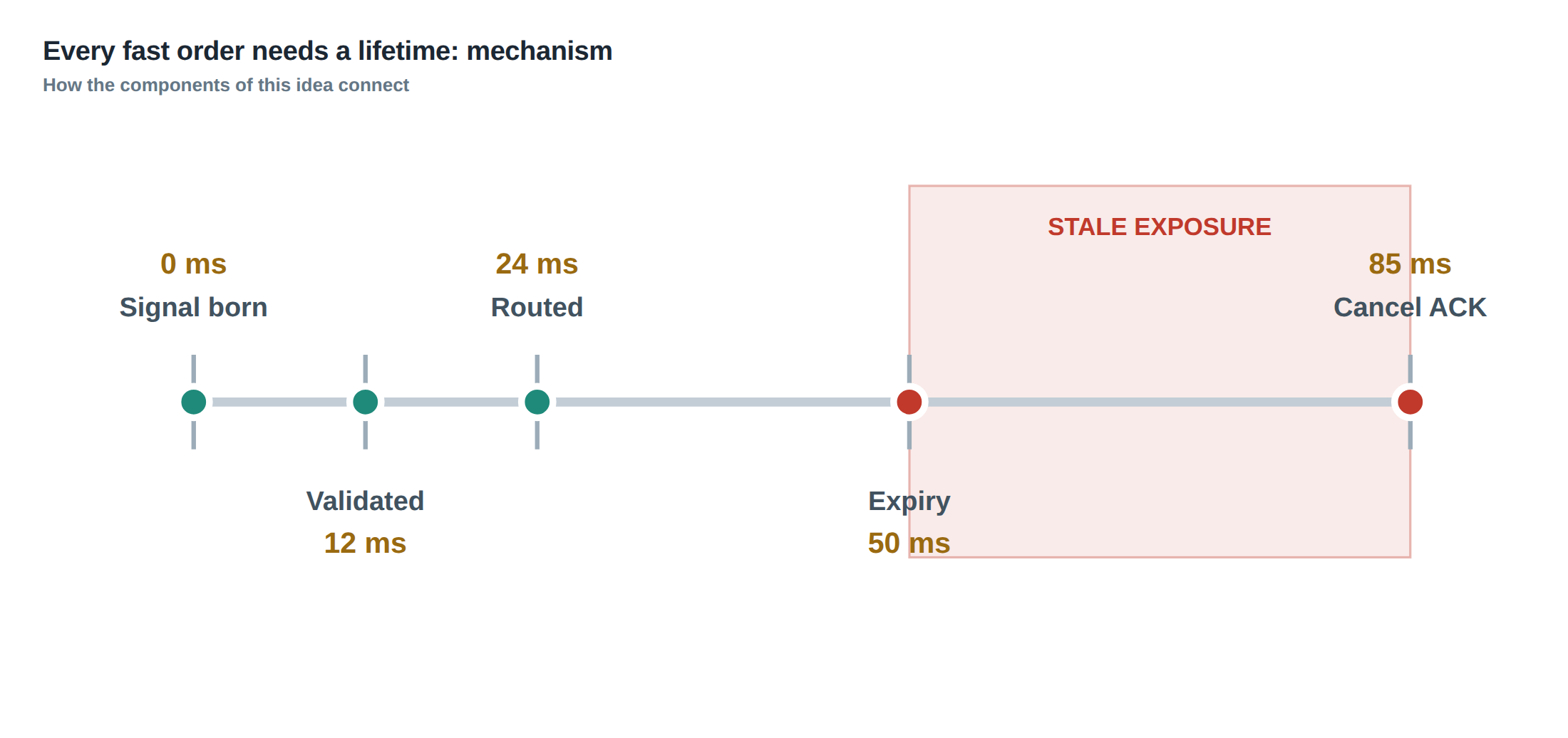
A practical way to visualise the issue is to imagine a 50 ms statistical arbitrage signal that, under ideal conditions, would be turned into a marketable order and either executed or cancelled within that same 50 ms. In reality, network jitter, gateway throttling, or a congested exchange can stretch the cancellation acknowledgement to several seconds. During that interval the order may sit at the top of the book, inadvertently providing liquidity to a counter‑party that is already exploiting the same price dislocation. The original signal has become stale, yet the order continues to affect the portfolio.
How the mechanism works, step by step
When a signal is emitted the trading engine stamps it with a maximum age – the longest interval for which the statistical model still believes the edge to be present. This age is derived from back‑tested decay curves that relate signal strength to elapsed time under various market conditions. The engine then creates an order object that inherits this age as a hard deadline.
The order is transmitted to the venue via a low‑latency gateway. At the venue it joins a price‑time priority queue. Its position in the queue determines the expected time to fill, but also the exposure to adverse selection: the longer the order remains unfilled, the higher the probability that the market moves against it. Simultaneously, the engine may issue a cancellation request if the signal’s age is exceeded or if market data indicates that the spread has narrowed beyond the profitability threshold.
Crucially, a cancellation request is only a local intent. The venue must acknowledge the cancellation before the order is truly removed from the queue. Until that acknowledgement arrives, the order retains its place in line and continues to generate exposure. If the acknowledgement is delayed – for example, because the venue is processing a large batch of updates – the order can linger for many multiples of the original signal age, creating a “storm” of stale orders that the trader never intended to keep alive.
The system therefore needs two distinct timers: one governing the signal age and another governing the order‑to‑cancellation acknowledgement latency. If the latter exceeds a pre‑defined safety margin, the engine must either issue a replacement order with a tighter price, or abort further activity on that venue until the stale order is definitively cleared.
A worked example with real numbers
Consider a statistical‑arbitrage signal that predicts a mean‑reversion move in a highly liquid futures contract. The model’s back‑test shows that the edge decays exponentially with a half‑life of 30 ms; the firm therefore sets a maximum signal age of 50 ms, beyond which the expected profit drops below transaction cost. At 10:15:23.120 UTC the signal fires, and the engine immediately creates a limit order to buy at the current best bid of 12 450.00, with a size of 10 contracts.
The order is transmitted over a 1 ms round‑trip to the exchange gateway. The exchange’s order book is thin at the top, so the order lands at the front of the queue. Within 8 ms the market moves 0.5 points higher, widening the spread and eroding the edge. The engine’s risk manager recognises that the signal age is now 58 ms, exceeding the 50 ms limit, and issues a cancellation request at 10:15:23.178 UTC.
Because the exchange is processing a large batch of order updates, the cancellation acknowledgement does not arrive until 10:15:23.730 UTC – a full 552 ms after the request. During that interval the order remains at the top of the book, and a counter‑party with a faster inbound connection lifts the offer, filling the order at 12 450.25. The realised price is 0.25 points worse than the original target, wiping out the expected profit and adding a small loss.
If the system had enforced a hard order‑lifetime of 100 ms – measured from the moment the order entered the queue – it would have automatically withdrawn the order at 10:15:23.220 UTC, well before the delayed acknowledgement. The loss would have been avoided, and the portfolio would have remained within its risk budget for that signal.
Where it breaks in live markets
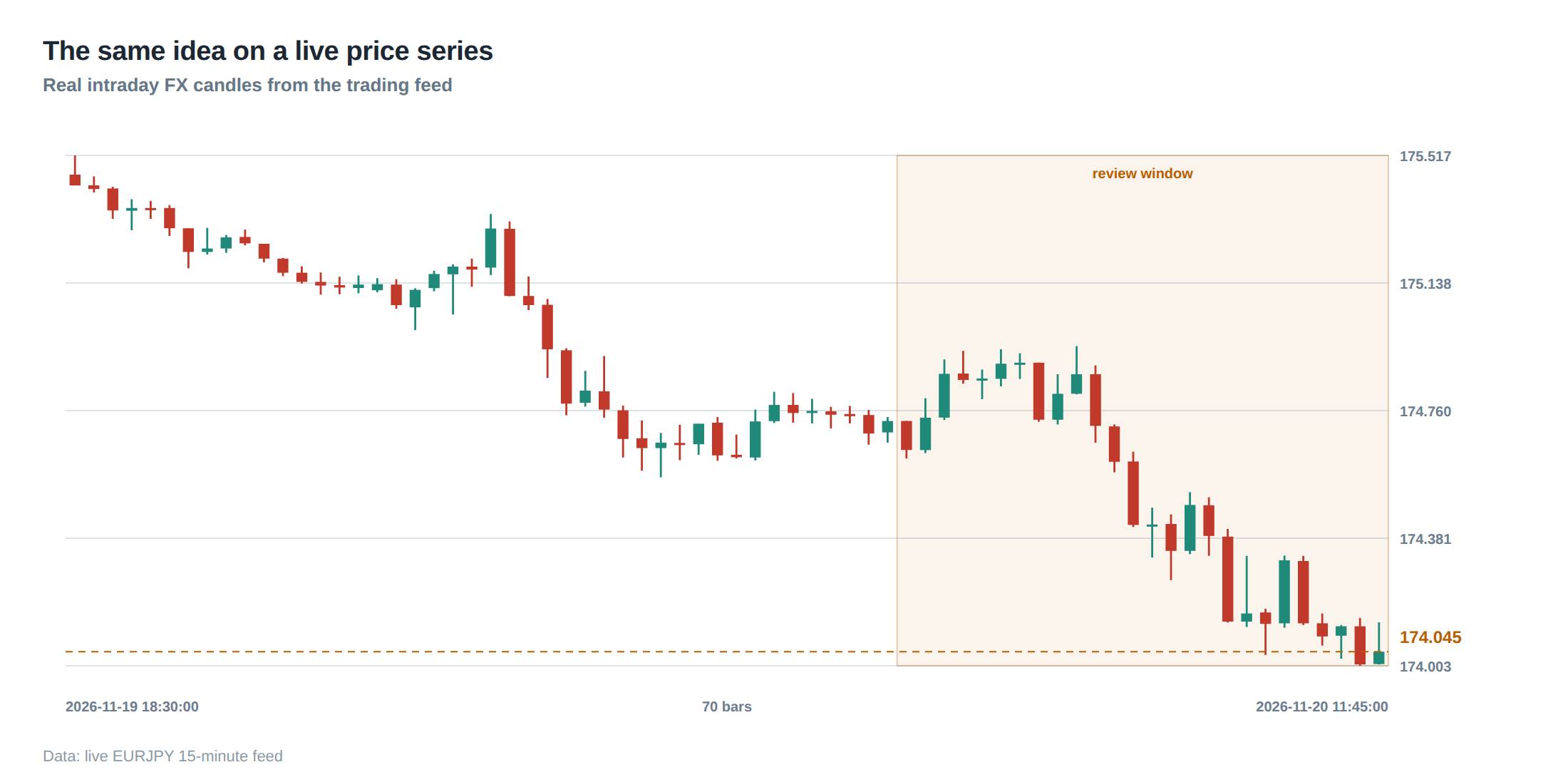
In live trading the idealised flow described above is constantly disrupted by network congestion, gateway throttling, and exchange‑level throttling mechanisms such as “burst‑limit” queues. When a venue receives more inbound messages than it can process, it begins to batch acknowledgements, creating a latency tail that can stretch from a few hundred microseconds to several seconds. The tail is stochastic; on a quiet market day it may be negligible, but during news‑driven spikes it becomes the dominant source of order‑lifetime risk.
Another failure mode is the “replacement storm”. A strategy that continuously re‑quotes to stay competitive may flood the venue with amendment messages. If the exchange cannot confirm each amendment before the next one arrives, the order’s effective state becomes indeterminate. The engine may believe the order has been cancelled, while the venue still holds an older version that is still eligible for execution. This mismatch is especially pernicious when the underlying signal has already decayed, because the stale order can be filled at a price that is now adverse.
Finally, the problem is amplified in fragmented markets where the same instrument trades on multiple venues. A signal may be valid on one venue but stale on another, yet a single cancellation request may be sent to both. If one venue acknowledges promptly and the other lags, the trader may inadvertently retain exposure on the slower venue while believing the entire position has been cleared. The resulting hidden exposure is difficult to audit without a dedicated monitoring layer.
The operating path, stage by stage
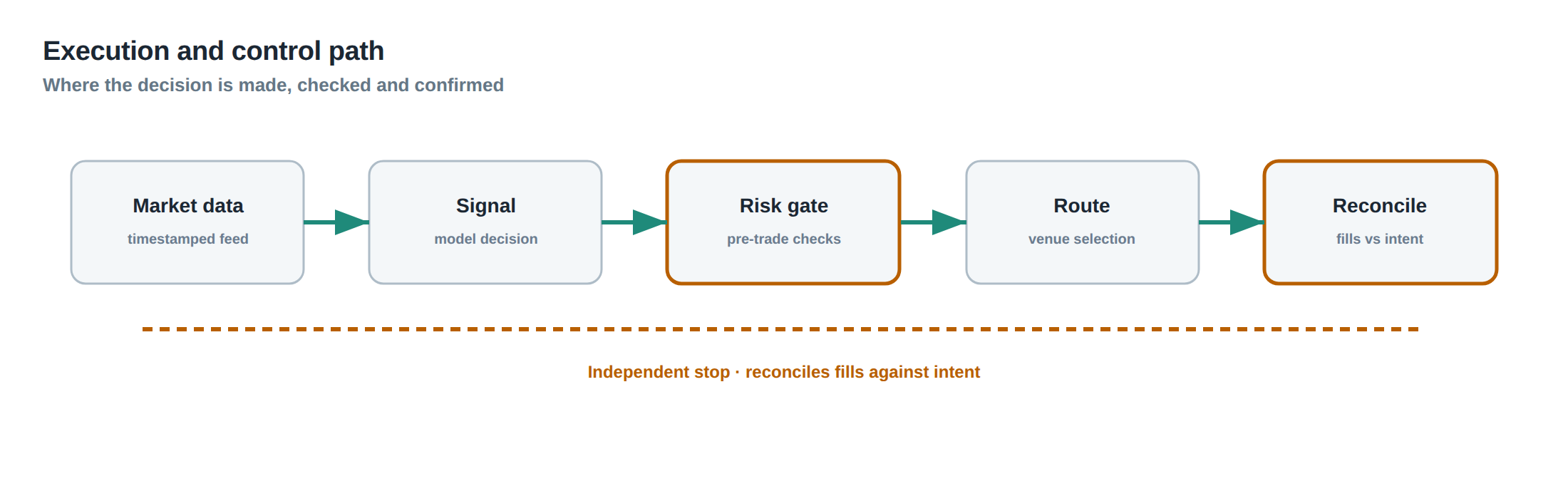
The first stage is signal generation. The model outputs a price target, a size, and a maximum age. The second stage is order creation. The engine stamps the order with both a signal‑expiry timestamp and an order‑expiry timestamp that is derived from the worst‑case acknowledgement latency observed historically for that venue.
The third stage is transmission. The order traverses the network stack, encountering variable latency that is measured continuously by timestamping at the gateway ingress and egress points. The fourth stage is venue queuing. The order is inserted into the price‑time priority queue; the venue returns a queue‑position token that can be used to estimate expected fill time.
The fifth stage is monitoring. The engine watches market data for spread changes, price moves, and order‑book depth. If any of these variables breach pre‑set thresholds, a local cancellation request is generated. The sixth stage is cancellation acknowledgement. The venue sends a confirmation that the order has been removed; until this arrives the order remains live.
The final stage is post‑mortem reconciliation. The system records the actual lifetime of the order, the time of signal expiry, and the time of cancellation acknowledgement. These records feed back into the latency‑budget calibration, tightening the order‑expiry timestamp if the observed acknowledgement tail exceeds the safety margin.
Controls that act before the damage
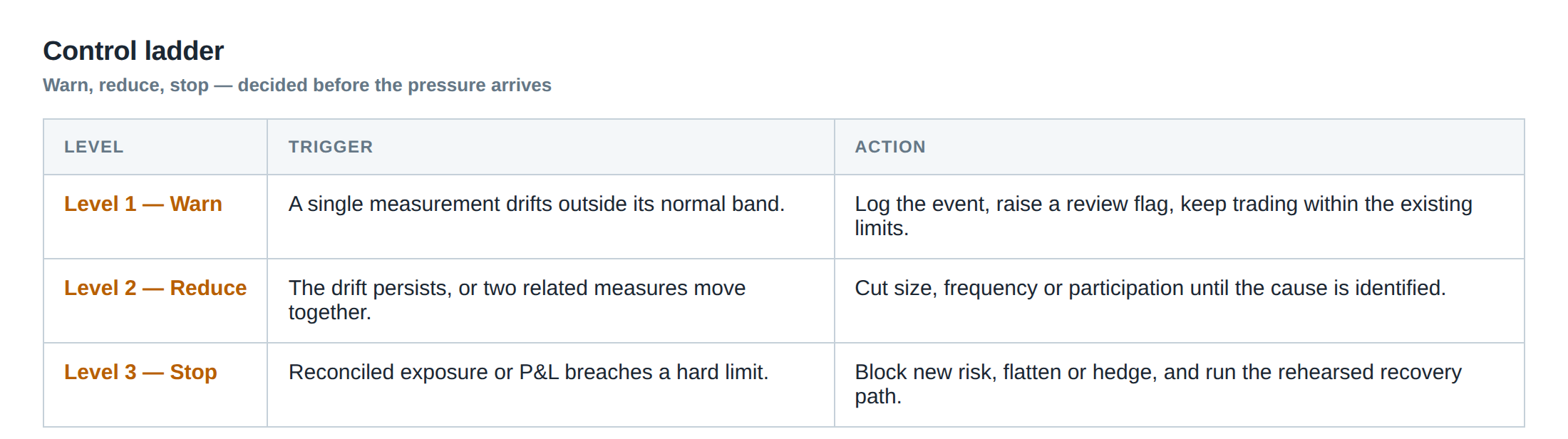
A robust control framework must intervene at the earliest possible point. The first line of defence is the maximum‑age filter that discards any signal whose age exceeds the model‑derived threshold before an order is even created. The second control is the order‑lifetime guard that caps the time an order may remain in the venue’s queue regardless of market conditions. This guard is enforced by a watchdog timer that automatically issues a hard cancellation if the acknowledgement does not arrive within the pre‑allocated window.
A third safeguard is the acknowledgement‑latency monitor. It tracks the distribution of acknowledgement times per venue and raises an alarm when the tail exceeds a configurable percentile (for example, the 99.5 % quantile). When the alarm triggers, the system can temporarily reduce the order‑expiry timeout for that venue, or route new orders to an alternative venue with a tighter latency profile.
The fourth control is the replacement‑storm limiter. It throttles the rate at which amendment messages are sent for a given order, ensuring that the venue has sufficient time to process each change before the next arrives. By enforcing a minimum inter‑message interval, the system reduces the probability that an older amendment remains active after a newer cancellation has been issued.
All these controls are orchestrated by a state machine that tracks each order’s lifecycle: Created → Sent → Queued → Active → Cancel‑Requested → Cancel‑Confirmed → Closed. Transitions that violate the timing constraints raise a flag that forces the order into a forced‑close state, preventing further exposure.
How to measure whether it is working
Measurement begins with a signal‑to‑order latency audit. For every executed trade the system records the timestamp of signal generation, order submission, queue entry, cancellation request, and cancellation acknowledgement. The difference between signal generation and cancellation acknowledgement defines the total exposure window.
Next, the adverse‑selection cost is estimated by comparing the execution price to the price that would have been realised had the order been cancelled at the moment the signal expired. The aggregate of these costs across all trades provides a direct measure of the financial impact of stale orders.
A second metric is the cancellation‑acknowledgement success rate, i.e. the proportion of cancellation requests that are confirmed within the pre‑defined order‑expiry timeout. A declining success rate signals that the latency budget is being breached and that the control parameters need tightening.
Finally, the replacement‑storm frequency is tracked by counting the number of amendment messages that are sent within a short interval (for example, less than 5 ms) and the proportion of those that result in a filled order after a cancellation request. A high frequency indicates that the throttling controls are insufficient.
These metrics should be visualised on a rolling‑window dashboard, with thresholds that trigger automatic adjustments to the maximum‑age and order‑expiry parameters. Continuous feedback ensures that the system adapts to changing market conditions without manual intervention.
The portfolio view
From a portfolio perspective, each stale order represents a hidden exposure that can erode risk‑adjusted returns. When many such exposures accumulate, the realised variance of the portfolio can exceed the forecasted variance, leading to unexpected drawdowns. By enforcing strict lifetimes on both signals and orders, the desk reduces the uncertainty‑adjusted exposure, aligning realised risk with the model‑led risk budget.
Moreover, the discipline of bounding order lifetimes improves capital utilisation. Orders that linger in the book tie up margin and inventory, preventing the allocation of those resources to fresh, higher‑probability signals. By freeing capital promptly after a signal expires, the desk can redeploy it to opportunities that still retain their statistical edge.
The portfolio‑level impact can be quantified by aggregating the stale‑order loss metric – the sum of adverse‑selection costs attributable to orders that outlived their signal – and expressing it as a percentage of total gross P&L. A well‑tuned system typically keeps this figure below a few basis points, ensuring that the cost of latency management does not outweigh the benefit of preserving edge.
In practice, the desk should integrate the stale‑order loss into its daily P&L attribution, alongside traditional components such as execution slippage and market impact. This inclusion makes the cost of delayed acknowledgements visible to senior management and justifies investment in low‑latency infrastructure, better routing algorithms, and more aggressive cancellation policies.
What steps will you take today to embed a hard lifetime on every order your desk sends to the market?
About the research behind this lesson
The seminar frames electronic markets as price-time-priority queues. It separates queue value into spread capture versus adverse-selection cost and the option value of retaining a place in line.
Applied to this lesson: An order lifetime therefore cannot be based on elapsed time alone: the system must reassess whether its queue position, expected spread and adverse-selection risk still justify keeping the order alive.
Two live systems, one desk
PULSE-X — power-packed HFT: high-frequency momentum on XAUUSD and EURUSD. System details · Live account
NIC-X — ultra-low drawdown: displaced-print arbitrage for large capital. System details · Live account
Start now: leave your email and request a free trial — we will send the pricing, the connection route and the trial terms. Pricing
Join the market discussion: Telegram @squawklive
Source: High-Frequency Trading and Modern Market Microstructure
Educational content only. Trading leveraged products involves risk.
Chat with XTRSK
Chat ready
Start a chat and the XTRSK team will be notified immediately.