
XCore HFT / Trading Lab
DMA gives control and responsibility
Quantitative execution, market-microstructure, and risk-control research from XTRSK.
What this problem really is
Direct market access (DMA) is often advertised as a shortcut that removes the “middle‑man” and lets a proprietary trading desk speak straight to the exchange’s order book. In practice the shortcut is only a reduction of latency and a trimming of the decision‑making chain. The real problem is the shift of operational responsibility that accompanies the removal of broker‑level safeguards. When a strategy can place an order directly into a price‑time‑priority queue, the firm must guarantee that every element of that order – the instrument identifier, buy or sell side, price, size and the account that will own the position – has been validated before the message is released to the venue. If any of those fields are wrong, the order may execute at an unintended price, generate an unwanted exposure, or even breach regulatory limits. The loss of the broker’s pre‑trade checks does not disappear; it must be rebuilt inside the firm’s own infrastructure, and it must be executed with at least the same speed and reliability that the exchange expects from its own participants.
The challenge is therefore twofold. First, the firm must implement a deterministic, low‑latency validation layer that can keep up with sub‑millisecond decision cycles. Second, the firm must retain an independent supervision path that can intervene, cancel or “kill” a faulty order without relying on the strategy’s own code path. The latter is often called a “kill switch” or “emergency stop” and must be insulated from the normal order‑generation logic, otherwise a software bug that corrupts the strategy’s state can also corrupt the safety mechanism.
In the absence of these controls, DMA becomes a liability rather than an advantage. The market’s price‑time‑priority mechanism is unforgiving: an erroneous order that reaches the exchange can capture the best price, displace other participants, and expose the firm to substantial financial and reputational damage. Consequently, the operational burden that DMA imposes is a central part of the risk‑management framework for any prop‑trading operation that wishes to trade directly.
How the mechanism works, step by step
When a trading algorithm decides to send an order, the request first enters a pre‑trade validation engine. This engine checks that the symbol exists in the firm’s master data, that the side (buy or sell) matches the intended market view, and that the price lies within the instrument’s defined price band. The price band may be a static tick size multiplied by a factor, or a dynamic band derived from recent volatility. The quantity is compared against the minimum lot size, the maximum order size for the account, and any client‑specific notional limits. The account identifier is cross‑checked against the firm’s allocation table to ensure that the order will be charged to the correct risk bucket.
If the order passes these checks, the validation engine forwards the message to a “fat‑finger” guard. This guard enforces limits on the absolute deviation of the price from the mid‑quote, the notional value of the order, the frequency of orders for the same symbol, and the detection of duplicate orders that may have been generated by a looping bug. The guard can be configured to either reject the order outright or to modify it (for example, by rounding the price to the nearest tick).
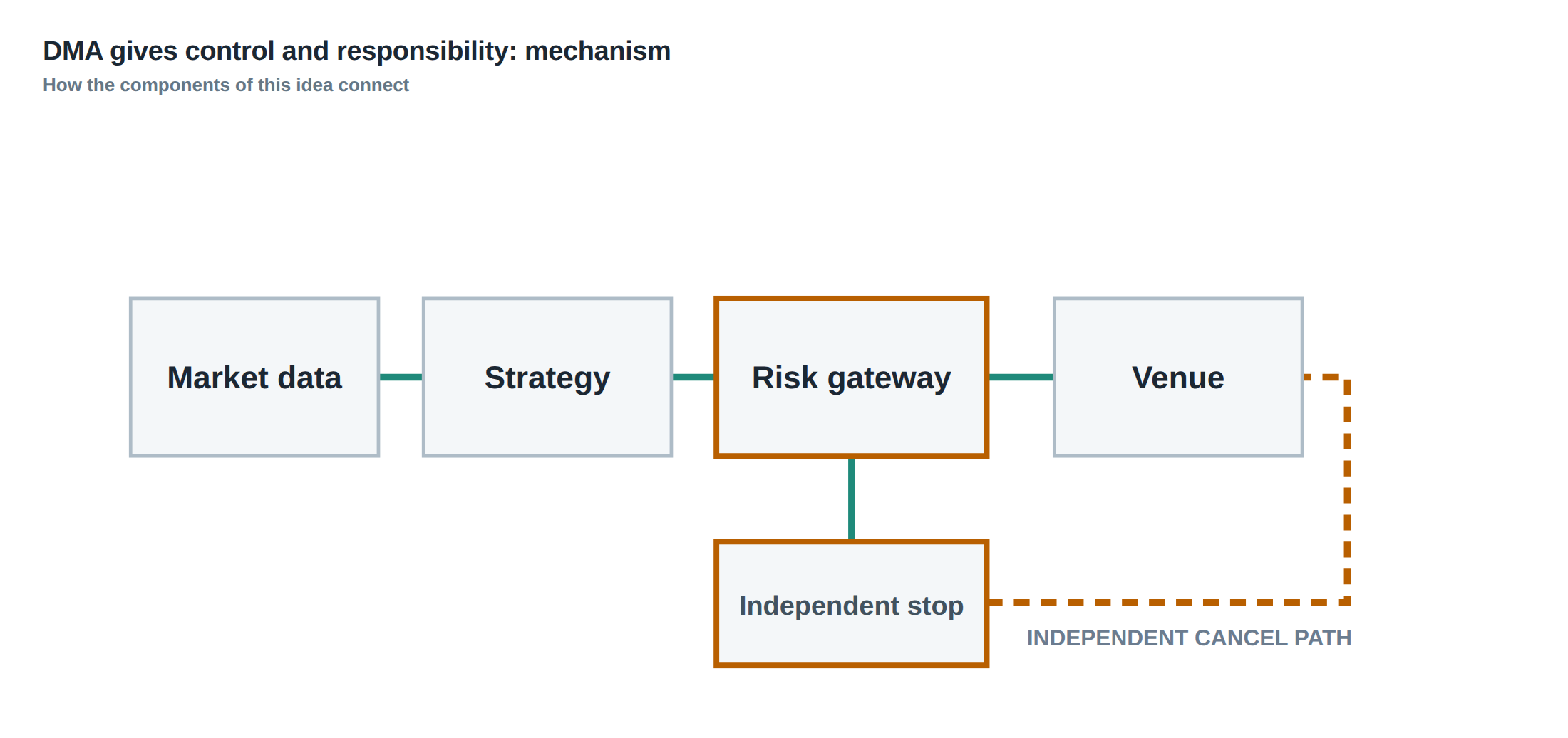
Once the guard clears the order, it is placed on a high‑priority outbound queue that is directly mapped to the exchange’s FIX or native protocol gateway. The gateway attaches a unique client order identifier (COID) and a timestamp, then transmits the order to the venue. The exchange acknowledges receipt with an execution report that may be an acknowledgement, a partial fill, a full fill, a cancel, or a reject. These reports are streamed back to the firm’s post‑trade processor, which reconciles them against the outbound queue, updates the internal position book, and generates any required regulatory reports.
Crucially, a parallel “kill path” runs alongside the normal flow. This path is a lightweight, pre‑approved command channel that can issue a market‑wide cancel or a specific order cancel without invoking the strategy’s code. It is typically implemented as a hardware‑level interrupt or a dedicated network socket that bypasses the validation engine, ensuring that a human operator or an automated monitor can stop the flow instantly if a systemic fault is detected.
A worked example with real numbers
Consider a statistical‑arbitrage strategy that monitors the EUR/USD and GBP/USD pairs and, when the cross‑rate deviates by more than 0.2 % from the implied rate, places a pair of offsetting orders to capture the spread. The strategy decides at 09:32:15.342 UTC to sell EUR/USD at 1.0875 and buy GBP/USD at 1.2580, each for a notional of €5 million. The internal risk limit for any single currency exposure is €10 million, and the maximum order size per instrument is €6 million.
The validation engine first checks the symbols. Both EUR/USD and GBP/USD are present in the master data, and the side flags (sell for EUR/USD, buy for GBP/USD) match the intended direction. The price for EUR/USD is 1.0875, which lies within the pre‑defined band of 1.0800–1.0950; the GBP/USD price of 1.2580 sits comfortably inside its band of 1.2500–1.2700. The quantities translate to €5 million each, well below the €6 million per‑order ceiling and the €10 million per‑currency exposure limit. The account identifier resolves to the “FX‑StatArb” bucket, which is authorised for both instruments.
The fat‑finger guard then evaluates the notional of the EUR/USD order: €5 million multiplied by the price of 1.0875 yields a USD notional of $5.4375 million, well under the $8 million per‑order notional cap. The guard also checks the price deviation from the mid‑quote; the market mid for EUR/USD at that instant is 1.0873, so the order is only 0.02 % away, comfortably inside the 0.05 % fat‑finger threshold. The frequency guard confirms that the last EUR/USD order was placed 12 seconds earlier, exceeding the minimum 5‑second inter‑order gap. No duplicate order identifiers are detected.
Having cleared both layers, the order is stamped with COID = FXA‑20231127‑093215‑001 and placed on the outbound queue. The gateway forwards the message to the exchange, which returns an acknowledgement at 09:32:15.344 UTC. A second acknowledgement arrives for the GBP/USD order at 09:32:15.345 UTC. The post‑trade processor receives a partial fill for EUR/USD at 1.0875 for €2 million at 09:32:15.500 UTC, and a full fill for GBP/USD at 1.2580 for €5 million at 09:32:15.512 UTC. The internal position book updates the net EUR exposure to –€2 million and the GBP exposure to +€5 million, preserving the intended market‑neutral stance.
If, however, the price for EUR/USD had been entered as 1.0975 – a simple transposition error – the fat‑finger guard would have flagged the price as outside the 1.0800–1.0950 band and rejected the order before it ever reached the exchange. The kill path would not have been needed in this case, but the same guard would have prevented a potentially costly execution at an unfavourable price.
Where it breaks in live markets
Even with a rigorous pre‑trade stack, failures surface when the market environment diverges sharply from the assumptions baked into the validation rules. One common failure mode is the “price‑band breach” that occurs during a flash crash. If the mid‑quote moves outside the static band before the order reaches the exchange, the order may be accepted by the venue but immediately cancelled, generating a cascade of reject messages that flood the post‑trade reconciler.
Another break point is the latency mismatch between the validation engine and the exchange’s order‑book. In a high‑frequency environment, the time between the moment the validation engine reads the market data and the moment the order arrives at the venue can be several milliseconds. During that interval the queue position can be lost, and the expected spread may evaporate, turning a profitable placement into an adverse‑selection loss.
Duplicate‑order detection also fails when the strategy’s state becomes inconsistent after a network partition. The same order identifier may be regenerated on two separate machines, leading the exchange to treat them as distinct orders that compete for the same queue slot. The result is a “race to the top” where one order fills and the other is rejected, but the internal risk engine may still record both as active, inflating the apparent exposure.
Finally, the kill path can be compromised if it shares resources with the normal order‑generation pipeline. A memory leak in the strategy’s process can corrupt the socket used for emergency cancels, rendering the kill switch ineffective precisely when it is needed most. These failure modes illustrate that DMA’s advantage in speed is matched by an equal need for resilience in the surrounding control architecture.
The operating path, stage by stage
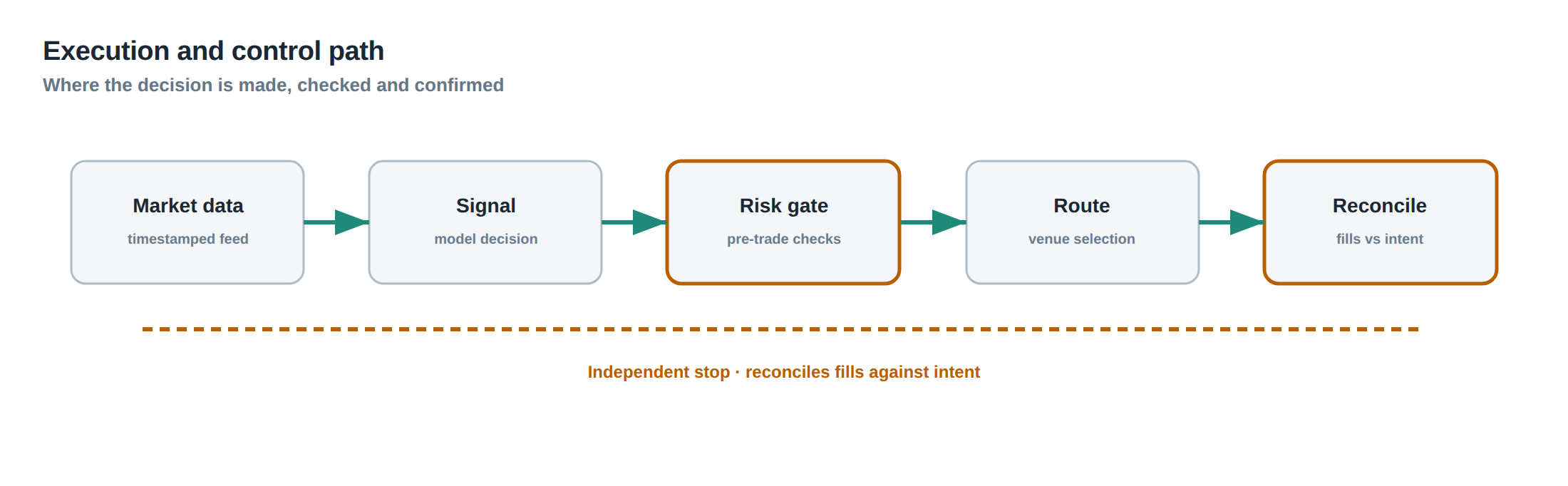
The operating path begins with market‑data ingestion, where a low‑latency feed handler normalises quotes and timestamps them to the microsecond. The normalised data is broadcast to the strategy engine, which produces a raw order request. The request is then handed to the pre‑trade validator, which performs symbol, side, price, quantity and account checks. If any check fails, the request is logged and discarded.
A successful validation passes the request to the fat‑finger guard. Here the system enforces notional limits, price‑deviation thresholds, order‑frequency caps and duplicate detection. The guard may adjust the request – for example, rounding the price to the nearest tick – before forwarding it to the outbound gateway.
The outbound gateway attaches a COID and a precise timestamp, then transmits the order over a dedicated low‑latency link to the exchange. The exchange replies with an execution report, which is captured by the inbound processor. The inbound processor reconciles the report against the outbound queue, updates the internal position book, and generates any downstream risk or compliance alerts.
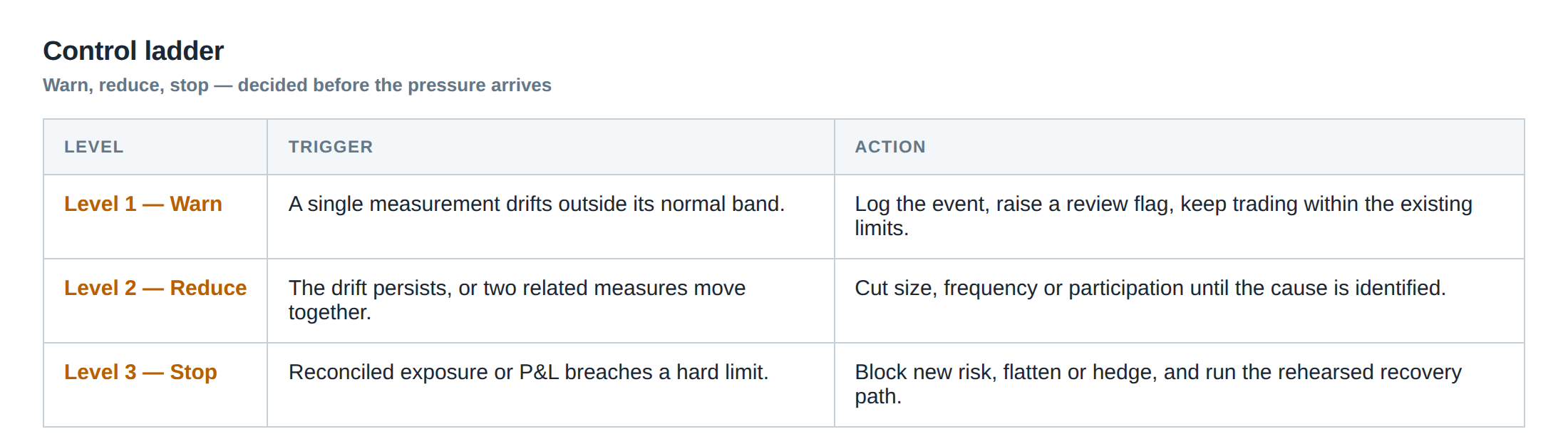
Parallel to this flow, the kill path monitors a set of health indicators – latency spikes, abnormal reject rates, and internal exception counters. When a threshold is breached, an operator or an automated rule can fire a cancel command that bypasses the validator and guard, sending a market‑wide cancel message directly to the exchange. The kill command is logged with a separate audit trail to preserve forensic evidence.
Controls that act before the damage
Pre‑trade controls are the first line of defence against costly mistakes. Symbol validation ensures that the order references a known instrument; a mismatched identifier would otherwise be rejected by the exchange after the latency penalty has been paid. Side validation prevents accidental reversal of a directional bet, which can double exposure in volatile markets.
Price validation comprises two parts: a static band check that guards against gross input errors, and a dynamic deviation check that limits the order to a percentage of the current mid‑quote. The dynamic check is essential when the market moves quickly; it prevents the strategy from unintentionally stepping ahead of the queue and paying the spread.
Quantity validation enforces both minimum lot sizes and maximum exposure per instrument. It is tied to the firm’s risk limits, which are usually expressed in notional terms. By converting the quantity to a notional using the latest price, the guard can enforce a consistent monetary cap across instruments with different price levels.
Account validation cross‑references the order to an allocation table that records which desk, trader or algorithm owns the risk. This prevents “account leakage” where an order intended for a low‑risk bucket is charged to a high‑leverage account, potentially breaching regulatory capital requirements.
The fat‑finger guard adds a layer of behavioural limits: it caps the number of orders per second for a given symbol, throttles the total notional per minute, and detects duplicate COIDs that could arise from a looping bug. These limits are calibrated to the venue’s order‑entry rules to avoid throttling penalties, while still providing a safety net against runaway code.
All of these controls must be implemented in a deterministic, lock‑free fashion so that they do not become the source of latency spikes themselves. The code paths are typically written in a compiled language, with pre‑allocated memory pools and avoidance of dynamic allocation during the critical path.
How to measure whether it is working
Measurement begins with latency profiling of each stage: market‑data receipt, validation, guard, gateway and acknowledgement. The firm should maintain a rolling percentile distribution (e.g., 50th, 95th, 99th) for each segment, and set service‑level targets that reflect the strategy’s tolerance.
Next, the firm monitors reject and cancel rates. A sudden increase in “price‑band breach” rejects indicates that the static bands are too tight or that market volatility has outpaced the guard’s dynamic thresholds. Similarly, an uptick in duplicate‑order rejections points to a state‑synchronisation issue in the strategy engine.
Notional and frequency limits are tracked against the guard’s configuration. If the guard is frequently throttling orders, the parameters may be overly conservative; if it rarely triggers, the limits may be insufficient. The key metric is the proportion of orders that pass through the guard unchanged versus those that are adjusted or rejected.
The kill path’s effectiveness is measured by “time‑to‑kill” – the interval between a kill command issuance and the receipt of a market‑wide cancel acknowledgement from the exchange. This should be an order of magnitude lower than the normal order‑to‑ack latency, and must be verified under load conditions that simulate a real‑world spike.
Finally, the firm reconciles internal position records with exchange‑provided end‑of‑day statements. Any discrepancy, however small, signals a breakdown in the post‑trade reconciliation that can be traced back to a missing acknowledgement or an unprocessed reject. Consistent zero‑discrepancy over a statistically significant sample confirms that the end‑to‑end pipeline is operating as intended.
The portfolio view
From a portfolio perspective, DMA’s primary benefit is the ability to capture fleeting spread opportunities that would be eroded by broker‑level latency. However, the operational risk introduced by removing the broker’s safety net must be reflected in the portfolio’s risk‑adjusted performance metrics.
The firm should allocate a capital charge for “operational latency risk” that is proportional to the proportion of orders that are sent via DMA versus those that go through a traditional broker. This charge can be expressed as a volatility‑adjusted VaR component, derived from the historical distribution of order‑to‑fill times and the observed frequency of pre‑trade rejections.
Furthermore, the portfolio’s Sharpe ratio should be adjusted for “control‑cost drag”. Each pre‑trade validation and guard introduces a deterministic cost measured in microseconds; when multiplied by the number of orders per day, this cost translates into a measurable opportunity cost that can be back‑tested against a hypothetical “broker‑screened” baseline.
The kill path adds a “tail‑risk mitigant” that should be modelled as a binary option: in the event of a catastrophic software fault, the kill switch reduces the loss from the full exposure to the exposure at the moment of kill, which is typically an order of magnitude smaller. Incorporating this optionality into the portfolio’s risk model yields a more realistic estimate of worst‑case drawdowns.
In practice, the desk monitors the aggregate notional flowing through DMA, the proportion of orders that trigger each guard, and the cumulative “time‑to‑kill” metric. These aggregates feed into a dashboard that the risk manager reviews each shift, ensuring that the operational burden does not silently erode the statistical edge that DMA was intended to deliver.
Will your firm’s pre‑trade architecture survive the next market micro‑structure shock, or will the very control layers you build become the bottleneck that erodes your edge?
About the research behind this lesson
The seminar frames electronic markets as price-time-priority queues. It separates queue value into spread capture versus adverse-selection cost and the option value of retaining a place in line.
Applied to this lesson: An order lifetime therefore cannot be based on elapsed time alone: the system must reassess whether its queue position, expected spread and adverse-selection risk still justify keeping the order alive.
Two live systems, one desk
PULSE-X — power-packed HFT: high-frequency momentum on XAUUSD and EURUSD. System details · Live account
NIC-X — ultra-low drawdown: displaced-print arbitrage for large capital. System details · Live account
Start now: leave your email and request a free trial — we will send the pricing, the connection route and the trial terms. Pricing
Join the market discussion: Telegram @squawklive
Source: High-Frequency Trading and Modern Market Microstructure
Educational content only. Trading leveraged products involves risk.
Chat with XTRSK
Chat ready
Start a chat and the XTRSK team will be notified immediately.