
XCore HFT / Trading Lab
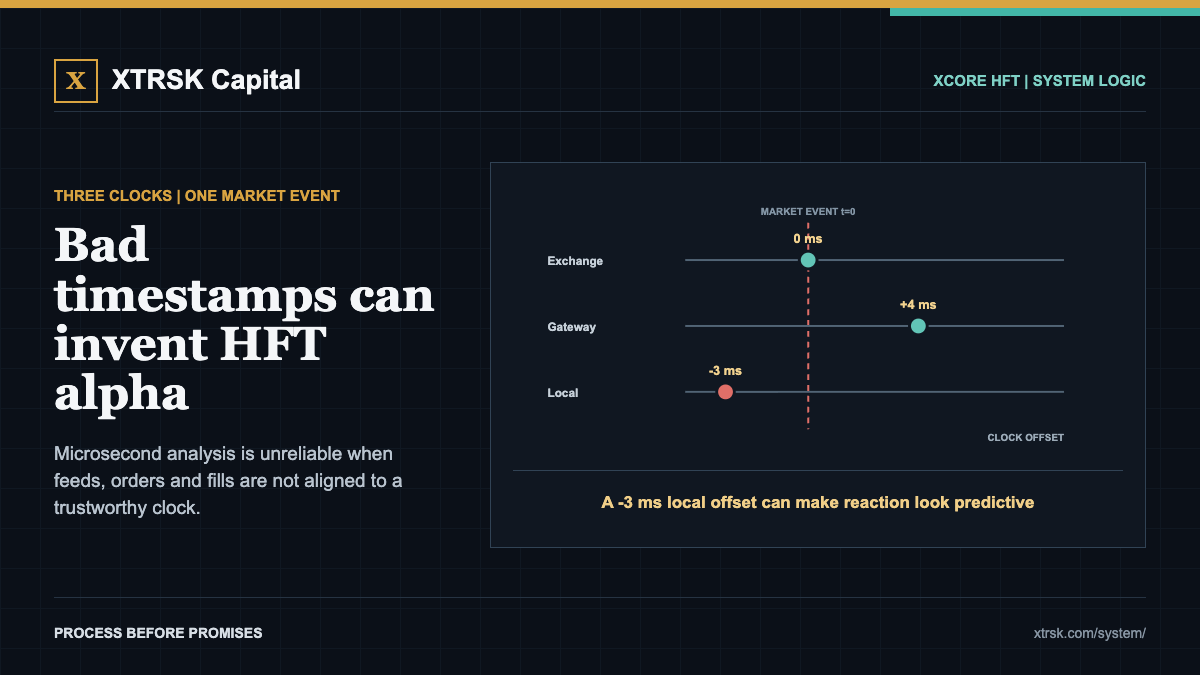
XCore HFT Trading Lab: Bad timestamps can invent HFT alpha
Quantitative execution, market-microstructure, and risk-control research from XTRSK.
A strategy does not trade a chart. It trades through queues, limits, acknowledgements and a finite capital budget. Bad timestamps can invent HFT alpha.
The useful analysis follows each state transition from observation to final exposure. Microsecond analysis is unreliable when feeds, orders and fills are not aligned to a trustworthy clock. Monitor clock offset and drift. Preserve sequence numbers and correction messages. For traders, this connects systematic, live test, measurable and strategy in one measurable problem.
Put a boundary around the claim. A backtest can appear to predict a price change when the trade feed is timestamped earlier than the quote update that actually arrived first. The example is not a forecast or a promise; it shows which variable must be measured before the apparent opportunity can be treated as usable.
A compact operating checklist is: 1) test out-of-order and duplicate events; 2) measure when information was knowable rather than when it was later recorded; 3) store exchange, gateway and local receive timestamps separately. Add hard exposure ceilings, observable rejection reasons and an event trail that lets operations reconstruct the decision without guessing. Control sequence: 1 signal, 1 order path, 1 reconciled risk state.
The common mistake is to optimise the visible number and ignore the conditions that produced it. Review the median, the stressed tail and the failure path separately. A result that survives only in quiet sessions, tiny size or perfect data is a research result, not yet a production capability.
Local optimisation can worsen the whole book. A faster fill or tighter stop is not automatically a better portfolio outcome. The objective is not to remove uncertainty. It is to size uncertainty, detect when assumptions break and preserve the ability to stop without creating a second problem.
Which measurement would most quickly reveal that this control is failing in your live order path?
#MarketData #HFT
Research desk: from MIT theory to trading controls
This section is an original XTRSK synthesis of the cited teaching and research material. MIT is an educational source and does not endorse XTRSK, XCore HFT or PULSE.
Risk and Return
What the MIT material establishes: Andrew Lo's lectures build risk analysis from return distributions and statistical measures, rather than treating one realised result as a complete description of risk.
Applied to this XCore lesson: For a fast strategy, median latency or average fill quality is not enough. The review has to include tail delays, stale-order frequency and the loss distribution when cancellation or routing behaves abnormally.
Study the original MIT OpenCourseWare, Finance Theory I
Theories of Nominal Exchange Rates and Exchange-Rate Regimes
What the MIT material establishes: The course separates short- and long-run exchange-rate mechanisms and then examines currency crises, exchange-rate regimes and capital controls.
Applied to this XCore lesson: A systematic FX process should distinguish execution controls from macro regime assumptions. A low-latency order rule cannot repair a model whose exchange-rate premise no longer fits the policy regime.
Study the original MIT OpenCourseWare, Applied Macro and International Economics
Blockchain and Money: Secondary Markets and Crypto-Exchanges
What the MIT material establishes: The course studies blockchain economics and devotes a session to secondary markets and crypto exchanges, placing tokens inside the practical structure of trading venues, custody and market access.
Applied to this XCore lesson: The same control principle crosses asset classes: venue state, settlement design and fragmented liquidity can outlive a short-lived signal, so speed must remain subordinate to confirmed exposure and executable liquidity.
Study the original MIT OpenCourseWare, Blockchain and Money
Further MIT learning path
- FX: Theories of Nominal Exchange Rates and Exchange-Rate Regimes
- Risk: Risk and Return
- HFT: High-Frequency Trading and Modern Market Microstructure
- Crypto: Blockchain and Money: Secondary Markets and Crypto-Exchanges
Explore XCore HFT: System details
PULSE XCORE HFT live account: Verify the live account on FX Blue
Live chat and updates: Telegram @xtrskhft
Educational content only. Trading leveraged products involves risk.
Chat with XTRSK
Chat ready
Start a chat and the XTRSK team will be notified immediately.