XCore HFT / Trading Lab
PULSE: Lot size translates a stop into money
Quantitative execution, market-microstructure, and risk-control research from XTRSK.
What this problem really is
Most desks understand the theory here long before they understand the operational cost of getting it wrong. The distance to a stop does not determine account risk until it is combined with position size and instrument value.
Lot size translates a stop into money. is easy to describe and harder to operate, and the gap between the description and the operation is where trading risk accumulates. Read the idea as a pipeline: observation, interpretation, permission, execution and reconciliation. The desk is only as strong as the weakest of those links on the day it matters.
Read the idea as a pipeline: observation, interpretation, permission, execution and reconciliation. The desk is only as strong as the weakest of those links on the day it matters.
The system becomes understandable when every transition is timestamped and every assertion is checkable against an independent record.
Professionals separate what the model intends from what the venue confirms. The difference between those two is where operational risk lives.
How the mechanism works, step by step
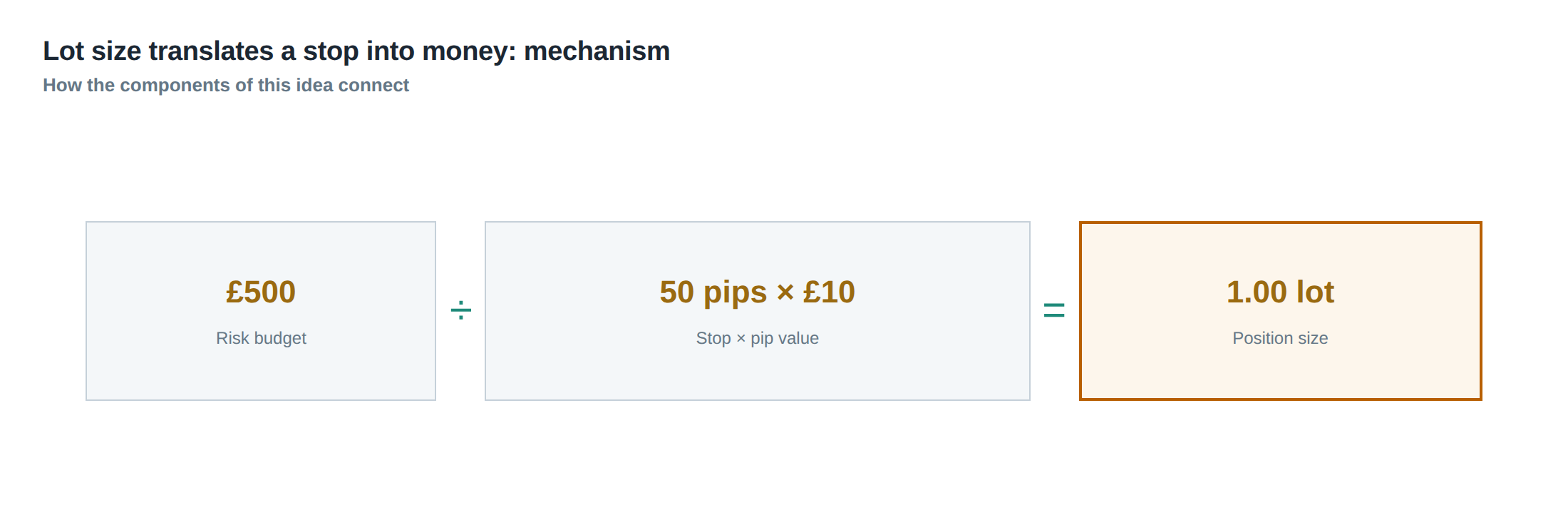
1) Start with an account risk budget. 2) Convert price distance through contract size, tick value and currency. 3) Round down to the venue lot increment. 4) Include spread and expected slippage. 5) Recalculate when the stop or volatility changes.
The mechanism is a sequence, not a single decision. Each stage consumes the output of the previous one, and a small error early in the chain is amplified by everything that follows.
Read the idea as a pipeline: observation, interpretation, permission, execution and reconciliation. The desk is only as strong as the weakest of those links on the day it matters.
The system becomes understandable when every transition is timestamped and every assertion is checkable against an independent record.
The first failure mode is silent drift: the measurement that justified the strategy stops matching the conditions that produce it, and nobody is watching the difference between the two.
A worked example with real numbers
With a five-hundred-pound risk budget, a stop twice as wide normally requires roughly half the position size before costs.
If a small change in one input flips the sign of the result, that input deserves a limit and a monitor of its own.
State the holding period explicitly. An edge measured over milliseconds and one measured over days need entirely different controls.
Where the cost is uncertain, use a conservative bound; an edge that survives only optimistic costs is not an edge.
A worked number is useful precisely because it can be wrong in public. If the arithmetic does not survive inspection, the strategy will not survive the market.
Where it breaks in live markets
The fifth is the recovery path. A desk that can stop but cannot restart safely has only solved half of the problem it set out to solve.
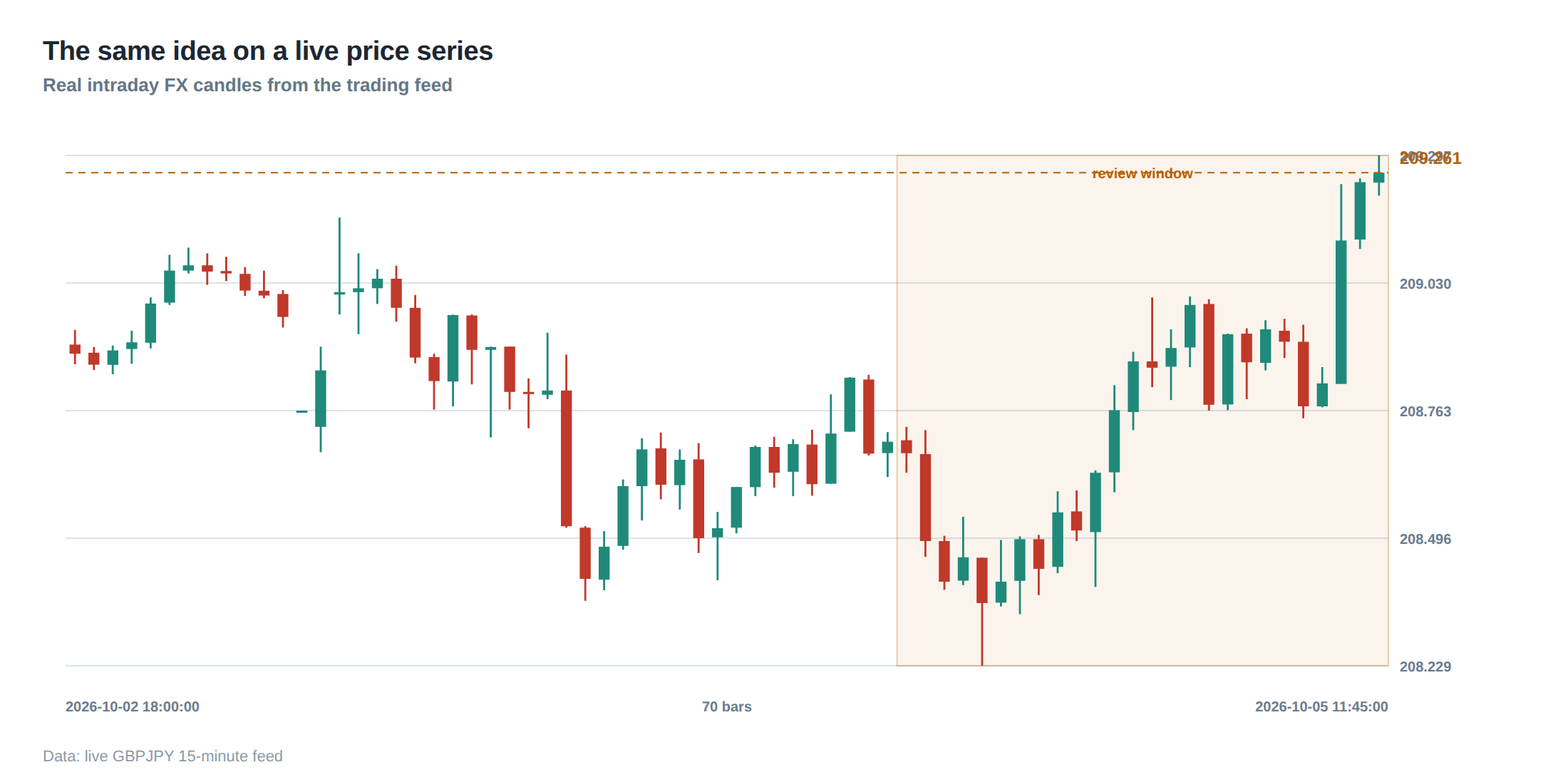
The first failure mode is silent drift: the measurement that justified the strategy stops matching the conditions that produce it, and nobody is watching the difference between the two.
The second is a control that exists in configuration but not in behaviour. A limit that reads stale or unreconciled state is documentation, not protection.
The third is concentration. Several positions that look independent share a factor, a venue or a liquidity source, and the book quietly becomes one larger bet than the dashboard suggests.
The fourth is capacity. The same signal that earns a thin edge at small size consumes that edge through market impact as the order grows.
The operating path, stage by stage
A compact checklist is: 1) round down to the venue lot increment; 2) include spread and expected slippage; 3) recalculate when the stop or volatility changes.
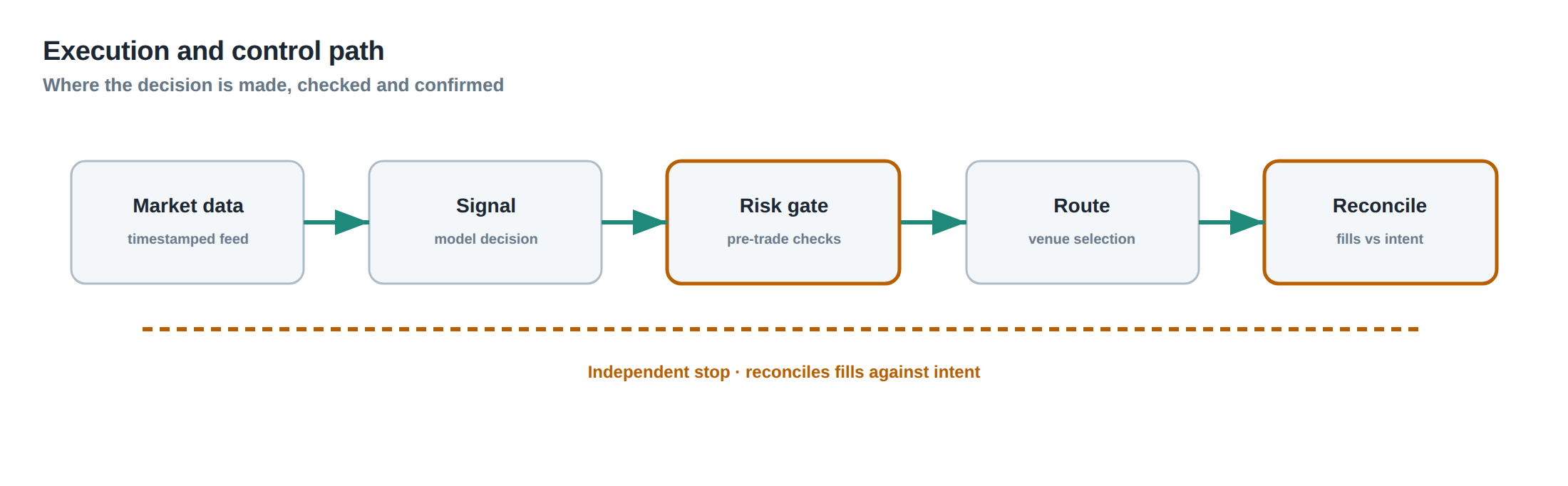
Reconciliation closes the loop: the system compares intended exposure with confirmed exposure and refuses to continue on an unexplained gap.
The kill path must be independent of the components it is meant to stop, or it inherits their failure modes at exactly the wrong moment.
Log the decisions the system declined to take, not only the ones it took; rejected opportunities are the cleanest evidence about how the controls behave.
A rehearsed recovery is part of the operating path, not an afterthought once the incident has already started.
Controls that act before the damage
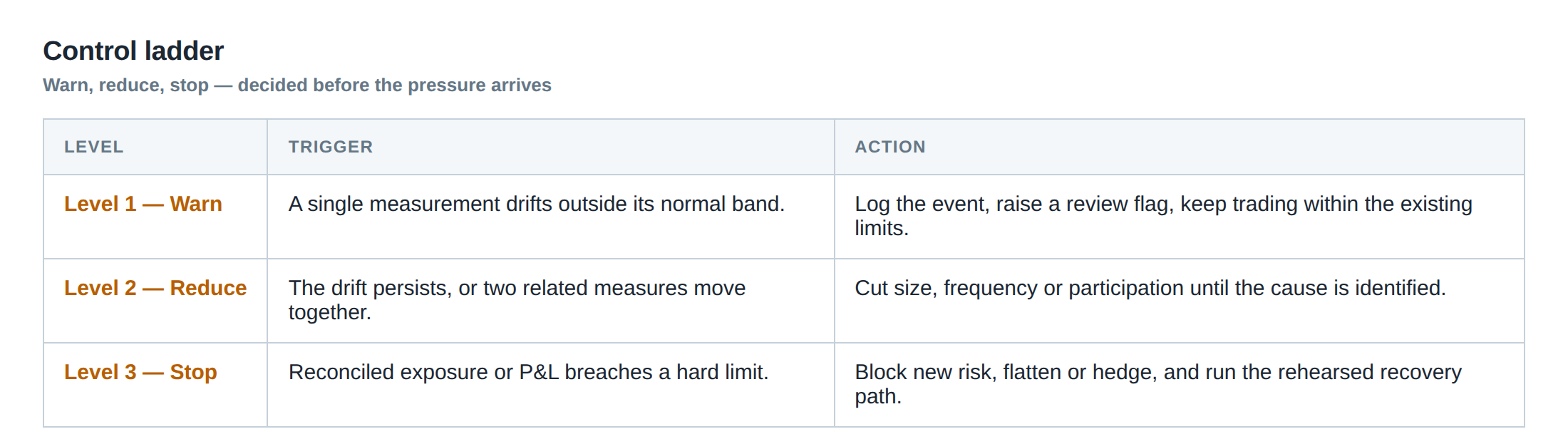
Use a three-level ladder. Level one warns and records; level two reduces size, frequency or participation; level three blocks new risk and invokes the rehearsed recovery path.
Prefer several narrow, well-understood limits over one clever aggregate that nobody can explain under pressure.
A control that fires constantly is a design fault, while a control that never fires has not really been tested.
The sequence matters: warn, then reduce, then stop, with each step leaving a record that the next one can trust.
Hard limits belong in a layer the strategy cannot edit at runtime, so a bug or a careless configuration change cannot lift its own ceiling.
How to measure whether it is working
Measure the median and the tail separately. An acceptable average can conceal a loss distribution the account could not survive twice.
Record the reason for every rejection and every reduction, not only the outcomes. The audit trail is what lets operations reconstruct a decision without guessing.
Compare decision price, arrival price and realised fill. The gap between intention and execution is the most honest measure of what the system actually delivered.
Track the frequency and duration of abnormal states, not just their existence. A control that fires constantly is a design problem, not a safeguard.
Choose a denominator and keep it fixed. Changing the base between reports makes progress impossible to judge.
Turning the idea into a daily routine
Keep a short list of conditions that would make the desk stand down. A pre-committed exit is worth more than a clever entry.
Feed the review back into the limits. A control that never changes after new evidence is not learning from the market.
Automate the boring part of the review so that attention is free for the ambiguous part, which is the only part that needs a human.
A deep idea earns its keep only when it becomes a routine check that somebody actually runs. Write the check as a question with a numeric answer, not as a principle.
The portfolio view
The account experiences combined profit, loss and liquidity demand even when the models are monitored in separate dashboards.
Risk should aggregate across instruments and strategies before another order is allowed to consume scarce liquidity or margin.
Aggregate by risk factor rather than by strategy label, because two desks can easily be one position.
Ask what happens to the whole book if the shared dependency fails at the worst moment, then size for that day rather than for the average one.
If the data and the venue ever disagreed, which record would your process believe, and why?
About the research behind this lesson
Andrew Lo's lectures build risk analysis from return distributions and statistical measures, rather than treating one realised result as a complete description of risk.
Applied to this lesson: For a fast strategy, median latency or average fill quality is not enough. The review has to include tail delays, stale-order frequency and the loss distribution when cancellation or routing behaves abnormally.
Explore PULSE: System details
PULSE live account: Verify the live account on FX Blue
Live chat and updates: Telegram @xtrskhft
Source: Risk and Return
Educational content only. Trading leveraged products involves risk.
Chat with XTRSK
Chat ready
Start a chat and the XTRSK team will be notified immediately.