
XCore HFT / Trading Lab
XCore HFT Trading Lab: Statistical arbitrage is a model-risk trade
Quantitative execution, market-microstructure, and risk-control research from XTRSK.
The screen can show a tiny opportunity while the order path carries a much larger operational risk. Statistical arbitrage is a model-risk trade.
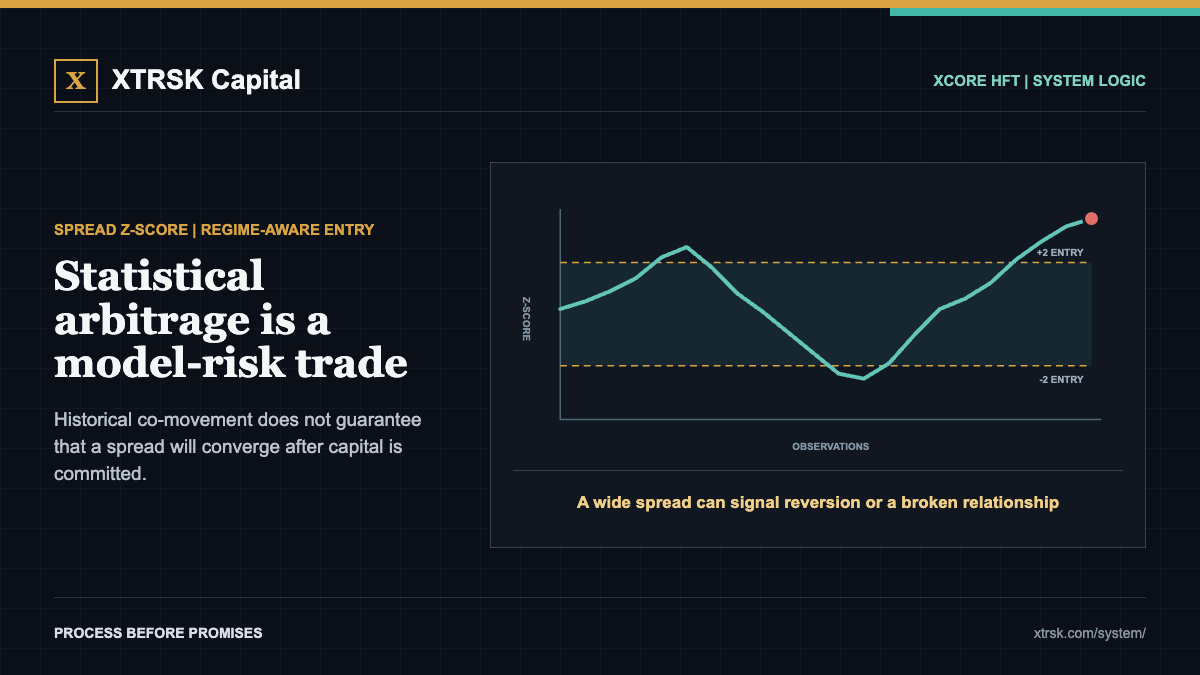
Good controls make hidden assumptions visible before capital discovers them. Historical co-movement does not guarantee that a spread will converge after capital is committed. Cap exposure when the relationship changes. Define a time stop as well as a price stop. The practical linkage is slippage → mechanism → friction → exposure; each step can be tested.
Put a boundary around the claim. A wide z-score can indicate opportunity, structural change or bad data; position size should reflect that uncertainty. The example is not a forecast or a promise; it shows which variable must be measured before the apparent opportunity can be treated as usable.
A compact operating checklist is: 1) test stationarity and half-life across multiple regimes; 2) separate common-factor exposure from residual spread behaviour; 3) include borrow, funding, turnover and execution costs. Add hard exposure ceilings, observable rejection reasons and an event trail that lets operations reconstruct the decision without guessing. Control sequence: 1 signal, 1 order path, 1 reconciled risk state.
The misleading shortcut is to treat an individual pass as proof that aggregate risk is acceptable. Review the median, the stressed tail and the failure path separately. A result that survives only in quiet sessions, tiny size or perfect data is a research result, not yet a production capability.
Individual controls answer whether one instruction is permitted. Portfolio controls answer whether the firm can absorb all permitted instructions together. The objective is not to remove uncertainty. It is to size uncertainty, detect when assumptions break and preserve the ability to stop without creating a second problem.
Which measurement would most quickly reveal that this control is failing in your live order path?
#StatArb #QuantTrading
The research behind this lesson
This paper explains The seminar frames electronic markets as price-time-priority queues. It separates queue value into spread capture versus adverse-selection cost and the option value of retaining a place in line.
Applied to this XCore lesson: An order lifetime therefore cannot be based on elapsed time alone: the system must reassess whether its queue position, expected spread and adverse-selection risk still justify keeping the order alive.
Explore XCore HFT: System details
PULSE XCORE HFT live account: Verify the live account on FX Blue
Live chat and updates: Telegram @xtrskhft
Source: High-Frequency Trading and Modern Market Microstructure
Educational content only. Trading leveraged products involves risk.
Chat with XTRSK
Chat ready
Start a chat and the XTRSK team will be notified immediately.