
XCore HFT / Trading Lab
DMA gives control and responsibility
Quantitative execution, market-microstructure, and risk-control research from XTRSK.
What this problem really is
Direct market access (DMA) promises the illusion of a frictionless conduit between a proprietary algorithm and the exchange order book. In practice the “frictionless” label merely reflects the removal of traditional broker‑dealer screens, not the disappearance of risk. When a strategy can inject an order directly into a price‑time‑priority queue, the firm inherits every pre‑trade validation that a broker would normally perform. The responsibility for confirming that the symbol exists, that the side (buy or sell) matches the intended exposure, that the price respects market limits, that the quantity respects position caps, and that the account is authorised now rests on the firm’s own infrastructure.
The problem deepens because DMA bypasses the human checks that have historically caught typographical errors, mis‑scaled notional values, or accidental duplicate submissions. Those “fat‑finger” safeguards are no longer implicit; they must be codified, audited and enforced by software that runs in microseconds. A single misplaced decimal can generate a 10 000‑contract order that, if accepted, would move the market, trigger circuit‑breakers and expose the firm to regulatory sanctions.
Consequently the operational model shifts from a layered defence—broker, compliance, risk—to a thin stack where the strategy process, the order‑router and the exchange interact directly. The thin stack is efficient, but any weakness in validation, limit enforcement or kill‑path execution becomes a single point of failure that can cascade into a market‑impact event, a compliance breach, or a capital‑requirement breach.
How the mechanism works, step by step
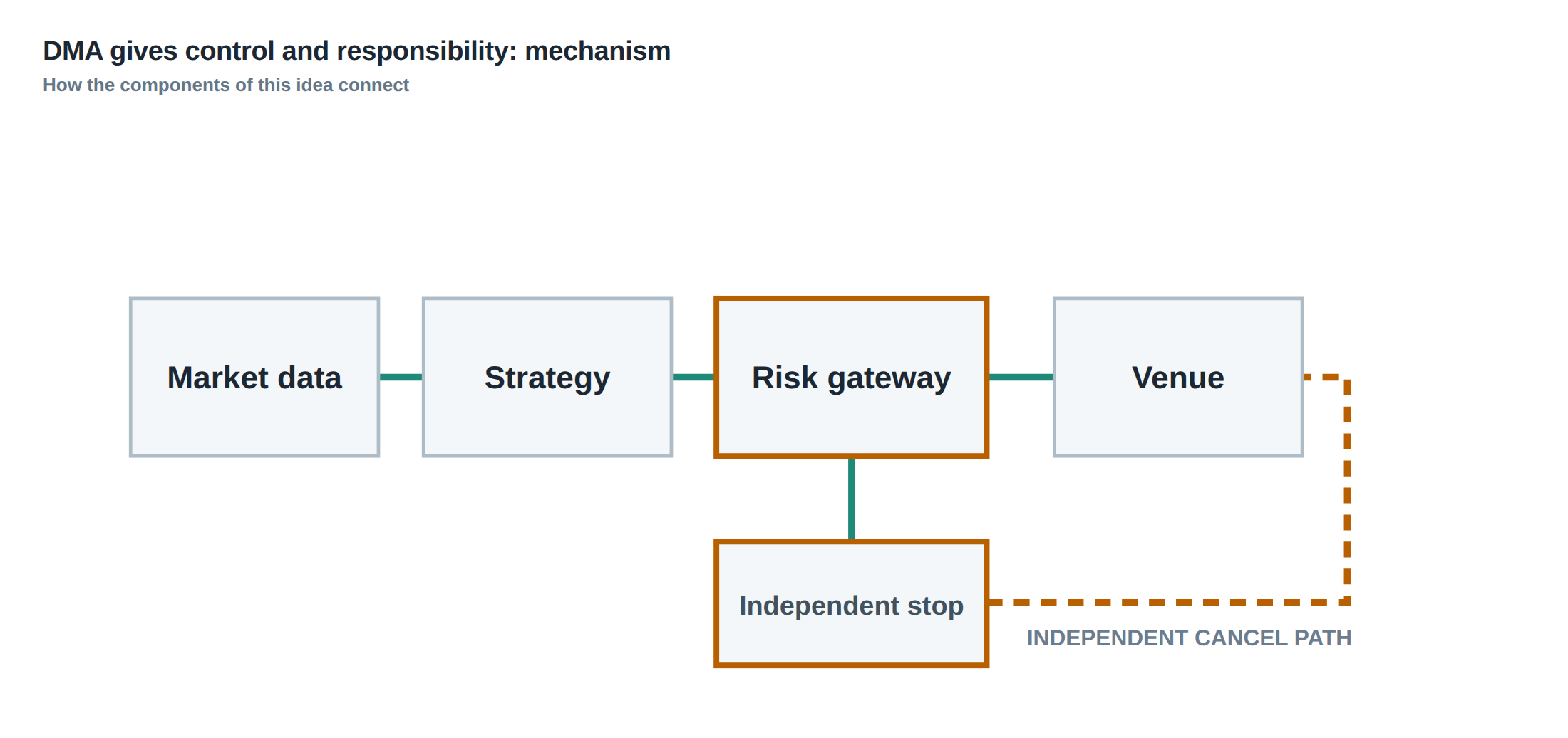
The first step is the strategy’s decision engine, which outputs a trade intent: symbol, side, price, quantity and the identifier of the trading account. That intent is handed to a pre‑trade validation module. The module checks the symbol against the master security master, confirms that the side aligns with the firm’s net‑position limits, and verifies that the price lies within the venue’s limit‑up/limit‑down band as well as any internal price‑band rules.
If the validation passes, the order is enriched with metadata – a unique client order identifier, a timestamp, and a risk tag that indicates the notional size. The enriched order then enters the routing layer, which applies a suite of operational limits: a fat‑finger guard that rejects any price deviation larger than a pre‑set number of ticks from the reference price, a notional cap that prevents orders exceeding, for example, £5 million, a frequency limiter that throttles the number of orders per second per strategy, and a duplicate‑order detector that flags identical orders within a configurable window.
Only after the order survives all gate‑checks does the router transmit it via a low‑latency FIX or proprietary protocol straight to the exchange gateway. The exchange acknowledges receipt, later sends fills, partial fills, cancellations or rejects. A reconciliation engine consumes these messages in real time, matches them against the original intent, updates the position book and, crucially, verifies that every acknowledgement corresponds to a previously sent order. Any mismatch triggers an alarm and initiates the kill‑path.
A worked example with real numbers
Consider a statistical‑arbitrage strategy that monitors the EUR/USD futures spread between two contract months. At 09:30:12.345 UTC the model signals a 5‑tick widening of the spread and recommends buying 1 200 contracts of the front‑month at 1.1125 and selling 1 200 contracts of the second month at 1.1070. The notional of each leg is £1 350 000 (1 200 × 1.1125 × £1 000).
The pre‑trade validator first confirms that the symbol “6E” (front month) and “6E2” (second month) are active, that the side (buy for 6E, sell for 6E2) respects the firm’s net‑exposure limits of ±2 000 contracts, and that the quoted prices sit within the exchange’s limit‑up/limit‑down bands of ±10 ticks. The fat‑finger guard checks that the price deviation from the mid‑quote (1.1120 for 6E, 1.1075 for 6E2) does not exceed the configured 5‑tick threshold; both pass. The notional cap of £5 million is not breached (each leg £1.35 million). Frequency control sees that the strategy has sent only two orders in the previous second, well below the 10‑order‑per‑second ceiling. Duplicate detection confirms that no identical order has been sent in the last 500 ms.
The router forwards the two orders. The exchange acknowledges both within 0.8 ms. Within 12 ms the front‑month order is filled for 1 200 contracts at 1.1125, while the second‑month order receives a partial fill of 800 contracts at 1.1070 and a reject for the remaining 400 contracts due to a sudden liquidity withdrawal. The reconciliation engine matches the fills, updates the position book (net long 400 contracts of the spread), and flags the partial reject. Because the residual 400 contracts on the second leg remain unfilled, the kill‑path is invoked: a market‑on‑close cancellation is sent, confirmed within 1 ms, and the strategy’s risk manager is notified. The whole sequence from intent to final resolution consumes 28 ms, well within the firm’s latency budget, and the pre‑trade controls prevented a potential £2 million unintended exposure.
Where it breaks in live markets
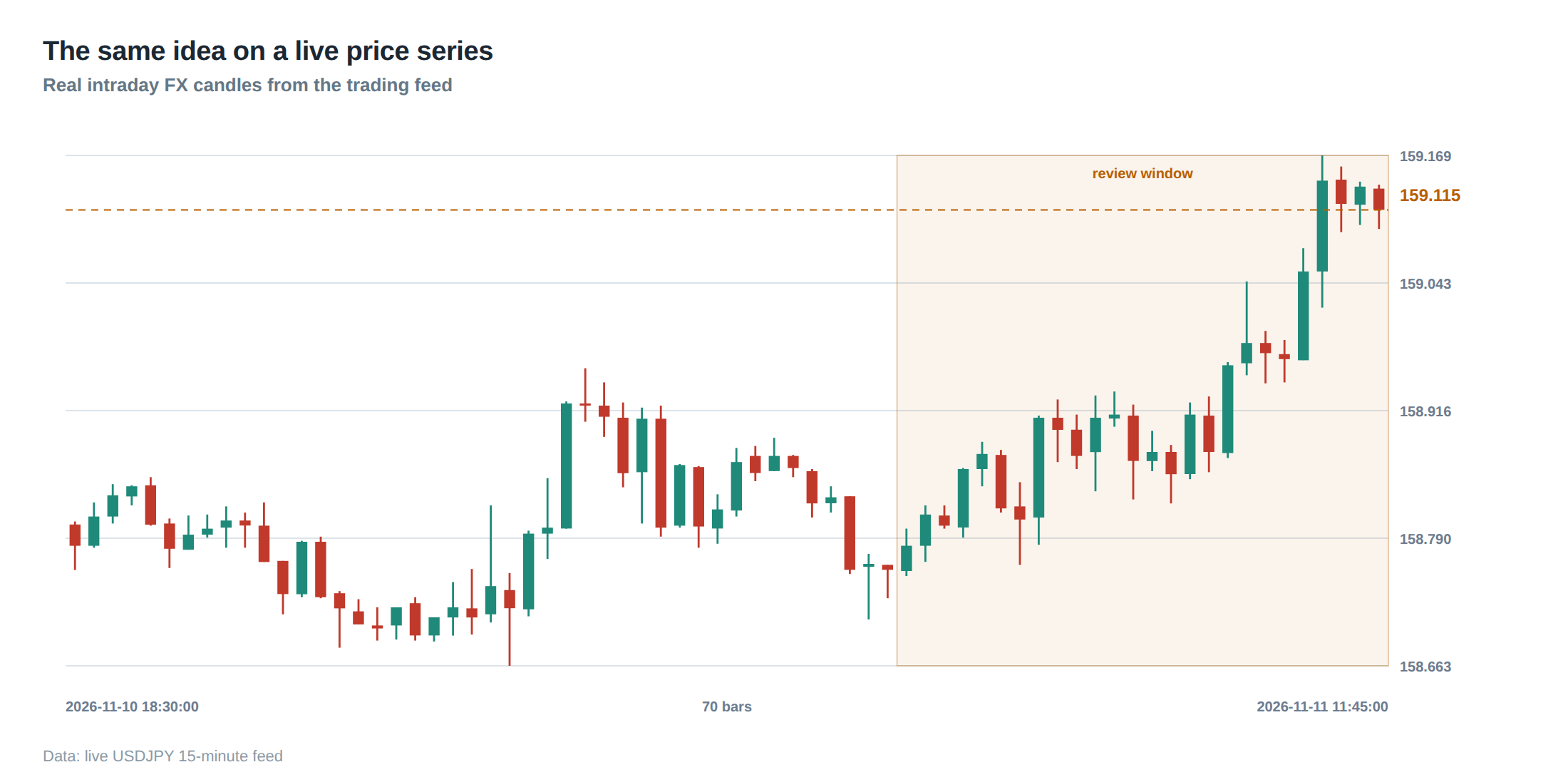
Even a well‑engineered DMA pipeline can falter when market conditions evolve faster than the control loop. In a flash‑crash scenario, price bands can shift by dozens of ticks within a few milliseconds, rendering the static fat‑finger thresholds obsolete. If the validator uses a stale reference price, an order that appears compliant at validation time may breach the venue’s dynamic limits the moment it reaches the gateway, leading to immediate rejects and possible regulatory scrutiny.
Another failure mode is the loss of order‑state synchronisation. High‑frequency gateways occasionally drop acknowledgement packets under network congestion. If the reconciliation engine does not receive a fill confirmation, it may assume the order is still live and issue a duplicate, violating the duplicate‑order limit and potentially creating a self‑matching scenario. Such desynchronisation can also mask a partial fill, leaving the strategy exposed to unintended market risk.
Finally, the kill‑path itself can become a bottleneck. If the kill‑signal is routed through the same low‑latency path as the original order, a downstream congestion event may delay the cancellation, allowing the stray order to sit in the queue while the market moves against it. In extreme cases the order may be executed at a price far beyond the original intent, generating a fat‑finger loss that the pre‑trade limits were designed to prevent.
The operating path, stage by stage
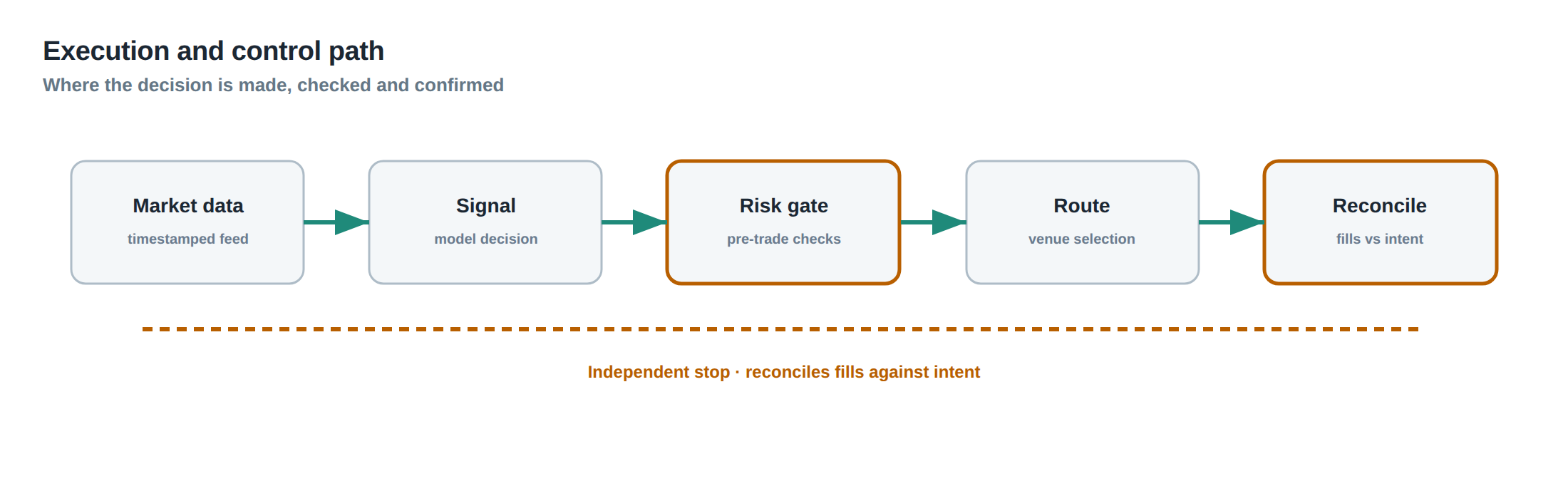
Stage one begins with the strategy engine emitting a trade intent. The intent is a plain data structure containing the security identifier, side, price, quantity, and account tag. Stage two is the pre‑trade validation service, which consults the security master, the current market data snapshot, and the firm’s risk parameters. It returns a pass/fail flag and, if passed, appends a unique client order ID and a timestamp.
Stage three is the operational‑limit enforcement layer. Here the order is examined against a hierarchy of controls: price‑deviation guards, notional caps, per‑strategy frequency limits, and duplicate‑order detection. The layer may also apply venue‑specific constraints such as minimum order size or iceberg‑order rules. If any rule is violated, the order is rejected locally and a diagnostic is logged.
Stage four is the routing engine, which selects the optimal gateway (e.g., a colocated FIX gateway) based on latency, bandwidth and connectivity health. The order is encoded in the exchange’s protocol, transmitted, and the router awaits an acknowledgement.
Stage five is the acknowledgement and fill processing service. It ingests execution reports, cancels, and rejects, matches them to the original client order ID, and updates the position and P&L books.
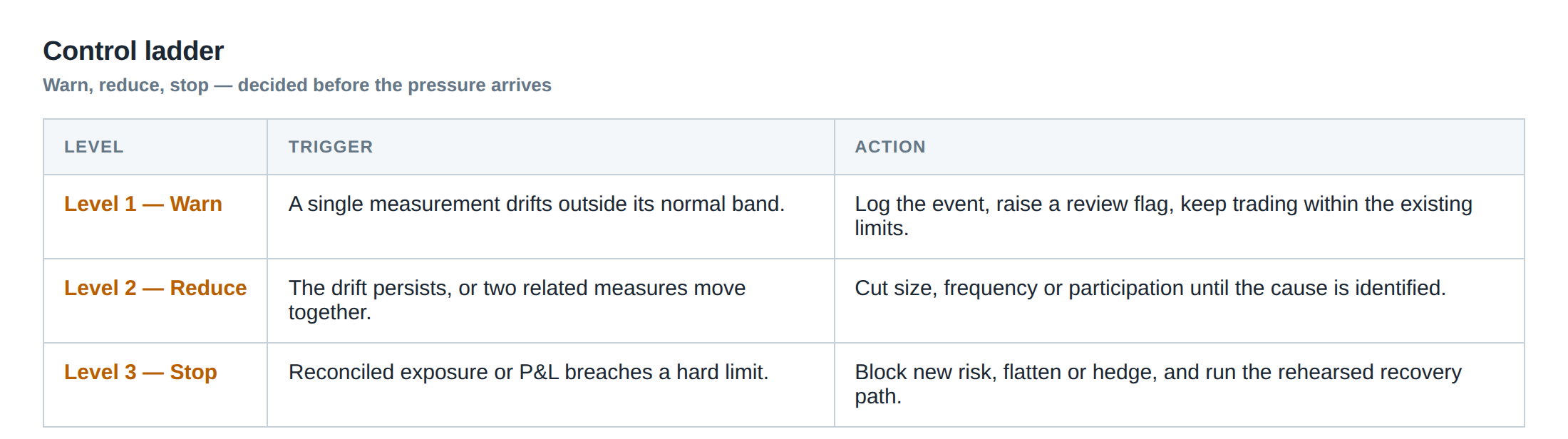
Stage six is the reconciliation and kill‑path monitor. It continuously checks that every sent order has a corresponding acknowledgement, that fills reconcile with the intended quantity, and that any outstanding orders are either cancelled or confirmed within a configurable timeout. If the timeout expires, the kill‑path is triggered, sending a market‑on‑close or immediate‑or‑cancel message independent of the strategy process.
Controls that act before the damage
The first line of defence is symbol validation. A centralised master data repository stores the ISIN, exchange code and contract specifications for every tradable instrument. The validation routine checks that the incoming symbol matches an active entry, that the contract’s tick size and lot size are honoured, and that the venue permits the requested order type.
Next comes side and account verification. The system cross‑references the requested side with the firm’s net‑position limits for the account, ensuring that a buy does not push the exposure beyond the pre‑approved ceiling. The account check also verifies that the order originates from a strategy authorised for that account, preventing cross‑strategy contamination.
Price validation implements a multi‑tiered guard. The first tier compares the submitted price to the best‑bid/best‑offer plus a configurable number of ticks; the second tier checks against the venue’s dynamic limit‑up/limit‑down bands. If the price lies outside either band, the order is rejected before it ever reaches the exchange.
Quantity validation enforces both minimum and maximum lot sizes, as well as an aggregate notional limit that caps the monetary exposure of any single order. The notional limit is expressed in the base currency of the venue and is calibrated to the firm’s capital allocation for the strategy.
Finally, duplicate‑order detection uses a short‑term hash of the order’s key fields (symbol, side, price, quantity, account) to spot re‑submissions within a configurable window, typically a few hundred milliseconds. When a duplicate is identified, the system discards the later submission and raises an alert, preventing accidental double‑fills.
All these controls are encapsulated in a stateless service that can be called by any strategy, ensuring uniform enforcement across the desk. The service is version‑controlled and subject to nightly regression testing, so that any change in market rules or internal policy is propagated without manual re‑coding.
How to measure whether it is working
Effectiveness is measured by two complementary metrics: the pre‑trade rejection rate and the post‑trade reconciliation drift. A low but non‑zero pre‑trade rejection rate indicates that the controls are catching genuine anomalies without throttling legitimate traffic. Conversely, a high rejection rate may signal overly tight limits or data‑feed latency.
Reconciliation drift is quantified by the percentage of orders for which the final fill quantity differs from the intended quantity by more than a tolerance (e.g., 0.1 %). The drift is tracked per venue, per strategy and per time‑bucket, allowing the operations team to pinpoint where latency, gateway outages or market‑microstructure effects are causing mismatches. Continuous monitoring of these metrics, combined with automated alerts when thresholds are breached, provides a quantitative view of control health.
The portfolio view
From a portfolio perspective, DMA‑induced responsibility manifests as an additional layer of operational risk that must be priced into the firm’s capital model. The risk capital allocated to a strategy now includes a component for “control breach risk”, reflecting the probability that a validation failure or kill‑path delay will generate a loss exceeding the strategy’s normal volatility‑adjusted VaR.
Aggregating the control‑breach risk across all strategies yields a desk‑wide operational‑risk charge that can be compared against the expected return on capital. If the charge erodes a significant portion of the strategy’s edge, the desk may choose to reinstate certain broker screens, tighten limits, or invest in more robust kill‑path infrastructure. In this way, the decision to adopt DMA is not purely a latency optimisation but a trade‑off between execution speed and the capital cost of additional operational safeguards.
Do you have a systematic process for quantifying the capital impact of the extra operational risk that DMA introduces?
About the research behind this lesson
The seminar frames electronic markets as price-time-priority queues. It separates queue value into spread capture versus adverse-selection cost and the option value of retaining a place in line.
Applied to this lesson: An order lifetime therefore cannot be based on elapsed time alone: the system must reassess whether its queue position, expected spread and adverse-selection risk still justify keeping the order alive.
Two live systems, one desk
PULSE-X — power-packed HFT: high-frequency momentum on XAUUSD and EURUSD. System details · Live account
NIC-X — ultra-low drawdown: displaced-print arbitrage for large capital. System details · Live account
Start now: leave your email and request a free trial — we will send the pricing, the connection route and the trial terms. Pricing
Join the market discussion: Telegram @squawklive
Source: High-Frequency Trading and Modern Market Microstructure
Educational content only. Trading leveraged products involves risk.
Chat with XTRSK
Chat ready
Start a chat and the XTRSK team will be notified immediately.