
XCore HFT / Trading Lab
DMA gives control and responsibility
Quantitative execution, market-microstructure, and risk-control research from XTRSK.
What this problem really is
Direct market access (DMA) is often presented as a shortcut that lets a trading firm speak straight to an exchange’s order‑book, bypassing the traditional broker overlay. In practice the shortcut removes several layers of human and procedural checks, leaving the firm to shoulder every validation, risk, and operational responsibility that the broker would normally perform. The consequence is a shift from a “broker‑managed” error‑handling regime to an in‑house regime that must be as robust as the exchange’s own matching engine. When the firm’s infrastructure fails to replicate those safeguards, a single malformed order can generate a cascade of regulatory breaches, financial loss, and reputational damage.
The core difficulty is not the speed of the connection but the loss of “soft” controls that arise from organisational separation. A broker’s front‑office staff, compliance desk and post‑trade settlement team each provide a distinct checkpoint. DMA collapses those checkpoints into a single software stack, and the stack must therefore contain explicit, testable controls for every element of an order: the ticker, the side, the price, the quantity and the account identifier. If any of these fields is incorrect, the exchange will accept the order and execute it, because the exchange assumes that the sender has already performed the necessary due diligence.
The problem is amplified by the fact that modern prop‑trading desks run dozens of strategies simultaneously, each emitting hundreds of orders per second. The sheer volume makes manual oversight impossible, so the firm must embed automated pre‑trade validation, real‑time monitoring of order flow, and an independent kill‑path that can abort a strategy’s activity without relying on the strategy’s own logic. The following sections unpack the mechanism, illustrate a concrete example, and describe how to keep the system honest in live markets.
How the mechanism works, step by step
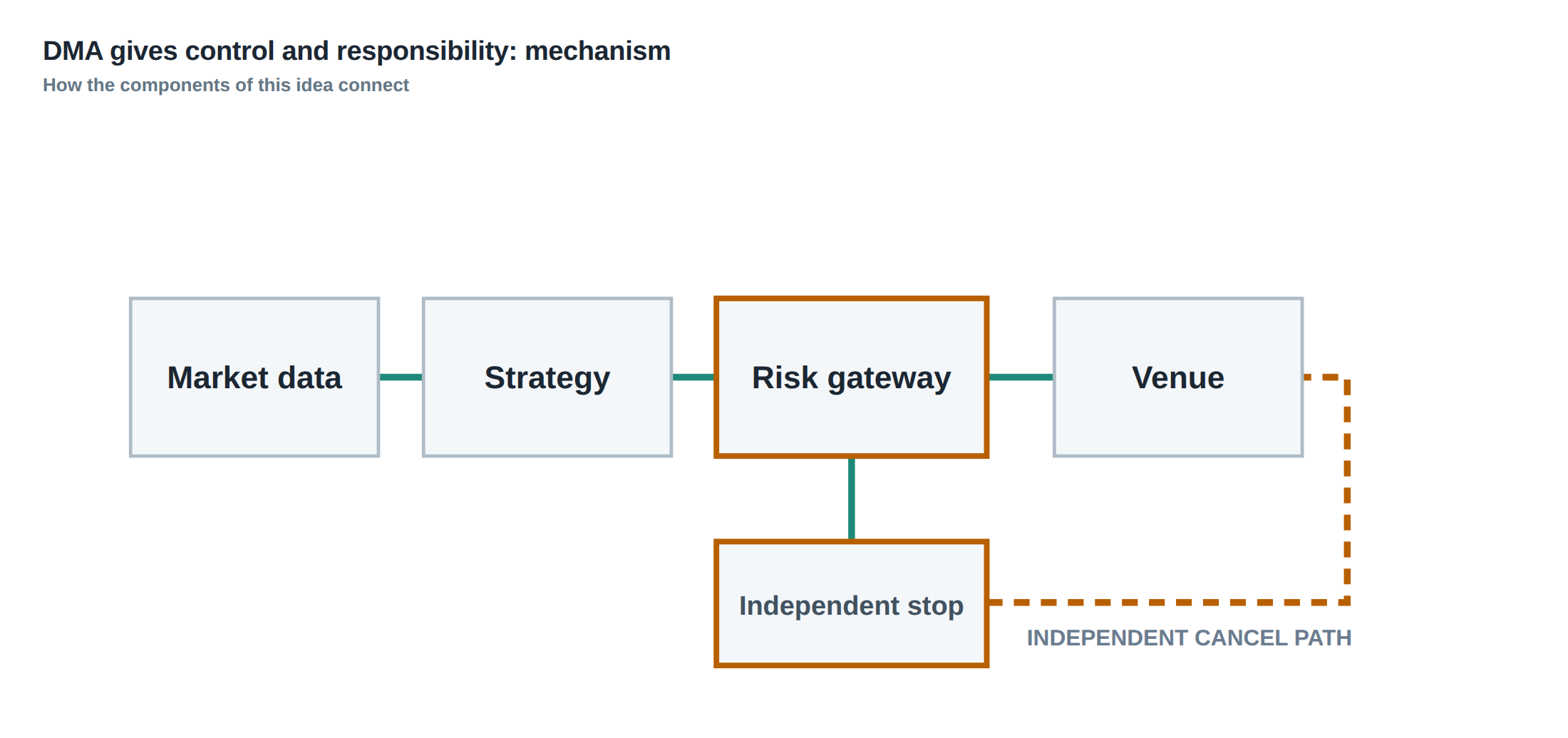
When a strategy decides to place an order, it first hands the request to a pre‑trade validation engine. This engine checks that the symbol exists in the firm’s master data, that the side (buy or sell) aligns with the strategy’s intent, that the price respects the market‑wide limits (price bands, circuit‑breaker thresholds) and that the quantity does not exceed the per‑order notional ceiling set by the risk team. It also confirms that the account identifier matches a live, funded allocation and that the order does not breach any of the firm‑wide constraints such as maximum daily turnover or per‑instrument frequency caps.
If the order passes these checks, it is stamped with a unique internal identifier and forwarded to the order‑router. The router selects the optimal venue based on latency, liquidity and fee considerations, then transmits the order over a low‑latency FIX or proprietary protocol to the exchange’s gateway. The exchange immediately sends an acknowledgement (ACK) indicating receipt, followed later by execution reports (fills, partial fills, cancellations, or rejects). The firm’s post‑trade reconciliation engine must match every inbound message to the original internal identifier, flag any mismatches, and update the position book in real time.
Parallel to this flow, a watchdog process monitors the aggregate order flow for signs of abnormal activity: a sudden spike in order frequency, a cluster of orders that exceed the fat‑finger threshold (for example a price deviation of more than 5 % from the mid‑quote), or duplicate orders that could indicate a software bug. Upon detection, the watchdog can invoke a pre‑configured kill‑path – a dedicated, low‑latency command that bypasses the strategy’s own error handling and instructs the router to cancel all outstanding orders for the affected strategy or account. This path must be exercised in a controlled test environment at least quarterly to prove that it works under load.
A worked example with real numbers
Consider a statistical arbitrage strategy that monitors the EUR/USD and GBP/USD pairs, posting limit orders every 250 ms to capture the spread. On a particular millisecond, the algorithm decides to sell 200,000 EUR at 1.0805 and buy 200,000 GBP at 1.3802, each order valued at roughly €216 000 and £276 000 respectively. The pre‑trade engine first validates the symbols “EURUSD” and “GBPUSD”, confirms the side is “sell” for EUR and “buy” for GBP, checks that the prices lie within the exchange’s quoted band (±0.02 % of the mid‑price), and ensures that the notional per‑order limit of €250 000 is not breached.
Next, the engine verifies that the account identifier “ACC‑00123” is active, that the daily notional exposure for EUR has not exceeded the €10 million ceiling, and that the frequency limit of 10 orders per second per instrument is respected – the strategy has already placed eight orders on EURUSD in the last second, so the new order is allowed. The order is then tagged with internal ID “ORD‑56789” and handed to the router, which selects the primary liquidity venue for EURUSD (Venue A) and a secondary venue for GBPUSD (Venue B) based on latency measurements. The router transmits the two orders, receives ACKs within 2 ms, and after 12 ms receives execution reports confirming that the EUR sell was fully filled while the GBP buy was partially filled (80 %).
At this point the reconciliation engine matches the ACKs and fills to “ORD‑56789”, updates the position book, and flags the remaining 40 % of the GBP order as open. A separate risk monitor sees that the GBP exposure now stands at £110 000, still below the daily limit, and lets the order sit. Two seconds later, a sudden market move pushes the GBP price 6 % away from the original limit price, triggering the fat‑finger watchdog. The watchdog automatically fires the kill‑path, sending a high‑priority cancel for the outstanding GBP order. The exchange acknowledges the cancellation, and the position book is reconciled to reflect the final state: EUR position closed, GBP position partially filled, no stray open orders.
This example demonstrates that while the broker screen has been removed, the pre‑trade validation, real‑time monitoring and independent kill‑path remain essential to prevent unintended exposure.
Where it breaks in live markets
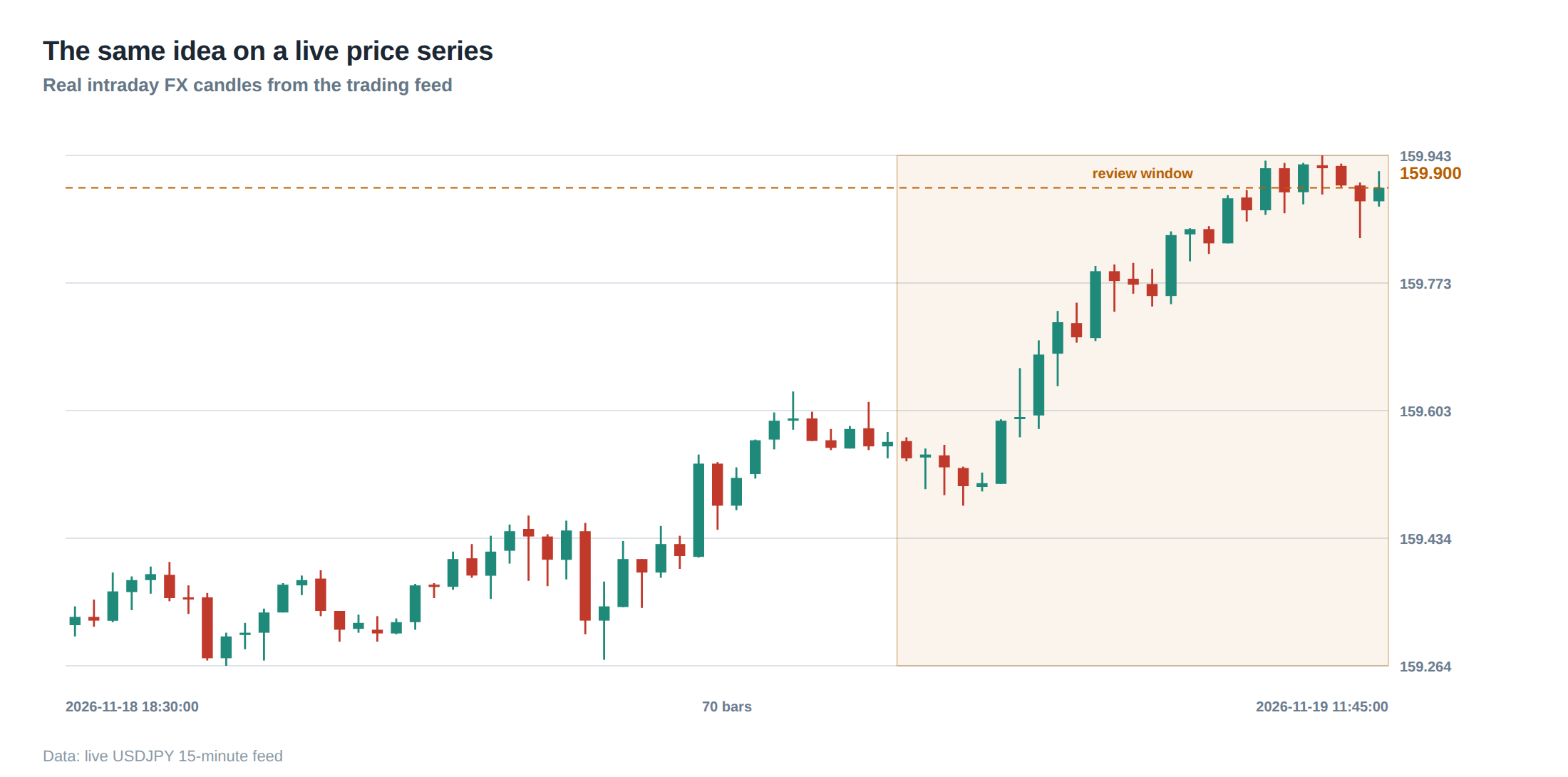
Even with a well‑designed stack, failures can arise from latency spikes, data‑feed mismatches, or software bugs that bypass validation. In a live environment, market data may arrive out of order, causing the price‑band check to use a stale mid‑quote and inadvertently allow a price that is now outside the exchange’s limits. If the validation engine does not re‑fetch the latest quote before sending the order, the exchange will reject the order, but the strategy may interpret the reject as a fill and double‑count exposure.
Another common failure mode is the loss of the kill‑path under high load. If the watchdog process is throttled by CPU contention, a rapid succession of fat‑finger events may be missed, leaving a cascade of erroneous orders in the market. Similarly, duplicate‑order detection can be undermined by clock drift between the strategy’s timestamp and the router’s timestamp, causing two orders that are actually the same to be treated as distinct and both executed.
Finally, reconciliation mismatches often surface when the exchange’s execution reports are delayed or lost due to network congestion. An unmatched fill can linger in the firm’s position book, inflating risk metrics and potentially triggering unnecessary risk limits. The root cause is usually a missing ACK or a corrupted message identifier, which underscores the need for end‑to‑end message integrity checks and periodic health‑checks of the communication channel.
The operating path, stage by stage
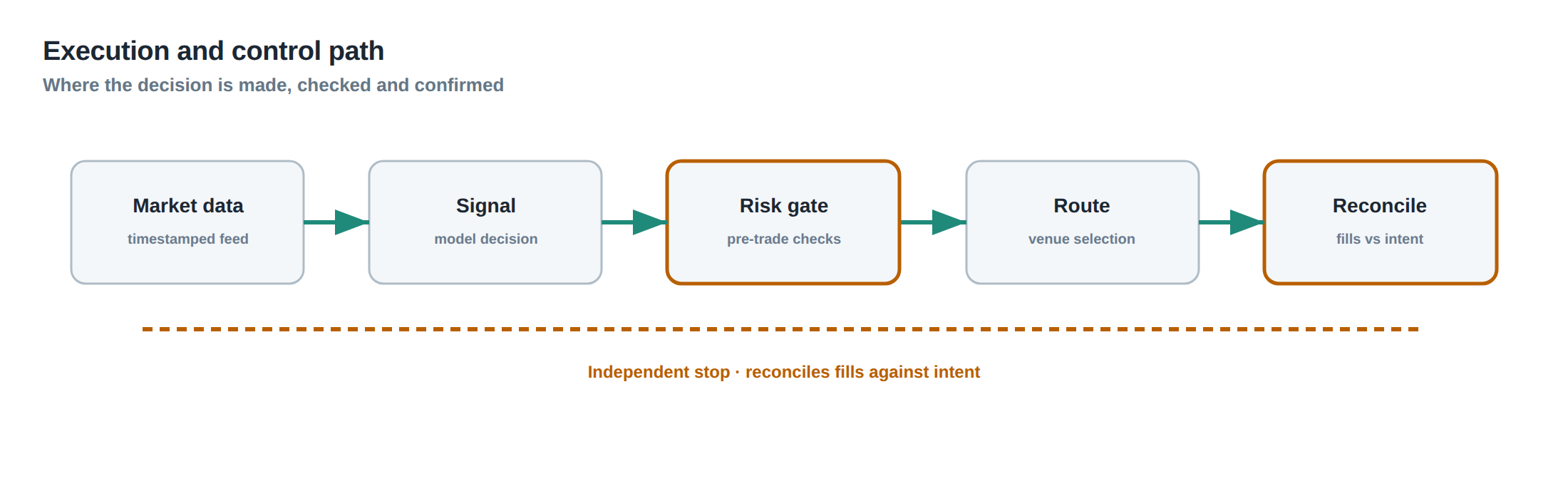
The order journey begins with the strategy’s intent, which is expressed as a data structure containing symbol, side, price, quantity and a reference to the funding account. Stage one is the pre‑trade validator, which interrogates the master data store, applies static limits (price bands, notional caps) and dynamic limits (frequency, exposure). Stage two is the routing decision engine, which consults latency matrices, fee schedules and venue‑specific rules to select the optimal path. Stage three is the gateway transmitter, which encodes the order in the exchange’s protocol, attaches the internal identifier and sends it over a dedicated low‑latency link.
Stage four is the exchange’s acknowledgement, which the firm’s acknowledgement handler receives, timestamps and stores against the internal identifier. Stage five is the execution report handler, which processes fills, partial fills, cancellations and rejects, updating the real‑time position ledger. Stage six is the post‑trade reconciler, which matches every inbound message to the outbound request log, flags any gaps, and triggers alerts for manual review. Throughout all stages, the watchdog monitors aggregate metrics and can invoke the kill‑path at any point, sending a high‑priority cancel that bypasses the normal strategy‑level error handling.
Each stage must be independently testable: unit tests for validation logic, integration tests for routing decisions, end‑to‑end tests that simulate exchange ACKs and fills, and stress tests that flood the watchdog with synthetic fat‑finger events to confirm the kill‑path remains responsive.
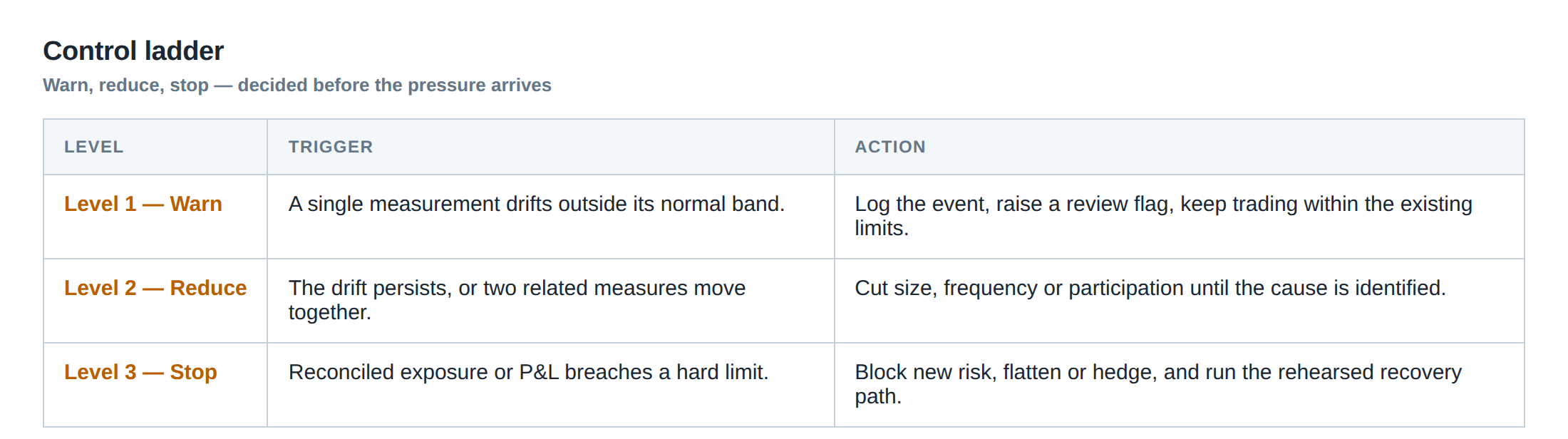
Controls that act before the damage
Pre‑trade controls are the first line of defence. Symbol validation checks that the ticker exists in the firm’s reference data and that the market is currently open. Side validation ensures that a sell order is not placed on a short‑restricted instrument. Price validation compares the proposed price to the prevailing mid‑quote, the exchange’s dynamic price band and any internal price‑offset limits the risk team has set. Quantity validation enforces per‑order size caps and verifies that the total notional does not breach the daily exposure ceiling for the account.
Fat‑finger controls monitor the distance between the order price and the mid‑quote; a deviation beyond a configurable percentage (for example 5 %) triggers an automatic reject before the order leaves the firm’s network. Notional limits guard against accidental large orders that could move the market. Frequency limits cap the number of orders per second per instrument, protecting both the exchange from flooding and the firm from algorithmic runaway. Duplicate‑order detection hashes the key fields of each order and rejects any new order that matches a recent hash within a short time window, preventing accidental double submissions.
All these controls produce a deterministic outcome: either the order is allowed to proceed, or it is rejected with a clear error code that can be logged and fed back to the strategy for corrective action. The controls are implemented as pure functions wherever possible, facilitating formal verification and regression testing.
How to measure whether it is working
Effectiveness is measured by a combination of quantitative and qualitative metrics. The primary quantitative indicator is the “pre‑trade reject rate”: the proportion of orders that are blocked by internal controls before they reach the exchange. A low but non‑zero rate indicates that the controls are catching genuine errors without throttling legitimate activity. The “post‑trade mismatch rate” tracks how often the reconciliation engine finds an ACK, fill or cancel that cannot be matched to an outbound order; this should trend toward zero.
Latency statistics are also crucial. The time from strategy intent to ACK receipt must remain within the firm’s latency budget (for example 10 ms for high‑frequency strategies). Any increase may signal congestion in the validation engine or routing layer. The watchdog’s “kill‑path latency” – the interval between detection of a fat‑finger event and receipt of a cancel ACK – must be measured continuously; a target of under 5 ms is typical for ultra‑low‑latency desks.
Qualitative assessment comes from periodic “kill‑path drills” where the team deliberately injects a synthetic error (such as a price far outside the band) and observes whether the system aborts the offending orders within the prescribed window. The results are logged, reviewed, and used to fine‑tune thresholds. Together these metrics provide a comprehensive picture of whether the DMA stack is delivering both speed and safety.
The portfolio view
From a portfolio perspective, DMA’s value lies in the ability to place orders at the exact moment a statistical edge materialises, without the latency introduced by a broker’s order‑management system. However, the operational risk introduced by removing that broker overlay can erode the edge if not managed rigorously. The pre‑trade controls act as a filter that preserves the statistical properties of the strategy by ensuring that only correctly sized, correctly priced orders enter the market.
The kill‑path serves as an insurance policy, capping the worst‑case loss from a single runaway order. When the portfolio’s risk model aggregates exposure across instruments, the real‑time reconciliation engine provides the accurate, up‑to‑the‑millisecond position data required for stress testing and scenario analysis. In essence, the DMA stack becomes an extension of the portfolio’s risk management framework: every order is a data point that feeds back into the model, and every control is a safeguard that protects the model’s assumptions.
When the controls are well‑tuned, the firm can reap the latency advantage of DMA while keeping the operational risk profile comparable to a broker‑mediated approach. The trade‑off is not between speed and safety, but between the speed of execution and the speed of detection and mitigation of errors. Maintaining that balance is the central challenge for any prop‑trading desk that wishes to operate at the cutting edge of electronic markets.
What aspect of your own DMA workflow would benefit most from tighter pre‑trade validation?
About the research behind this lesson
The seminar frames electronic markets as price-time-priority queues. It separates queue value into spread capture versus adverse-selection cost and the option value of retaining a place in line.
Applied to this lesson: An order lifetime therefore cannot be based on elapsed time alone: the system must reassess whether its queue position, expected spread and adverse-selection risk still justify keeping the order alive.
Two live systems, one desk
PULSE-X — power-packed HFT: high-frequency momentum on XAUUSD and EURUSD. System details · Live account
NIC-X — ultra-low drawdown: displaced-print arbitrage for large capital. System details · Live account
Start now: leave your email and request a free trial — we will send the pricing, the connection route and the trial terms. Pricing
Join the market discussion: Telegram @squawklive
Source: High-Frequency Trading and Modern Market Microstructure
Educational content only. Trading leveraged products involves risk.
Chat with XTRSK
Chat ready
Start a chat and the XTRSK team will be notified immediately.