
XCore HFT / Trading Lab
XCore HFT Trading Lab: A hedge replaces one risk with another
Quantitative execution, market-microstructure, and risk-control research from XTRSK.
The hardest trading question is not whether an idea has edge. It is whether that edge remains executable at real size. A hedge replaces one risk with another.
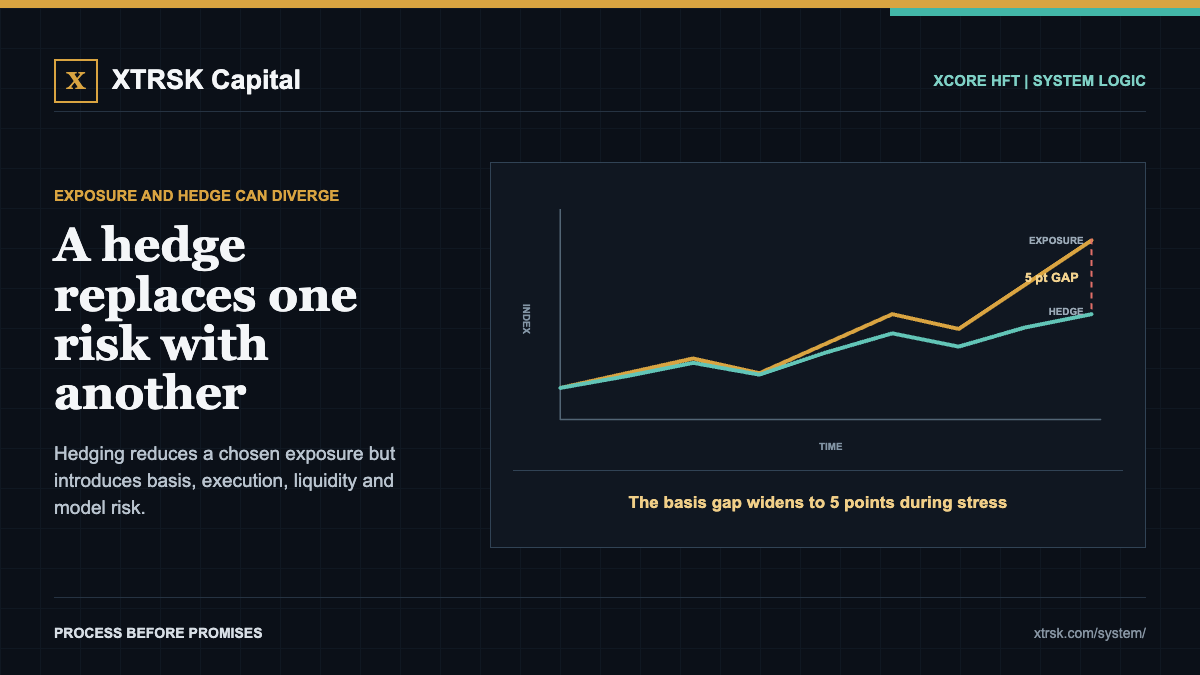
Good controls make hidden assumptions visible before capital discovers them. Hedging reduces a chosen exposure but introduces basis, execution, liquidity and model risk. Define the factor being hedged. Estimate hedge ratio and its uncertainty. This is where conviction meets exposure: position size and liquidity decide whether the result survives live conditions.
Put a boundary around the claim. A correlated proxy can reduce average directional risk yet fail during stress when the relationship breaks and both spreads widen. The example is not a forecast or a promise; it shows which variable must be measured before the apparent opportunity can be treated as usable.
A compact operating checklist is: 1) track divergence between instrument and hedge; 2) include financing and roll costs; 3) plan for an incomplete or rejected hedge. Add hard exposure ceilings, observable rejection reasons and an event trail that lets operations reconstruct the decision without guessing. Control sequence: 1 signal, 1 order path, 1 reconciled risk state.
The attractive explanation is usually one-dimensional. The real result depends on several linked constraints. Review the median, the stressed tail and the failure path separately. A result that survives only in quiet sessions, tiny size or perfect data is a research result, not yet a production capability.
A disciplined process reconciles trade-level intent with portfolio-level capacity after every material fill. The objective is not to remove uncertainty. It is to size uncertainty, detect when assumptions break and preserve the ability to stop without creating a second problem.
Which tail metric has taught you more than the corresponding average?
#Hedging #PortfolioRisk
The research behind this lesson
This paper explains Andrew Lo's lectures build risk analysis from return distributions and statistical measures, rather than treating one realised result as a complete description of risk.
Applied to this XCore lesson: For a fast strategy, median latency or average fill quality is not enough. The review has to include tail delays, stale-order frequency and the loss distribution when cancellation or routing behaves abnormally.
Explore XCore HFT: System details
PULSE XCORE HFT live account: Verify the live account on FX Blue
Live chat and updates: Telegram @xtrskhft
Source: Risk and Return
Educational content only. Trading leveraged products involves risk.
Chat with XTRSK
Chat ready
Start a chat and the XTRSK team will be notified immediately.