XCore HFT / Trading Lab
A kill switch is a system, not a button
Quantitative execution, market-microstructure, and risk-control research from XTRSK.
What this problem really is
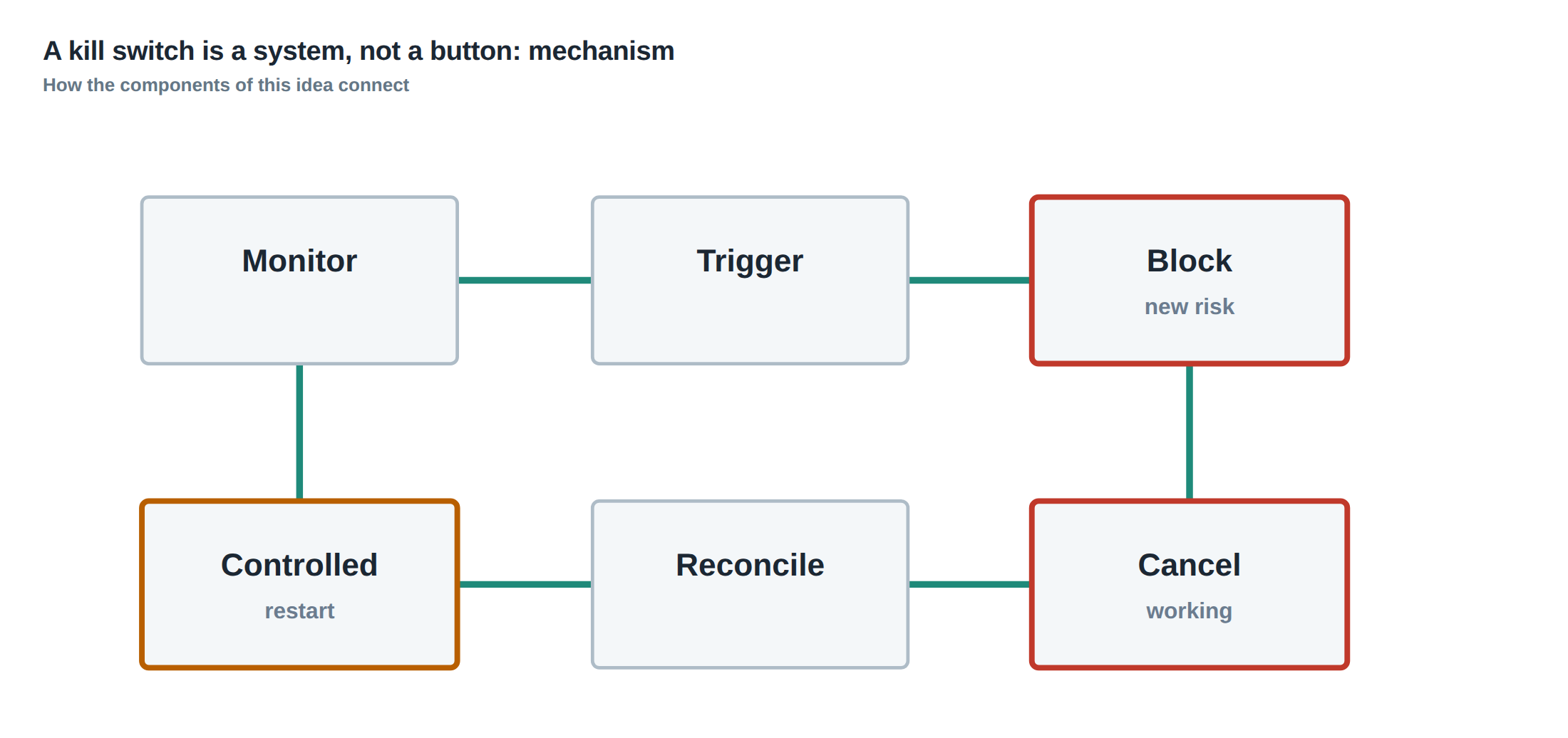
In a high‑frequency prop desk the notion of a “kill switch” is often reduced to a single button that, when pressed, is expected to halt all activity. In practice the button is only the visible tip of a far more complex control system. The underlying problem is not the act of stopping a process, but the need to guarantee that every source of risk – new order generation, pending execution, and open exposure – is neutralised in a deterministic way. A naïve stop may kill the trading engine, yet leave orders sitting in the order books of multiple venues, or leave a hedge leg that was supposed to offset a directional position still open. Those orphaned orders can be filled after the switch is pressed, creating unintended market impact and, more seriously, exposing the firm to unmanaged loss. The kill switch must therefore be conceived as a coordinated set of controls that act on three distinct layers: the individual strategy, the trading account that aggregates the strategies, and the firm‑wide risk envelope. Only by addressing each layer can a desk ensure that “stop” truly means “no further risk, no residual exposure”.
How the mechanism works, step by step
The first step is to classify the stop request. A strategy‑level stop is triggered when a model breaches its own risk limits – for example, a realised volatility spike that pushes the expected Sharpe below a pre‑set threshold. The request is then escalated to the account level, where the aggregate exposure of all strategies tied to a single capital allocation is examined. If the combined delta, gamma or VaR exceeds the account’s hard limit, an account‑wide stop is issued. Finally, a firm‑wide stop is reserved for systemic events such as a market‑wide circuit breaker, a connectivity outage, or a breach of regulatory capital requirements.
Once the appropriate level is identified, the system must decide whether the action should cancel outstanding orders, flatten existing positions, or perform both. Cancellation removes the order from the exchange queue without affecting the position that generated the order. Flattening, by contrast, sends market‑or‑near‑market orders to unwind the position, which may generate new execution risk. In many cases the safest approach is a two‑stage operation: first cancel all working orders, then, after a short grace period, flatten any residual net exposure.
The control logic is deliberately placed outside the primary trading application. By hosting the kill‑switch service in a separate, highly available process – often on a dedicated management server – the desk guarantees that a failure of the main engine does not also disable the emergency stop. Permissions are tightly scoped: only senior risk officers and automated risk monitors may invoke a firm‑wide stop, while strategy developers can trigger a strategy‑level stop. Each invocation is logged, acknowledged, and requires a secondary confirmation before execution, preventing accidental activation.
Because markets are dynamic, the stop mechanism must continuously reassess the value of an order’s queue position. In a price‑time‑priority market, an order’s worth is not simply a function of how long it has been resting. It is the sum of the expected spread capture, the adverse‑selection cost of being front‑run, and the option value of retaining a place in line. The system therefore recomputes, at the moment of a stop request, whether the remaining queue position justifies keeping the order alive. If the expected spread has eroded or the adverse‑selection risk has risen above a threshold, the order is cancelled even if it has only been live for a few milliseconds.
A worked example with real numbers
Consider a statistical arbitrage strategy that maintains a delta‑neutral book by continuously posting a buy limit order for 10,000 shares of XYZ at £20.05 and a sell limit order for 10,000 shares at £20.07 on two separate venues. The strategy also holds a hedge leg – a short futures contract for 100 contracts – intended to offset the net delta of the equities. At 09:30:12.345 the model detects a sudden widening of the spread: the best bid on Venue A falls to £20.00 while the best offer on Venue B rises to £20.12. The expected spread capture for the limit orders drops from an estimated £0.03 per share to £0.01, and the adverse‑selection cost, measured by the probability of being picked off, rises from 0.2 % to 1.5 %.
The risk engine flags a strategy‑level stop. The kill‑switch service receives the request, evaluates the action type, and decides to cancel first. It sends cancellation messages to both venues. Venue A acknowledges the cancellation of the buy order after 1.2 ms; Venue B confirms the sell order cancellation after 1.8 ms. Meanwhile the hedge futures contract remains open, still short 100 contracts, with a mark‑to‑market loss of £5,000 because the futures price has moved from 1,250 to 1,255.
Because the hedge leg is unmatched, the system proceeds to the flattening phase. It generates a market order to buy back the 100 futures contracts. The order is routed to the primary futures exchange, filled at 1,255.20, incurring an additional £200 of transaction cost. The total residual exposure after the stop is now zero: no working equity orders remain, and the futures position is flat. The entire stop sequence, from detection to full flatten, took 12 ms, well within the desk’s 50 ms emergency‑response budget.
If the kill‑switch had only stopped the trading process without cancelling the limit orders, the buy order could have been executed at £20.00 later that second, creating a long exposure that the hedge could not offset because the futures market was already closed for a brief circuit‑breaker. The example illustrates why a stop must address both new risk generation and lingering open orders.
Where it breaks in live markets
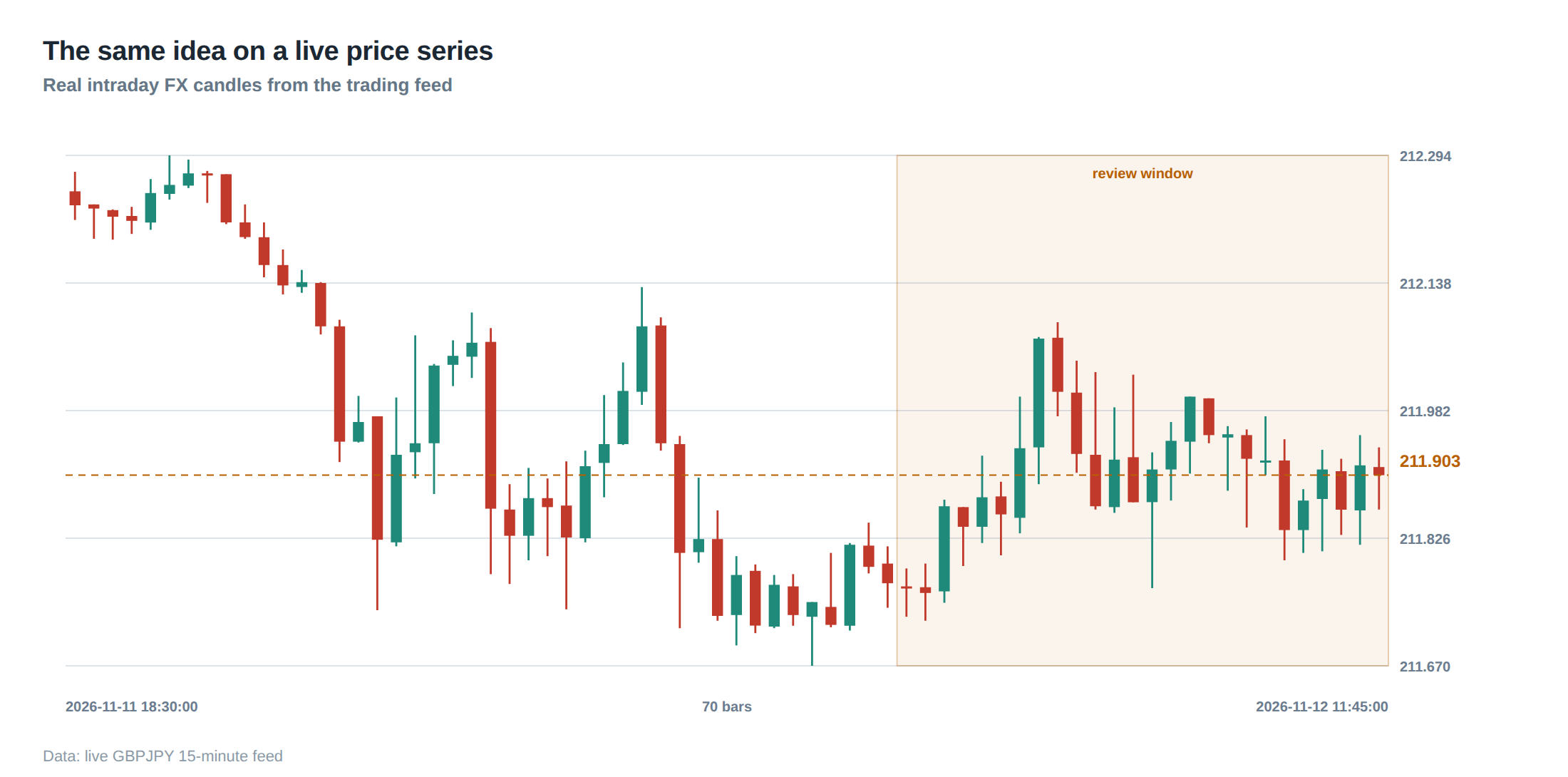
Even a well‑designed kill‑switch can falter when confronted with real‑world contingencies. One common failure mode is latency asymmetry: the cancellation message reaches one venue within a few milliseconds while another venue experiences a network congestion spike, delaying the acknowledgement by tens of milliseconds. During that window the order may be matched, especially if the market is volatile and the order sits near the top of the book.
Another break occurs when the hedge leg is executed on a venue that does not share the same connectivity path as the primary order gateway. If the hedge order is routed through a separate FIX connection that suffers a temporary drop, the flattening step may stall, leaving a net directional exposure that can be amplified by rapid price moves.
A third class of breakdown is procedural. If the kill‑switch service is co‑located with the trading engine and both share a common dependency – for example, a shared Redis cache – a failure in that dependency can render the emergency control inoperable exactly when it is needed. Similarly, insufficient permission testing can allow a junior operator to invoke a firm‑wide stop inadvertently, causing unnecessary market disruption and triggering compliance investigations.
Finally, human factors matter. In the heat of an incident, operators may bypass the secondary confirmation step, or they may misinterpret the status messages, believing that a cancel has been confirmed when it has not. Without clear, unambiguous acknowledgements, the desk may continue to assume that risk has been eliminated while it has not.
The operating path, stage by stage
The emergency‑control workflow can be visualised as a ladder of stages, each with a distinct responsibility and a built‑in timeout. Stage 1 is detection: a risk monitor, either rule‑based or model‑driven, flags a breach and raises a stop flag. Stage 2 is escalation: the flag is examined against the hierarchy of strategy, account, and firm limits, and the appropriate stop level is selected. Stage 3 is authorisation: the request is presented to the designated approvers, who must provide a signed acknowledgement within a pre‑defined window (typically 5 ms for automated approvals, 200 ms for manual).
Stage 4 is order cancellation: the kill‑switch service publishes cancel messages to every venue where the strategy holds working orders, and it subscribes to the corresponding acknowledgements. If any acknowledgement is missing after the timeout, the service escalates to Stage 5, forceful cancellation, which may involve sending a “replace with zero quantity” message or directly invoking the venue’s administrative cancel function.
Stage 6 is position flattening: once all orders are confirmed cancelled, the service calculates the net exposure across all instruments and generates market or aggressive limit orders to unwind the remaining positions. Stage 7 is verification: a post‑mortem snapshot of the order book, the position book, and the risk metrics is taken and compared against the expected zero‑exposure state. Any discrepancy triggers an alert to the recovery team.
Stage 8 is recovery: the desk decides whether to restart the strategy, restart the whole account, or keep the system in a dormant state pending a full review. The recovery decision is logged, and the kill‑switch is reset to a ready state only after the review is complete.
Controls that act before the damage
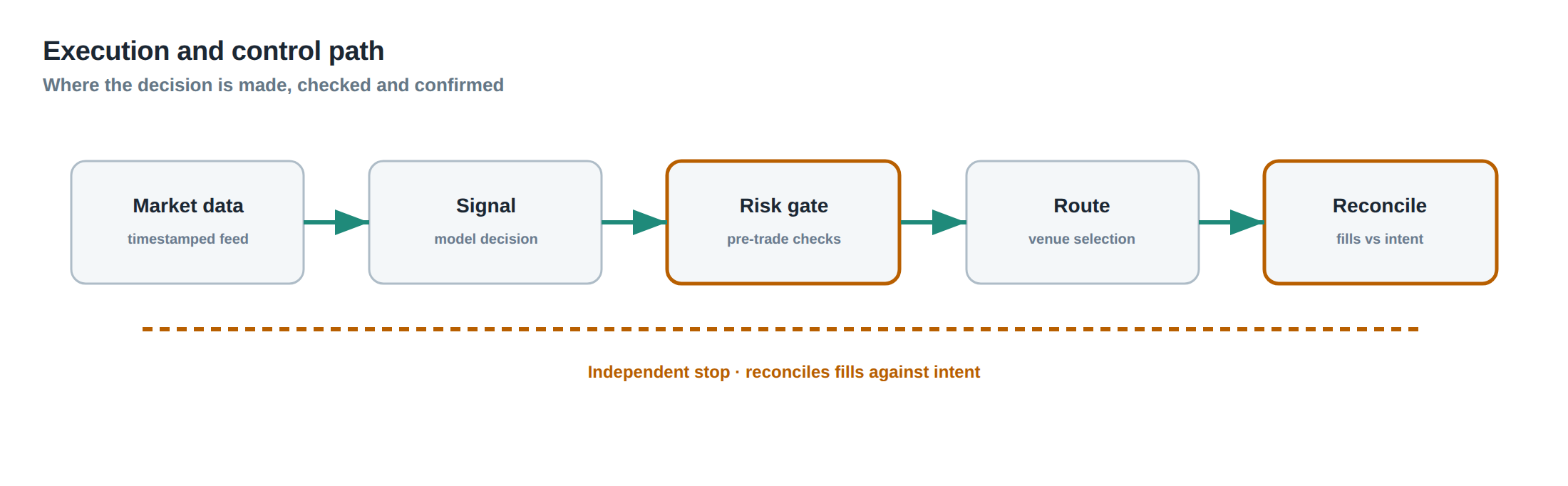
Preventative controls sit upstream of the kill‑switch and reduce the probability that an emergency stop will ever be required. The first line is pre‑trade validation: every order is checked against real‑time limits on size, price, and venue‑specific constraints. The second line is dynamic queue valuation: the system continuously estimates the expected spread capture, the adverse‑selection cost, and the option value of staying in line, and it withdraws orders whose net value falls below a threshold.
A third control is redundant connectivity: critical order and hedge routes are duplicated across independent network paths and hardware, so that a single point of failure does not isolate a leg of the trade. Fourth, role‑based access ensures that only authorised risk personnel can modify stop thresholds or invoke a stop, and that any change is recorded with a digital signature. Fifth, heartbeat monitoring watches the health of every component – market data feeds, order gateways, risk engines – and raises a pre‑emptive alert if latency or packet loss exceeds safe limits.
All these controls are exercised in regular drills. A drill might simulate a sudden market crash, a loss of connectivity to a primary venue, or a software exception in the strategy engine. Participants run through the full kill‑switch ladder, from detection to recovery, measuring the time taken at each stage and verifying that all acknowledgements are correctly logged. The drills also test the acknowledgement path: after a stop is issued, the operator must confirm receipt, and the system must confirm that the confirmation has been stored in an immutable audit log.
How to measure whether it is working
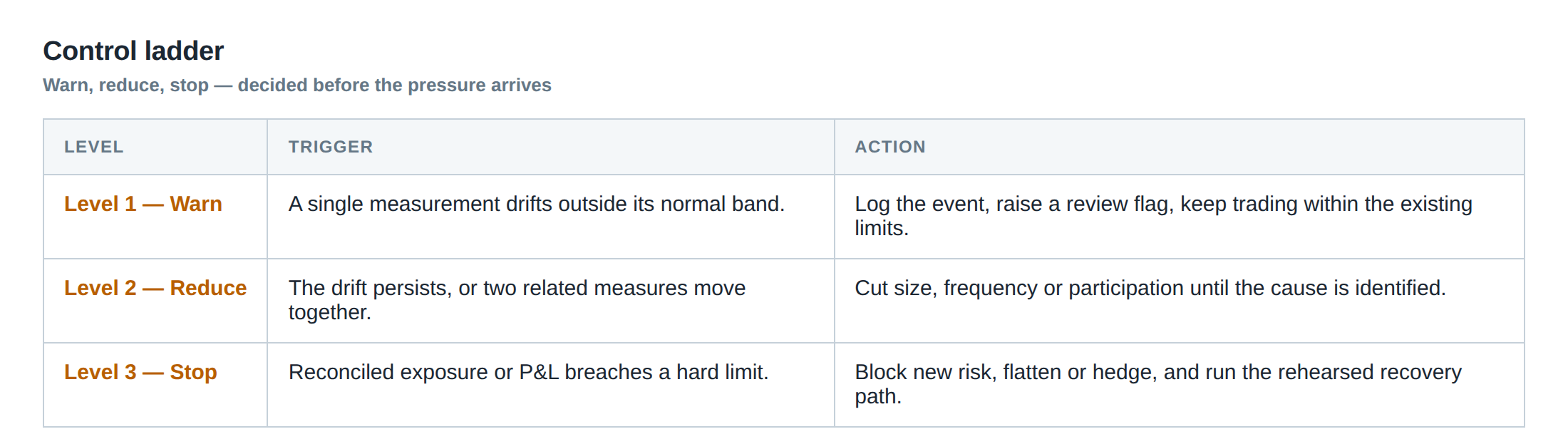
Quantitative assessment of the kill‑switch effectiveness hinges on two complementary metrics: latency and completeness. Latency is measured from the moment a risk breach is detected to the instant the last working order is confirmed cancelled, and then to the moment the final flattening order is filled. The desk should maintain a target – for example, 30 ms total – and track the distribution of latencies over a rolling window of 10 000 stops or simulated drills.
Completeness is a binary indicator: did any order remain active after the stop sequence? Did any hedge leg stay open? The measurement is performed by reconciling the post‑stop order book with the pre‑stop snapshot. Any residual order or position is flagged as an incomplete stop, and the root cause is logged. Over time the proportion of incomplete stops should trend to zero.
A third, more subtle, metric is risk‑exposure drift. Even when all orders are cancelled, the market can move during the latency window, creating a temporary exposure that the flattening orders must absorb. By comparing the realised P&L during the stop window against a model of the expected slippage, the desk can gauge whether the flattening step is sufficiently aggressive or whether the stop needs a tighter latency budget.
Regular reporting of these metrics to senior management, combined with visual dashboards that highlight any outliers, ensures that the kill‑switch remains a living control rather than a static checkbox.
The portfolio view
From the portfolio perspective, the kill‑switch is not an isolated tool but part of the broader risk architecture that governs capital allocation, leverage, and liquidity. When a strategy stop fires, the portfolio manager must immediately see the impact on the aggregate risk metrics: the change in net delta, the shift in VaR, and the alteration of the portfolio’s cash balance. Because the stop may flatten positions at market prices, the realised cost of the stop – both in terms of transaction fees and adverse price movement – should be fed back into the strategy’s performance attribution.
If an account‑wide stop is triggered, the portfolio view must also consider the cross‑strategy correlations. For instance, a sudden flatten of a long‑biased equity strategy may increase the net short exposure of a market‑neutral statistical arbitrage strategy, pushing the overall portfolio into a net short stance. The risk engine therefore recomputes the portfolio‑level Greeks after each stop stage, and if the resulting profile breaches a higher‑level limit, a firm‑wide stop may be automatically escalated.
Finally, the post‑incident analysis should be recorded at the portfolio level, documenting not only the technical steps taken but also the business decision‑making process: why the stop was deemed necessary, whether the chosen action (cancel, flatten, or both) was optimal, and what adjustments to limits or thresholds are required. This holistic view ensures that the kill‑switch continues to protect the desk’s capital while providing actionable insight for future strategy development.
Do you have a clear, testable ladder of emergency controls that can guarantee no residual exposure after a stop, and how will you validate it under live market stress?
About the research behind this lesson
The seminar frames electronic markets as price-time-priority queues. It separates queue value into spread capture versus adverse-selection cost and the option value of retaining a place in line.
Applied to this lesson: An order lifetime therefore cannot be based on elapsed time alone: the system must reassess whether its queue position, expected spread and adverse-selection risk still justify keeping the order alive.
Two live systems, one desk
PULSE-X — power-packed HFT: high-frequency momentum on XAUUSD and EURUSD. System details · Live account
NIC-X — ultra-low drawdown: displaced-print arbitrage for large capital. System details · Live account
Start now: leave your email and request a free trial — we will send the pricing, the connection route and the trial terms. Pricing
Join the market discussion: Telegram @squawklive
Source: High-Frequency Trading and Modern Market Microstructure
Educational content only. Trading leveraged products involves risk.
Chat with XTRSK
Chat ready
Start a chat and the XTRSK team will be notified immediately.