XCore HFT / Trading Lab
A kill switch is a system, not a button
Quantitative execution, market-microstructure, and risk-control research from XTRSK.
What this problem really is
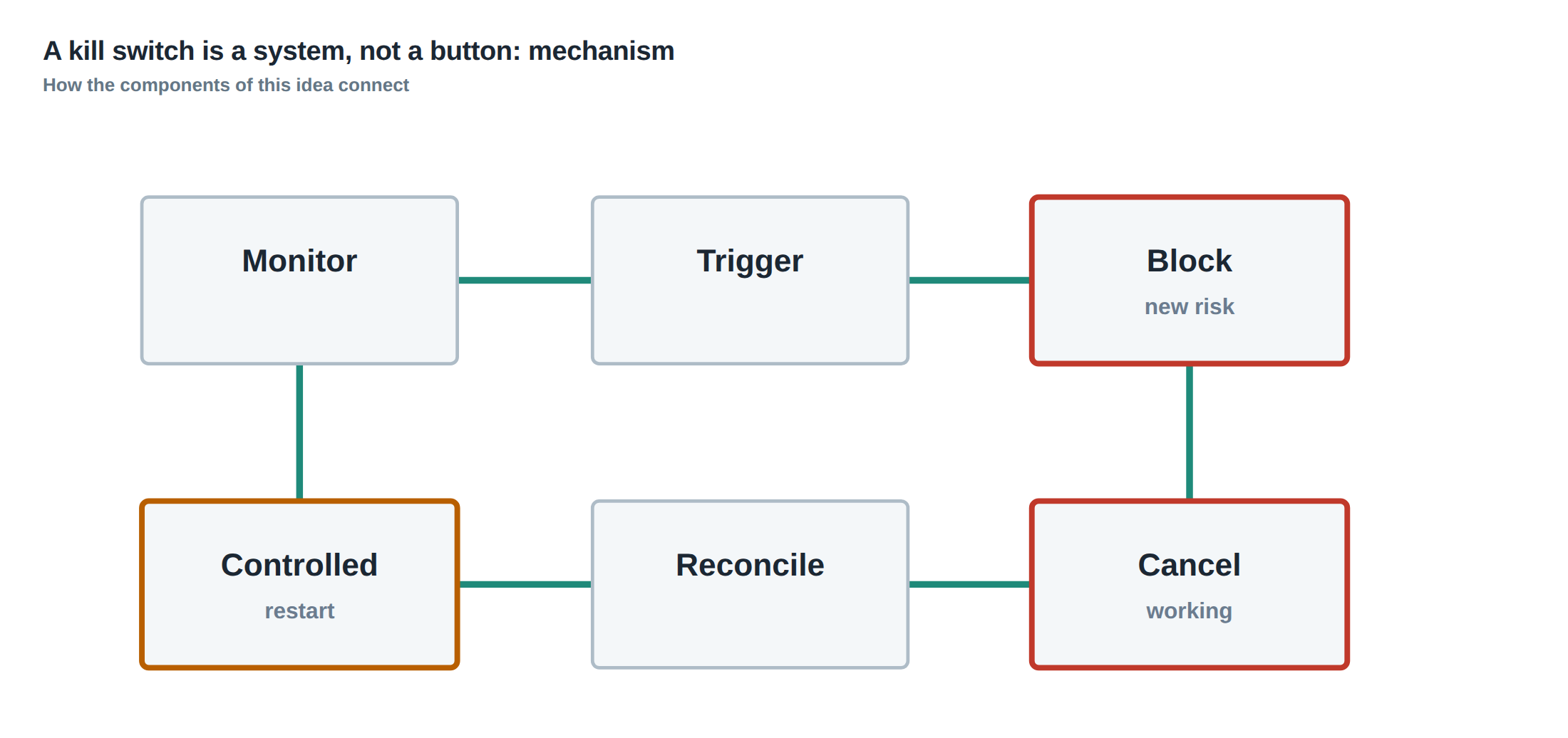
A “kill switch” is often imagined as a single button that, when pressed, shuts everything down. In reality it is a layered control system that must intervene at three distinct levels: the individual strategy, the trading account and the firm‑wide infrastructure. Each level has its own risk appetite, its own latency budget and its own set of downstream actions. The purpose of the switch is not merely to stop a piece of software; it is to halt the creation of new exposure, to unwind or cancel any outstanding orders, and to surface the residual position that will remain after the automated response. If any of those three tasks is omitted, the “kill” is only partial and the market can still move against the desk while the system is trying to recover.
The difficulty lies in the fact that electronic markets operate as price‑time‑priority queues. An order that is already in the queue may continue to accrue profit or loss even after the originating process has been halted. Likewise, a hedge leg that was meant to offset a primary position may sit unmatched for seconds, exposing the firm to adverse‑selection risk. The emergency control therefore has to be aware of the state of each order, the state of each hedge, and the state of each risk metric that the strategy was tracking. Only then can it decide whether to cancel, flatten or both.
A well‑designed kill switch is therefore a system, not a button. It must be reachable even when the primary trading application has crashed, and it must be able to execute its logic without relying on the same resources that have just failed. This separation of control path and execution path is the cornerstone of any robust emergency response.
How the mechanism works, step by step
The first step is detection. A watchdog process monitors heartbeat signals from each strategy, each account gateway and the central order router. If a heartbeat is missed beyond a configurable threshold, the watchdog flags the component as “failed”. The flag is propagated through a publish‑subscribe bus that is isolated from the trading data feed, ensuring that a failure in the market data pipeline does not prevent the alarm from being raised.
Once a failure is flagged, the control engine evaluates the scope of the stop. It consults a policy table that maps the failed component to the appropriate stop level – strategy, account or firm. The policy also defines the action type: “cancel only”, “flatten only” or “cancel + flatten”. The engine then issues commands to the order management system (OMS) via a low‑latency API that bypasses the normal order‑creation path. These commands are signed with a separate set of credentials that are stored in a hardware security module, guaranteeing that the kill switch can be invoked even if the primary credential store is compromised.
The OMS receives the command and immediately marks all active orders belonging to the affected scope as “frozen”. Frozen orders are no longer eligible for amendment or cancellation by any client, but they can still be cancelled by the emergency engine. The engine then sends a batch cancel request to every venue where the orders reside. Simultaneously, if the policy includes flattening, the engine calculates the net position across all venues and generates market‑able orders that close the exposure in the fastest possible way, respecting venue‑specific throttling limits.
Finally, the control engine publishes a summary of the actions taken – number of orders cancelled, volume flattened, residual exposure – to a monitoring dashboard. An acknowledgement is required from a senior risk officer before the system returns to a normal state. This acknowledgement step prevents accidental activation and provides a clear audit trail.
A worked example with real numbers
Consider a market‑making strategy that holds a 5 000‑share long position in XYZ, hedged by a 5 000‑share short futures contract. At 09:45 am the process that generates the hedge leg crashes, leaving the futures leg unmatched. The watchdog detects the missed heartbeat after 200 ms and raises a strategy‑level stop. The policy for this strategy is “cancel + flatten”.
The OMS receives a cancel command for 120 outstanding limit orders that were posted at the best bid, each for 100 shares at £12.35. The total notional of those orders is £148 200. Within 150 ms the venues acknowledge the cancellations, and the orders disappear from the order books. Because the policy also requires flattening, the engine calculates the net exposure: the long equity position of 5 000 shares remains, while the short futures leg is still pending. To neutralise the equity exposure the engine submits a market sell order for 5 000 shares at the prevailing ask of £12.38, generating a cash inflow of £61 900. The futures leg, still open, is subsequently cancelled by a separate command, removing the unmatched hedge.
The post‑kill snapshot shows: 0 active orders, 0 open hedge legs, and a residual cash balance of £61 900. The dashboard records 120 cancellations, 5 000 shares flattened, and a total latency of 350 ms from detection to completion. The senior risk officer signs off, and the system returns to idle, ready for a manual restart of the strategy.
Where it breaks in live markets
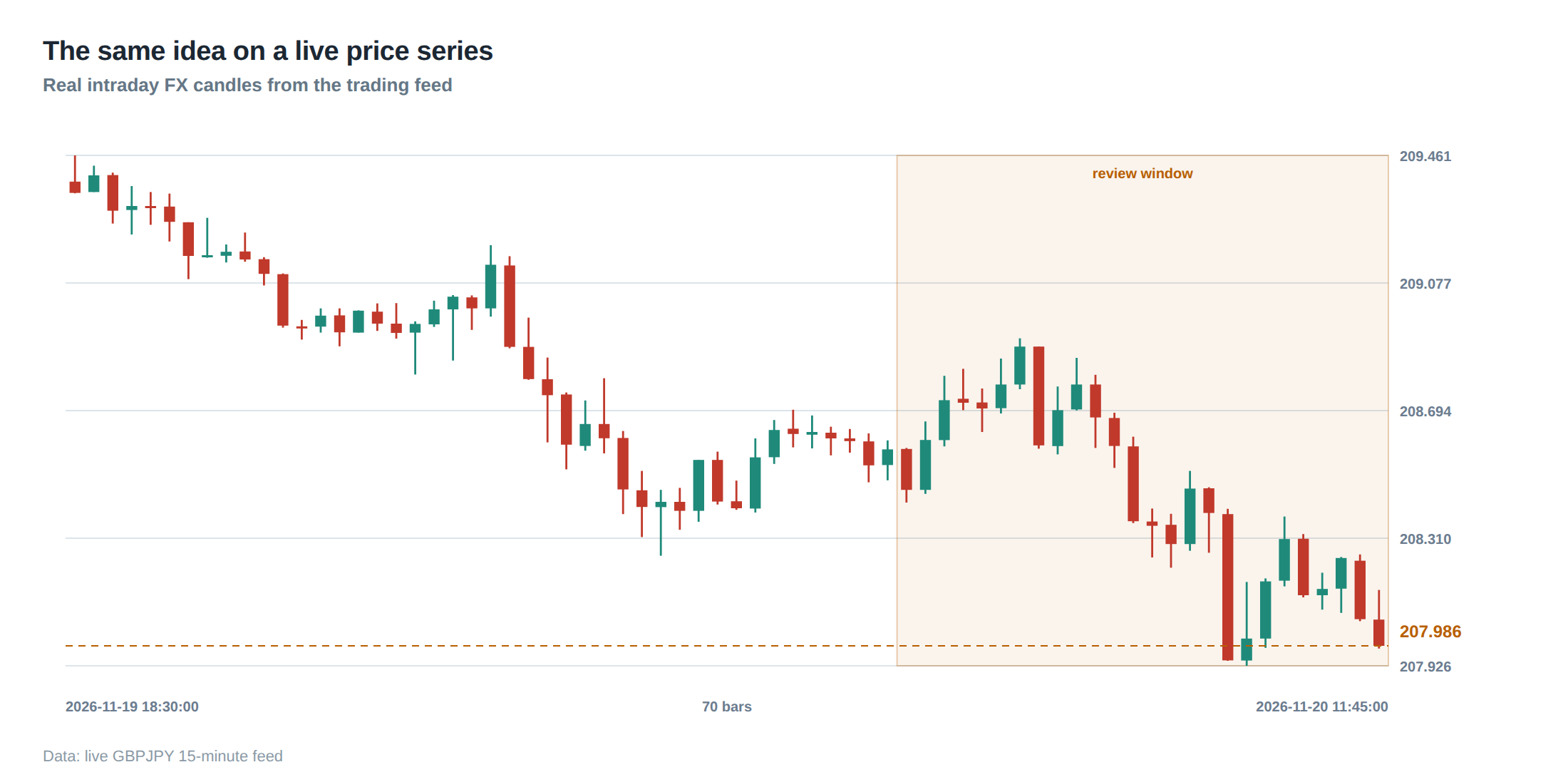
Even a well‑engineered kill switch can be undermined by market microstructure. Venues may reject bulk cancellations if they exceed rate limits, causing a fraction of orders to linger. In a fast‑moving market, a lingering order can be executed at an unfavourable price, instantly creating a loss that the kill switch was meant to avoid. Moreover, some venues do not provide immediate acknowledgements; they may queue the cancel request, meaning the system’s “all clear” signal is premature.
Another failure mode is the loss of connectivity to the OMS itself. If the network partition that caused the strategy crash also isolates the control engine, the emergency commands never reach the order gateway. In that scenario the only remaining protection is the local order‑book state held by the exchange, which cannot be relied upon to cancel the orders.
Finally, the hedge leg example illustrates a logical gap: flattening the primary position does not automatically unwind the hedge. If the hedge is a separate instrument with its own clearing timeline, the kill switch must issue a distinct instruction to close it, otherwise the desk remains exposed to basis risk. Ignoring that step leaves a hidden tail risk that can materialise when the market moves against the hedge.
The operating path, stage by stage
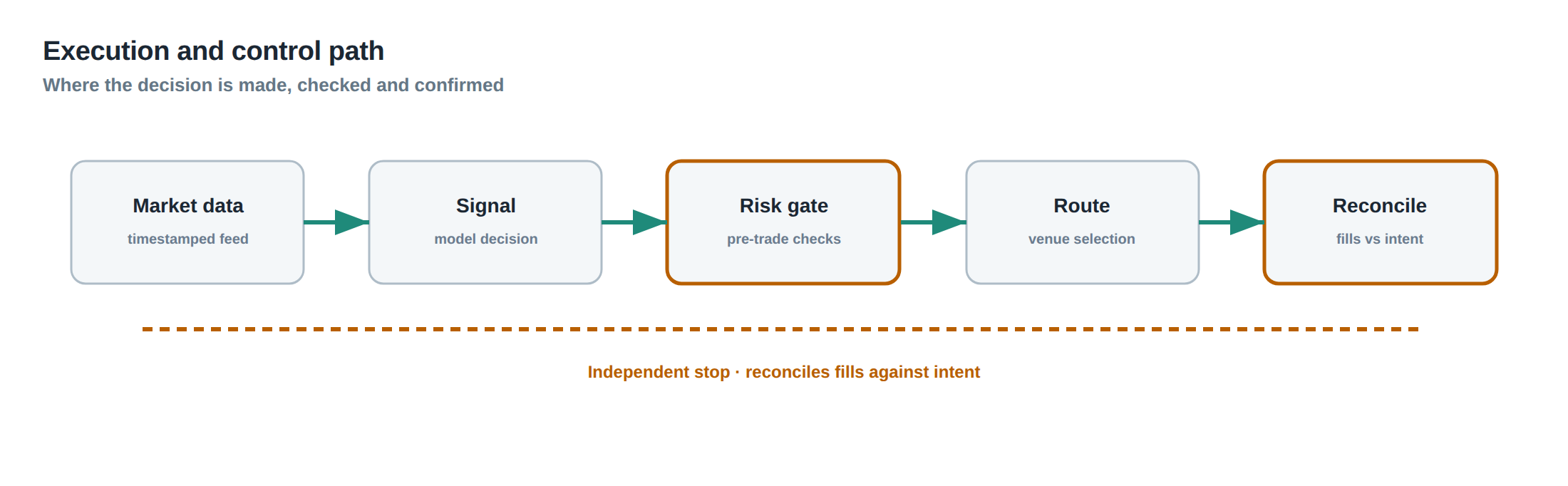
Stage 1 – Detection: a watchdog monitors heartbeats, latency metrics and exception logs. The detection threshold is tuned per component; a strategy may tolerate a 100 ms delay, an account gateway 250 ms, and the firm‑wide router 500 ms.
Stage 2 – Classification: the failure flag is matched against a policy matrix that determines stop scope (strategy, account, firm) and action type (cancel, flatten, both). The matrix is stored in a read‑only configuration service to prevent tampering during an incident.
Stage 3 – Command Issuance: the control engine constructs a command packet containing identifiers of all affected orders, the desired action and a cryptographic signature. The packet is sent over a dedicated, low‑latency channel that bypasses the normal order‑routing path.
Stage 4 – Venue Interaction: each venue receives the command and processes it according to its own protocol. Bulk cancels are broken into sub‑batches respecting venue‑specific throttles. Flattening orders are priced aggressively to guarantee execution, often using market‑on‑close or immediate‑or‑cancel flags.
Stage 5 – Confirmation and Reporting: acknowledgements flow back to the control engine, which aggregates them into a concise report. The report includes timestamps, success ratios and any residual exposure. The dashboard displays the report in real time, and an alert is raised for senior risk personnel.
Stage 6 – Acknowledgement and Recovery: a senior officer reviews the report, signs off via a two‑factor authenticated interface, and the system transitions from “emergency” to “recovery”. The recovery routine clears the kill‑switch flag, releases frozen order slots and re‑initialises the heartbeat monitors.
Controls that act before the damage
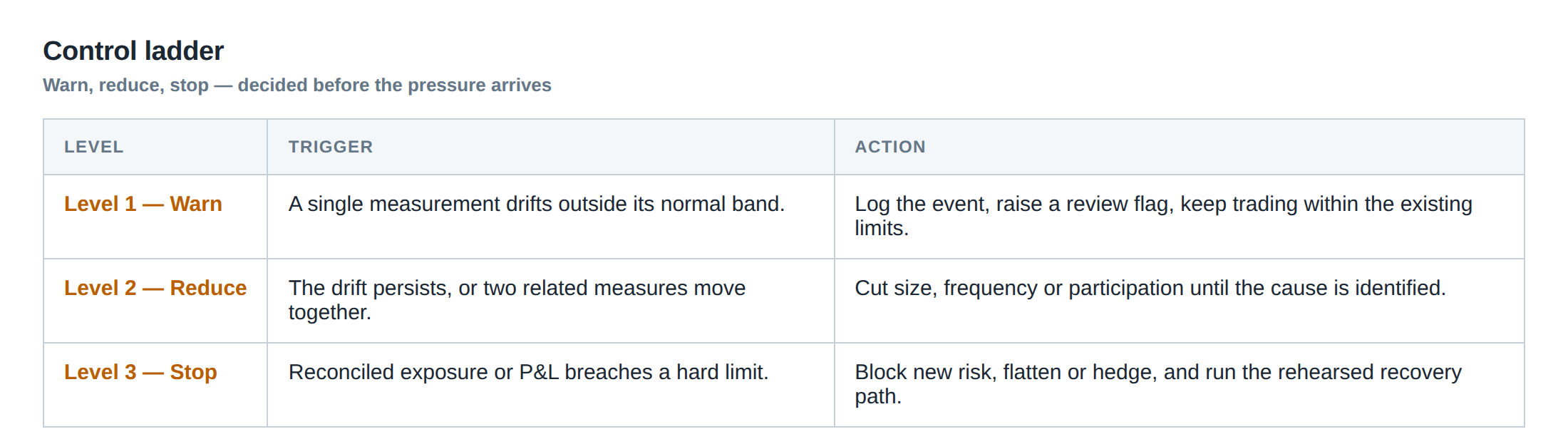
Preventative controls sit upstream of the kill switch and reduce the probability that an emergency will be needed. The first rung is a pre‑trade risk filter that checks order size, price deviation and venue liquidity before the order leaves the strategy. The second rung is a position‑limit monitor that continuously aggregates exposure across all accounts and raises a warning when a threshold of 80 % of the maximum allowed is breached.
A third rung is a “soft stop” that automatically reduces order aggressiveness when market volatility, measured by a 30‑second realised variance, exceeds a predefined band. This throttling prevents the strategy from flooding the market with orders that could later become difficult to unwind.
All these controls are implemented in a separate risk engine that runs on a different server cluster from the strategy code. The risk engine receives market data via a redundant feed, so a failure in the primary feed does not disable the checks. Permissions for the risk engine are locked down to read‑only access for market data and write access only for order‑submission APIs.
Testing of these controls is performed daily in a sandbox environment that mirrors the production topology. The sandbox injects synthetic spikes in latency and price to verify that the soft stop engages as intended. Permission checks are validated by attempting to invoke the kill‑switch API from a non‑privileged user; the request must be rejected with a clear audit log entry. Recovery drills involve resetting the sandbox to a clean state after each test, ensuring that no residual state contaminates subsequent runs.
How to measure whether it is working
Effectiveness is measured against three quantitative criteria: latency, coverage and residual exposure. Latency is the elapsed time from heartbeat loss to the final acknowledgement from all venues; the target for a strategy‑level stop is sub‑500 ms, for an account‑level stop sub‑1 s, and for a firm‑wide stop sub‑2 s. Coverage is the proportion of active orders that are successfully cancelled or flattened; a coverage rate above 99 % is required for compliance. Residual exposure is the net position that remains after the emergency actions; it must be below the pre‑defined “safe‑harbor” threshold, typically 0.5 % of the desk’s total capital.
These metrics are logged automatically for every activation, successful or not. A rolling dashboard aggregates the data and triggers a post‑mortem if any metric deviates from its target for more than two consecutive incidents. The post‑mortem includes a root‑cause analysis, a timeline reconstruction and an action plan to tighten the relevant parameter.
In addition, a periodic stress test is run where the kill‑switch is triggered artificially while the market is simulated with extreme order‑book dynamics. The test records the same three metrics, allowing the desk to verify that the system meets its design specifications under worst‑case conditions.
The portfolio view
From a portfolio perspective the kill switch is a safeguard that preserves the integrity of the capital allocation model. When the switch fires, the portfolio manager receives a concise snapshot: the list of strategies that were halted, the net cash realised from flattening, and any residual positions that need manual oversight. This snapshot is fed directly into the risk‑budgeting engine, which re‑balances the remaining capital across the surviving strategies.
Because the emergency actions are deterministic – the same policy will always produce the same flattening orders for a given net exposure – the impact on the portfolio’s risk‑return profile can be modelled ahead of time. Monte‑Carlo simulations can incorporate the probability of a kill‑switch event and its typical latency, providing a more realistic estimate of tail risk.
The key is that the kill switch does not merely “stop the lights”; it actively reshapes the portfolio back to a known, controllable state. By cancelling stray orders, flattening open positions and exposing the remaining exposure, the desk can resume trading with confidence that the hidden risk has been surfaced and quantified.
Do you have a clear, documented procedure that can bring every active order to a known state within the latency targets you have set for your desk?
About the research behind this lesson
The seminar frames electronic markets as price-time-priority queues. It separates queue value into spread capture versus adverse-selection cost and the option value of retaining a place in line.
Applied to this lesson: An order lifetime therefore cannot be based on elapsed time alone: the system must reassess whether its queue position, expected spread and adverse-selection risk still justify keeping the order alive.
Two live systems, one desk
PULSE-X — power-packed HFT: high-frequency momentum on XAUUSD and EURUSD. System details · Live account
NIC-X — ultra-low drawdown: displaced-print arbitrage for large capital. System details · Live account
Start now: leave your email and request a free trial — we will send the pricing, the connection route and the trial terms. Pricing
Join the market discussion: Telegram @squawklive
Source: High-Frequency Trading and Modern Market Microstructure
Educational content only. Trading leveraged products involves risk.
Chat with XTRSK
Chat ready
Start a chat and the XTRSK team will be notified immediately.