
XCore HFT / Trading Lab
XCore HFT Trading Lab: Capacity is where size consumes edge
Quantitative execution, market-microstructure, and risk-control research from XTRSK.
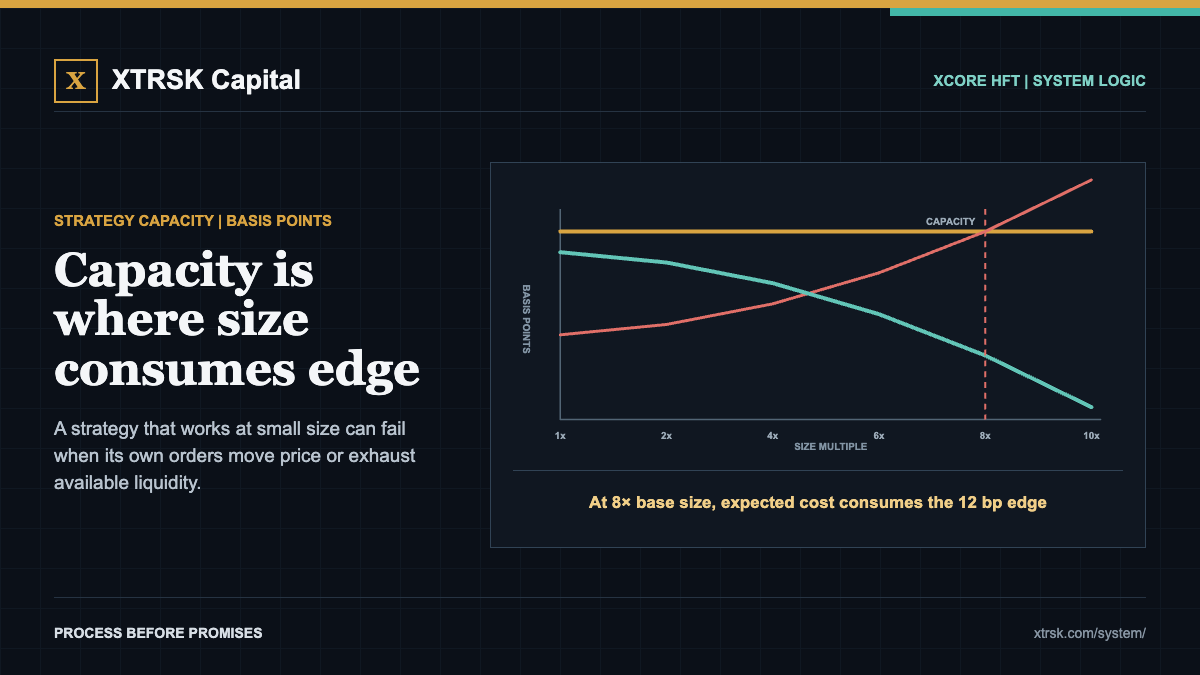
The dangerous trading system is not always the slow one. It is often the fast one whose risk state is wrong. Capacity is where size consumes edge.
The engineering view is simple: identify every dependency, timestamp every event and reconcile every outcome. A strategy that works at small size can fail when its own orders move price or exhaust available liquidity. Measure costs by participation rate and volatility. Stress thin sessions and urgent exits. What matters operationally is the link between decision, friction, edge and proof.
Put a boundary around the claim. Doubling quantity can more than double cost when the extra order must trade through deeper and worse price levels. The example is not a forecast or a promise; it shows which variable must be measured before the apparent opportunity can be treated as usable.
A compact operating checklist is: 1) increase simulated size until expected net edge disappears; 2) monitor live slippage against the capacity curve; 3) model spread, temporary impact, permanent impact and opportunity cost. Add hard exposure ceilings, observable rejection reasons and an event trail that lets operations reconstruct the decision without guessing. Control sequence: 1 signal, 1 order path, 1 reconciled risk state.
The attractive explanation is usually one-dimensional. The real result depends on several linked constraints. Review the median, the stressed tail and the failure path separately. A result that survives only in quiet sessions, tiny size or perfect data is a research result, not yet a production capability.
The account experiences combined profit, loss and liquidity demand, even when models are monitored in separate dashboards. The objective is not to remove uncertainty. It is to size uncertainty, detect when assumptions break and preserve the ability to stop without creating a second problem.
Which tail metric has taught you more than the corresponding average?
#Execution #QuantTrading
The research behind this lesson
This paper explains The seminar frames electronic markets as price-time-priority queues. It separates queue value into spread capture versus adverse-selection cost and the option value of retaining a place in line.
Applied to this XCore lesson: An order lifetime therefore cannot be based on elapsed time alone: the system must reassess whether its queue position, expected spread and adverse-selection risk still justify keeping the order alive.
Explore XCore HFT: System details
PULSE XCORE HFT live account: Verify the live account on FX Blue
Live chat and updates: Telegram @xtrskhft
Source: High-Frequency Trading and Modern Market Microstructure
Educational content only. Trading leveraged products involves risk.
Chat with XTRSK
Chat ready
Start a chat and the XTRSK team will be notified immediately.