XCore HFT / Trading Lab
PULSE: Trading risk includes the machinery
Quantitative execution, market-microstructure, and risk-control research from XTRSK.
What this problem really is
Electronic markets are, at their core, price‑time‑priority queues. Every incoming order is placed behind all orders that arrived earlier at the same price, and it is removed the instant a matching trade occurs or the order is cancelled. The value of a queue position can be split into three components: the expected spread capture, the adverse‑selection cost of being filled at an unfavourable price, and the optionality of retaining a place in line for a later price move. In theory a model that predicts these components can be perfectly calibrated, yet the trading system that implements the model may still bleed money. The loss does not stem from a mis‑priced spread but from the machinery that moves orders in and out of the queue. Duplicated submissions, stale internal state, or a failure to recover correctly after a restart can leave an order alive on the venue while the desk believes it has been cancelled, or conversely can cause a second order to be sent after a first one has already been executed. The resulting “ghost” exposure is invisible to the risk engine until the venue reports a fill or a reject, at which point the P&L impact is already realised.
The problem is therefore not a statistical forecasting error but a systems‑engineering failure. It is a breach of the contract between the internal order book and the external market. When that contract is broken, the model’s correctness is irrelevant – the system is simply executing the wrong set of trades. The challenge for a prop‑trading desk is to make that contract robust, to guarantee that each logical order in the desk’s state corresponds to exactly one live order on the exchange, and that the correspondence is restored instantly after any disruption.
How the mechanism works, step by step
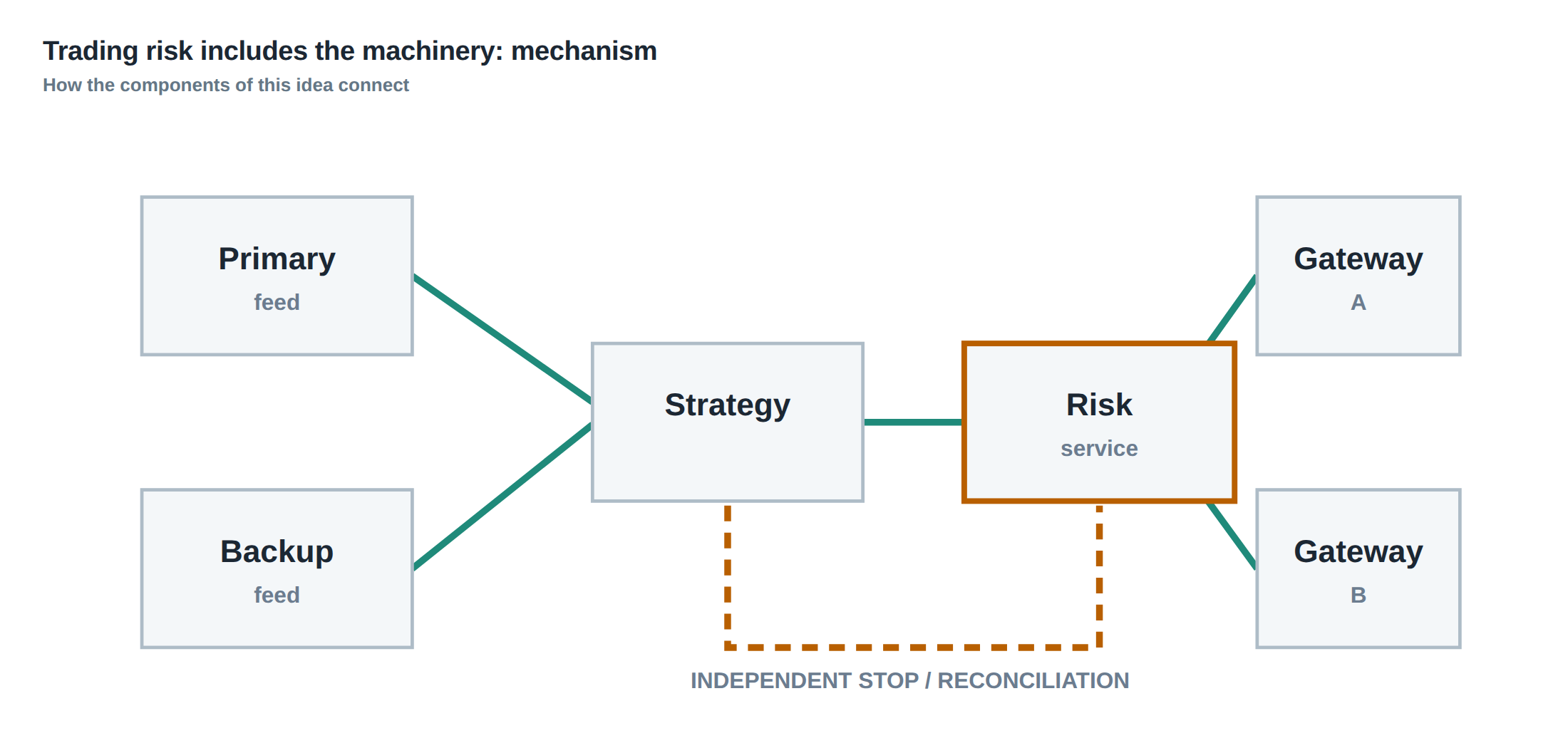
When a trading signal is generated, the strategy engine creates an intent: “buy 100 000 shares of XYZ at the best bid, with a maximum price of 50.30”. This intent is handed to the order‑management layer, which assigns a unique identifier (UID) and creates a deterministic state machine: Pending → Sent → Live → Filled/Cancelled. The UID is attached to the outbound FIX message as the ClOrdID, and the venue returns an OrderID that is stored alongside the UID.
The gateway then publishes an internal event “OrderSent(UID, timestamp)”. A downstream component, the state reconciler, subscribes to both the internal event stream and the venue’s execution reports. For every report that contains the OrderID, the reconciler matches it back to the UID, updates the state, and emits “OrderLive” or “OrderFilled”. The crucial invariant is that for each UID there is at most one live OrderID at any moment.
If the gateway crashes, the in‑memory map of UID→OrderID is lost. On restart the system must reload a persistent event log, reconstruct the map, and query the venue for the current status of every OrderID that was known to be live before the crash. Only after that reconciliation is complete does the gateway accept new intents for the same instrument. This “reconcile‑first” discipline prevents the accidental submission of a second order that would otherwise duplicate the original.
A worked example with real numbers
Consider a mid‑cap equity that trades at an average bid‑ask of 50.20/50.25. The model signals a 0.5 % expected spread capture over a 30‑second horizon, suggesting a 250‑share order at the best bid. The strategy engine therefore creates an intent to buy 250 shares, with a maximum price of 50.22. The order‑management layer assigns UID = A1B2C3 and sends a FIX NewOrderSingle with ClOrdID = A1B2C3. The exchange replies with OrderID = 123456, which is persisted.
At 09:30:12.345 the gateway experiences a hard crash. The volatile map {A1B2C3 → 123456, state = Live} is lost. The system restarts at 09:30:15.000, reads the immutable event log, and reconstructs the intent “Buy 250 shares, UID = A1B2C3, last known state = Live”. Before re‑accepting any new orders, it sends a OrderStatusRequest for OrderID = 123456. The exchange returns “PendingNew”, meaning the order has not yet entered the book. The reconciler therefore marks the internal state as “Cancelled” and issues a CancelRequest to the venue.
While the CancelRequest is in flight, a separate monitoring thread, unaware of the crash, receives a market data tick that shows the best bid has moved to 50.24. It decides the original signal is still valid and issues a new intent. Because the state machine still believes UID = A1B2C3 is “Live”, it generates a second NewOrderSingle with a fresh ClOrdID = D4E5F6, but re‑uses the same logical intent. The exchange now holds two live orders: the original 250‑share order (still pending) and the new 250‑share order.
At 09:30:16.200 the first order is filled at 50.20, generating a trade of £12 550. The second order is subsequently cancelled by the venue after the CancelRequest is processed, but the internal risk engine has already recorded a fill of 250 shares. The desk’s P&L shows a realised profit of £12 550, while the actual market exposure was double‑counted for a brief interval, inflating the risk‑adjusted return. If the price had moved unfavourably during that overlap, the duplicated exposure could have turned a profitable signal into a loss.
The numbers illustrate the chain reaction: a three‑second outage, loss of volatile state, and an unsynchronised monitoring thread produced a duplicate order, a stale order, and a mis‑reported fill. The model’s forecast of a 0.5 % spread capture was correct, but the machinery turned a neutral expectation into a material P&L swing.
Where it breaks in live markets
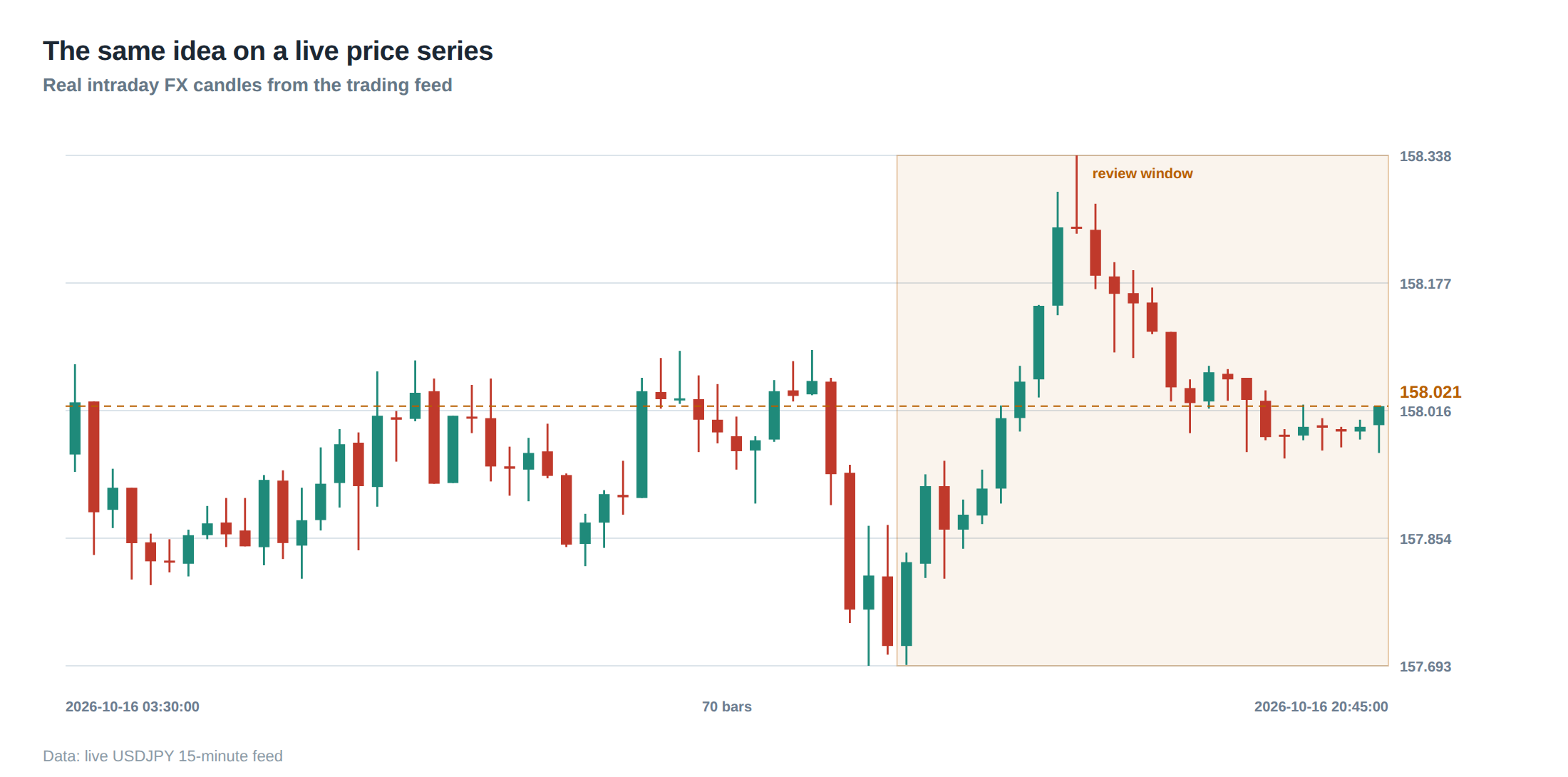
In production environments the failure modes are rarely binary. A common source of duplication is the “at‑least‑once” delivery guarantee of many messaging buses. When a FIX message is retransmitted after a network hiccup, the gateway may treat it as a brand‑new order if the ClOrdID is not checked for idempotency. Another break point is the latency between market‑data receipt and order‑submission. If the market data feed is delayed, the system may decide that an order should be refreshed, send a CancelReplace, but the original Cancel never reaches the venue before the Replace does, leaving two live orders.
Stale state also arises when the internal order book is updated only on execution reports. If a venue silently drops an order because of a risk limit breach, the internal system still believes the order is live. The next time the strategy evaluates the same price level, it may send a new order, effectively double‑exposing the position.
Failover designs that spin up a hot‑standby gateway can inadvertently introduce double execution. If the standby receives the same market data snapshot and the same intent, and both instances forward the order to the venue before the primary declares itself active, the venue will see two identical orders. The problem is amplified when the standby does not inherit the primary’s in‑flight order identifiers, because the venue will assign distinct OrderIDs, breaking the one‑to‑one mapping.
Finally, monitoring of feed age, queue depth and reject rate is often performed downstream of the order‑submission path. If a feed falls behind, the system may be operating on a price that is already obsolete, prompting unnecessary order amendments that clash with pending cancellations. High reject rates can also mask the fact that an order never reached the market, while the internal state assumes it did.
The operating path, stage by stage
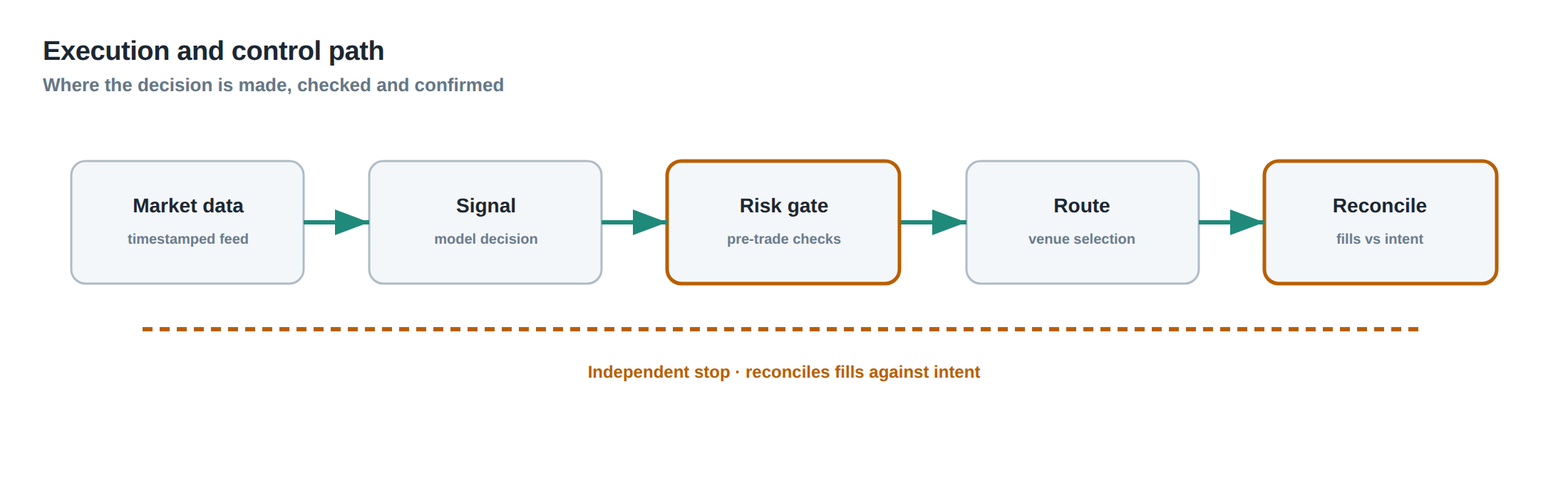
The first stage is signal generation, where a statistical model outputs a directional intent together with a risk budget. The second stage translates the intent into a deterministic order object, assigning a globally unique UID and stamping a creation timestamp. The third stage is the gateway interface, which serialises the order into FIX, attaches the UID as ClOrdID, and records the outbound event in an immutable log.
The fourth stage is the venue acknowledgement, where the exchange returns an OrderID and a status. The reconciler updates the internal map, linking UID to OrderID, and emits a “Live” event. The fifth stage is the execution‑report handling loop, which consumes fills, partial fills, cancellations, and rejections, updating the internal state accordingly.
The sixth stage is the health‑monitoring loop, which continuously checks feed latency, order‑queue depth, and reject ratios. If any metric crosses a pre‑defined threshold, the system raises an alarm and may suspend new intents for the affected instrument. The seventh stage is the recovery routine, triggered by any crash or network partition. It re‑reads the immutable event log, re‑issues OrderStatusRequests for every UID marked as “Live”, and reconciles the responses before resuming normal operation.
Each stage must be designed to be idempotent: re‑processing the same event must not change the resulting state. This property guarantees that if a message is duplicated by the transport layer, the internal state machine will recognise the duplicate and discard it without side effects.
Controls that act before the damage
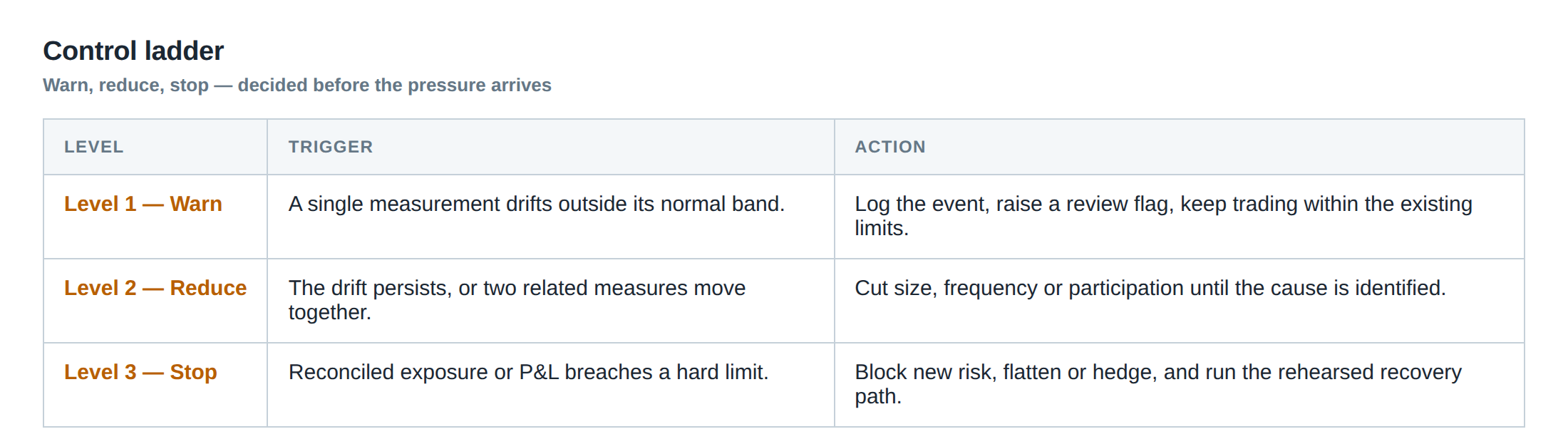
The first line of defence is an idempotent order‑submission protocol. The gateway must maintain a cache of recent ClOrdIDs and reject any inbound order that repeats a UID within a configurable time window. This prevents accidental retransmission of the same logical order.
Continuous reconciliation between internal and venue state forms the second barrier. A background task polls the exchange for the status of every OrderID that is marked “Live” in the internal map, at a frequency that matches the market’s tick rate. Any discrepancy – for example, an OrderID reported as “Cancelled” while the internal state is “Live” – triggers an immediate corrective action, typically a state correction event followed by a risk‑engine alert.
Failover designs must include a “single‑source‑of‑truth” lock. When a standby instance takes over, it first acquires an exclusive lease on the order‑state store, reads the latest UID→OrderID map, and only then begins to accept new intents. The lock ensures that at most one instance can issue a new order for a given UID.
Monitoring of feed age, queue depth and reject rate provides early warning. If the market‑data timestamp lags the wall‑clock by more than a few milliseconds, the system can pause order generation for the affected venue, avoiding decisions based on stale prices. A rising reject rate can be interpreted as a sign that the venue is throttling the connection; the gateway can then back‑off, reducing the probability of duplicate submissions caused by rapid retransmission.
An immutable event trail, written to a write‑once storage medium, records every state transition, every outbound FIX message and every inbound execution report. Because the trail cannot be altered, post‑mortem analysis can pinpoint exactly where the divergence between internal and external state occurred, and can be used to tighten the control logic.
Finally, practising degraded‑mode operation means deliberately disabling non‑essential components – for example, turning off optional predictive order‑refresh logic – during a simulated outage. By exercising the system in a controlled “what‑if” scenario, the team verifies that the recovery path restores the correct order map without spawning duplicates.
How to measure whether it is working
The primary metric is the “duplicate‑order rate”, defined as the number of distinct OrderIDs that share the same UID over a given period, divided by the total number of UIDs created. A rate below one in a million is generally acceptable for high‑frequency desks.
A secondary metric is “state‑drift latency”, the elapsed time between a venue’s OrderStatusReport and the internal state update that reflects it. This should be measured in microseconds for sub‑millisecond strategies; any drift beyond the market’s typical quote‑update interval indicates a reconciliation bottleneck.
The third indicator is “recovery‑time to consistency” after a crash. This is the wall‑clock interval from the moment the gateway restarts to the moment the internal map matches the venue for all live orders. The target is usually under 500 ms for latency‑sensitive desks.
Monitoring feed age, queue depth and reject rate remains essential. Feed‑age should stay within a few milliseconds of the exchange timestamp; queue depth should not exceed the configured maximum buffer size, otherwise back‑pressure may cause order messages to be dropped or duplicated. Reject rate should stay below a pre‑agreed threshold, typically 0.01 % of total submissions.
Finally, the immutable event trail can be audited daily. An automated script parses the log, builds a graph of UID→OrderID transitions, and flags any cycles or multiple live edges. The number of flagged anomalies per day is a direct health indicator of the order‑machinery.
The portfolio view
From a portfolio perspective, the machinery risk is orthogonal to market risk but can dominate realised P&L if left unchecked. A duplicated order creates an unintended position that is not reflected in the risk engine’s exposure calculations, leading to under‑estimation of VaR and stress‑test breaches. Conversely, a stale order that the desk believes is live can cause the strategy to under‑hedge, exposing the portfolio to adverse price moves that the model did not anticipate.
When the order‑machinery is robust, the portfolio’s risk metrics – exposure, turnover, realised P&L – align closely with the model’s forecasts. The desk can therefore attribute deviations to market factors rather than systems failures. In the opposite case, the portfolio may exhibit spikes in realised P&L that have no correlation with market volatility, prompting a forensic investigation that often uncovers duplicated or ghost orders.
A well‑engineered control stack also enables more aggressive capital utilisation. Knowing that the order‑machinery will not inadvertently double‑execute, the desk can safely increase position limits, tighten order‑lifetime thresholds, and reduce the safety buffers that were previously required to absorb unexpected exposure. The result is a higher risk‑adjusted return without sacrificing the integrity of the trading process.
—
Is your current order‑management pipeline truly idempotent, and can you guarantee that every live order on the exchange has a single, unambiguous counterpart in your internal state?
About the research behind this lesson
The seminar frames electronic markets as price-time-priority queues. It separates queue value into spread capture versus adverse-selection cost and the option value of retaining a place in line.
Applied to this lesson: An order lifetime therefore cannot be based on elapsed time alone: the system must reassess whether its queue position, expected spread and adverse-selection risk still justify keeping the order alive.
Explore PULSE: System details
PULSE live account: Verify the live account on FX Blue
Live chat and updates: Telegram @xtrskhft
Source: High-Frequency Trading and Modern Market Microstructure
Educational content only. Trading leveraged products involves risk.
Chat with XTRSK
Chat ready
Start a chat and the XTRSK team will be notified immediately.