XCore HFT / Trading Lab
Trading risk includes the machinery
Quantitative execution, market-microstructure, and risk-control research from XTRSK.
What this problem really is
The majority of electronic‑trading failures are not caused by a flawed pricing model but by a mismatch between the model’s logical view of an order and the physical reality of the venue. A model can predict that a limit order will capture a half‑tick spread with a 70 % probability, yet the desk ends up with a net loss because the same order is sent twice, or because an order that should have been cancelled remains in the market after a crash. The root cause is the “machinery” that translates model intent into exchange messages: order identifiers, state synchronisation, and recovery logic. When any of these components become out of sync, the system can generate duplicated executions, stale positions, or unintended exposure.
In practice the problem manifests as a hidden cost that is difficult to attribute. A trader may see a series of small, unexplained fills that together erode the expected edge. The underlying issue is often a failure to treat order submission as an idempotent operation, to continuously reconcile internal order books with the venue, or to design a fail‑over path that does not permit a second “live” copy of the same order. The result is a leakage of capital that is not captured by traditional risk metrics such as VaR, because the loss is operational rather than market‑driven.
How the mechanism works, step by step
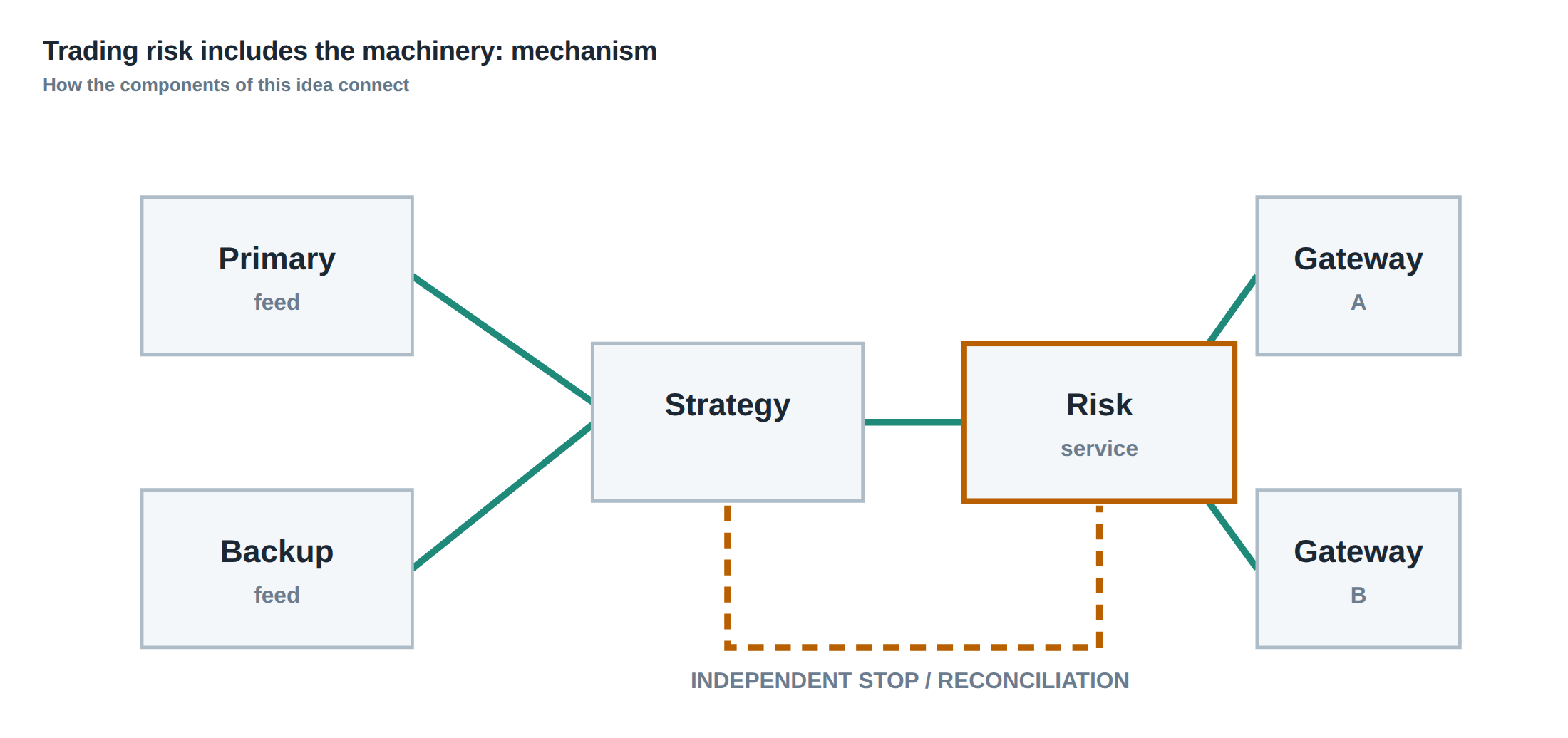
The first step is to assign a globally unique, immutable order identifier at the moment the model decides to act. This identifier must be attached to every message that leaves the gateway – new order, amendment, or cancellation – and must be stored in an append‑only event log. When the exchange acknowledges the message, the acknowledgement carries the same identifier, allowing the system to match inbound and outbound events without ambiguity.
A second layer continuously reconciles the internal order state with the venue’s state. The gateway subscribes to the exchange’s order‑status stream and periodically polls the order book for the specific order identifier. Any discrepancy – for example, an order that the internal engine believes is cancelled but the venue still shows as active – triggers an immediate corrective action, typically a forced cancellation followed by a verification loop.
The third layer handles failure recovery. Upon a process restart, the recovery routine reads the immutable event log, reconstructs the last known state for each identifier, and re‑issues only those orders that were not confirmed as fully filled or cancelled. Crucially, the routine must recognise that an order may already be live at the venue; it therefore sends a “status‑check” request before attempting to re‑submit. This prevents the classic double‑execution scenario that occurs when a gateway is restarted without restoring live order state.
A worked example with real numbers
Consider a market‑making strategy that places a 10‑lot limit order at 100.05 on a futures contract, expecting a half‑tick capture. The order is assigned the identifier OM‑20231108‑001. The gateway sends the NewOrderSingle message, receives an acknowledgement, and records the event at 09:30:12.345 UTC. At 09:30:13.200 UTC the exchange confirms the order is live.
At 09:31:00 UTC the gateway experiences a hardware fault and restarts. The recovery script reads the event log, sees that OM‑20231108‑001 has a “Live” status but no final fill or cancel. Rather than blindly re‑sending a new order, it issues a StatusRequest for OM‑20231108‑001. The exchange replies that the order remains live with 8 lots filled and 2 lots pending. The recovery routine therefore does not create a second order; it only updates the internal state to reflect the partial fill.
If the recovery logic were naïve – for example, simply replaying every NewOrderSingle without checking – it would submit a second order with a new identifier OM‑20231108‑001‑R. The exchange would treat this as a distinct order, leaving the original 2‑lot pending order untouched. The desk would now hold 12 lots in the market, exposing an unintended 20 % over‑allocation. Assuming the price moves unfavourably by 2 ticks, the extra 2 lots generate a loss of 4 ticks, equivalent to 0.4 % of the notional, directly eroding the model’s expected edge.
Where it breaks in live markets
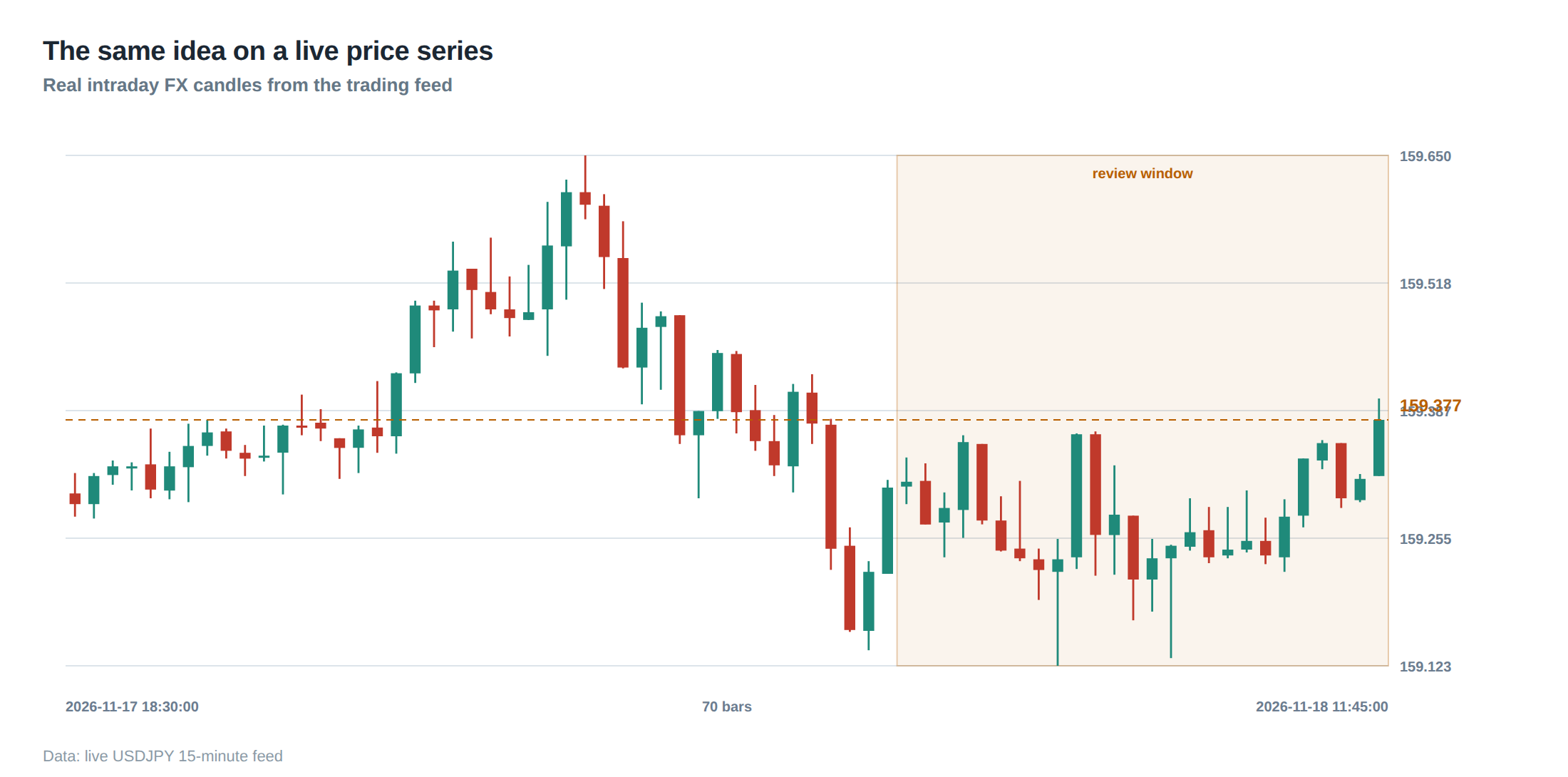
In a high‑throughput environment, the latency between order submission and acknowledgement can be measured in microseconds, yet the recovery window after a crash may span several seconds. During that window the internal engine may have already generated downstream signals based on the belief that the original order was cancelled. If the cancellation never reached the venue, the system may place a hedge that offsets the original exposure, creating a net zero position that later diverges when the venue finally processes the pending order.
Another common failure mode is the “stale state” problem caused by delayed market data. If the feed age exceeds a configurable threshold, the model may continue to believe it is at the front of the queue, while in reality the order has been displaced by faster participants. The system then continues to hold an order that no longer offers the expected spread capture, exposing the desk to adverse selection without any warning.
The operating path, stage by stage
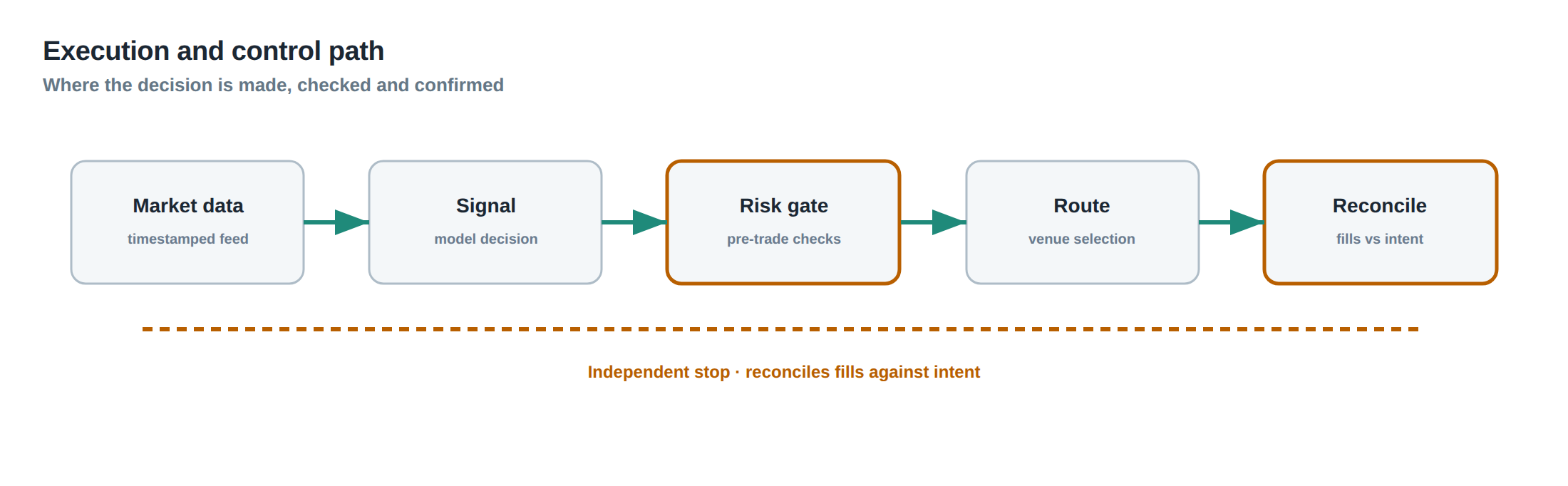
The first stage is intent generation: the quantitative model outputs a decision – new order, amend, or cancel – together with a risk‑adjusted size. At this point the order identifier is minted and the event is written to an immutable log.
The second stage is transmission: the gateway packages the message, attaches the identifier, and forwards it to the exchange. Simultaneously, a duplicate copy is sent to an internal acknowledgement monitor that waits for the exchange’s response.
The third stage is confirmation and reconciliation: upon receipt of an acknowledgement, the monitor updates the internal state and records the round‑trip latency. A parallel process consumes the exchange’s order‑status stream, matching each update to the stored identifier. Any mismatch triggers a corrective workflow that may involve a forced cancel, a re‑price, or an alert to the operations team.
The fourth stage is degradation handling: if the feed age exceeds the defined limit, the system automatically switches to a “degraded mode”. In this mode it suspends new order generation, reduces order sizes, and increases the frequency of status checks. The aim is to prevent the accumulation of hidden exposure while the data source recovers.
Controls that act before the damage
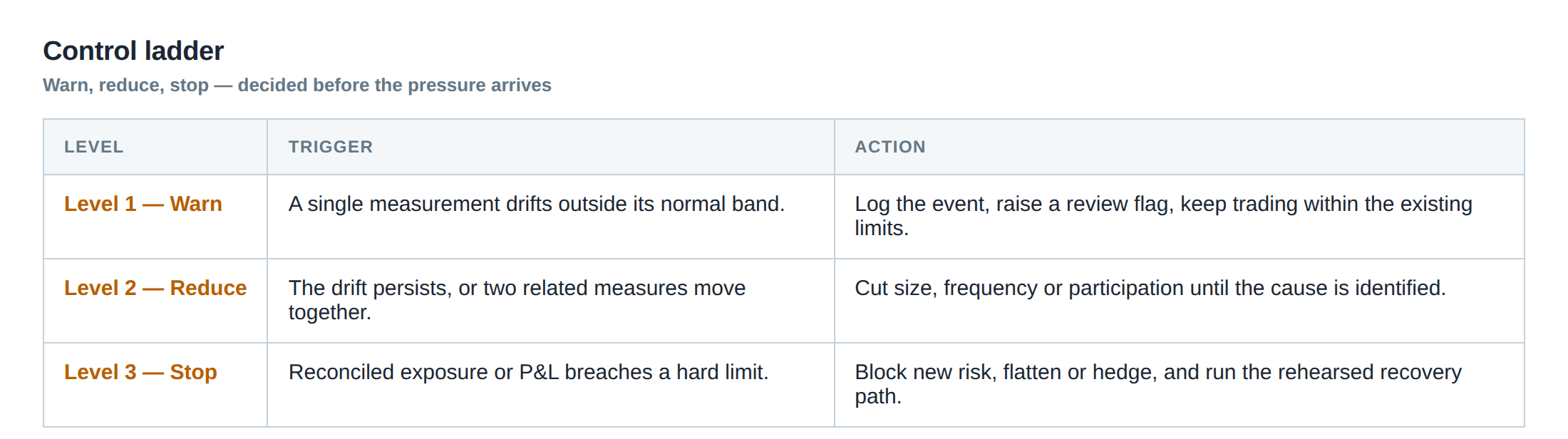
Idempotency is enforced at the API layer. The gateway rejects any outbound message that carries an identifier already present in the in‑flight buffer, returning an error to the calling component. This prevents accidental double‑submission caused by race conditions in multi‑threaded code.
State reconciliation is performed continuously, not only on a periodic timer. The system maintains a sliding window of the last 10 seconds of venue status messages and cross‑checks each against the internal ledger. If the reject rate for a particular identifier spikes above 0.1 % within that window, the order is automatically withdrawn and a diagnostic ticket is raised.
Fail‑over design incorporates a “single‑source‑of‑truth” ledger that lives on a replicated, write‑once storage tier. During a switchover, the standby node reads the ledger, re‑hydrates the order book, and issues a batch of StatusRequests before any new order is emitted. This disciplined sequence guarantees that no order can be resurrected without first confirming its venue state, eliminating the double‑execution hazard demonstrated in the worked example.
How to measure whether it is working
The primary metric is the “duplicate‑execution rate”, defined as the number of orders that were sent to the venue with a distinct identifier while an earlier order with the same logical intent remained live. A well‑engineered system should sustain this rate below 0.001 % over a month‑long observation window.
A secondary indicator is the “state‑drift lag”, measured as the median time between a venue status update and the corresponding internal state adjustment. In a healthy deployment this lag should stay under 5 ms even during peak traffic, ensuring that the internal view never lags far enough to cause a stale‑order decision.
The portfolio view
When the machinery operates correctly, the realised P&L of the strategy aligns closely with the model‑predicted edge, and the residual variance can be explained by market risk alone. Conversely, a persistent mismatch between expected and actual returns often signals hidden operational leakage. By aggregating the duplicate‑execution rate and state‑drift lag across all instruments, the desk can construct a “machinery risk score” that is added to the traditional risk dashboard.
In practice this score allows capital allocation decisions to factor in the cost of operational risk. For instance, a strategy with a 0.3 % expected edge but a machinery risk score of 0.2 % may be deprioritised in favour of a lower‑edge strategy with negligible operational leakage. The portfolio manager therefore gains a clearer view of where true alpha resides, separated from the noise generated by faulty order handling.
Do you have a systematic process in place to verify that every order identifier is reconciled with the venue before any recovery action is taken?
About the research behind this lesson
The seminar frames electronic markets as price-time-priority queues. It separates queue value into spread capture versus adverse-selection cost and the option value of retaining a place in line.
Applied to this lesson: An order lifetime therefore cannot be based on elapsed time alone: the system must reassess whether its queue position, expected spread and adverse-selection risk still justify keeping the order alive.
Two live systems, one desk
PULSE-X — power-packed HFT: high-frequency momentum on XAUUSD and EURUSD. System details · Live account
NIC-X — ultra-low drawdown: displaced-print arbitrage for large capital. System details · Live account
Start now: leave your email and request a free trial — we will send the pricing, the connection route and the trial terms. Pricing
Join the market discussion: Telegram @squawklive
Source: High-Frequency Trading and Modern Market Microstructure
Educational content only. Trading leveraged products involves risk.
Chat with XTRSK
Chat ready
Start a chat and the XTRSK team will be notified immediately.