XCore HFT / Trading Lab
Every fast order needs a lifetime
Quantitative execution, market-microstructure, and risk-control research from XTRSK.
What this problem really is
In a modern electronic market the moment a trading signal is generated it is already racing against a cascade of latencies. The signal may be valid for only a few dozen milliseconds, yet the order that carries it can spend a comparable or longer time travelling across the network, sitting in a venue’s order‑book queue, or awaiting a cancellation acknowledgement. If any of those stages stretch beyond the signal’s intrinsic lifetime, the order may execute at a price that no longer reflects the original edge, turning a potential profit into an adverse‑selection loss.
The difficulty is not merely that orders are slower than signals; it is that the market’s price‑time priority mechanism continuously re‑prices the queue. A price that was favourable when the order entered may have been displaced by a flurry of new liquidity or by a sudden shift in the underlying price. The order’s “age” therefore matters both in absolute time and in the context of the queue’s evolving value.
Treating an order as a static object that lives until it is filled or explicitly cancelled ignores the dynamic risk that accumulates while the order is in limbo. The core thesis is that every fast order must carry a lifetime that is evaluated continuously, and that the system must be capable of aborting or replacing the order the instant the original signal ceases to be valid.
How the mechanism works, step by step
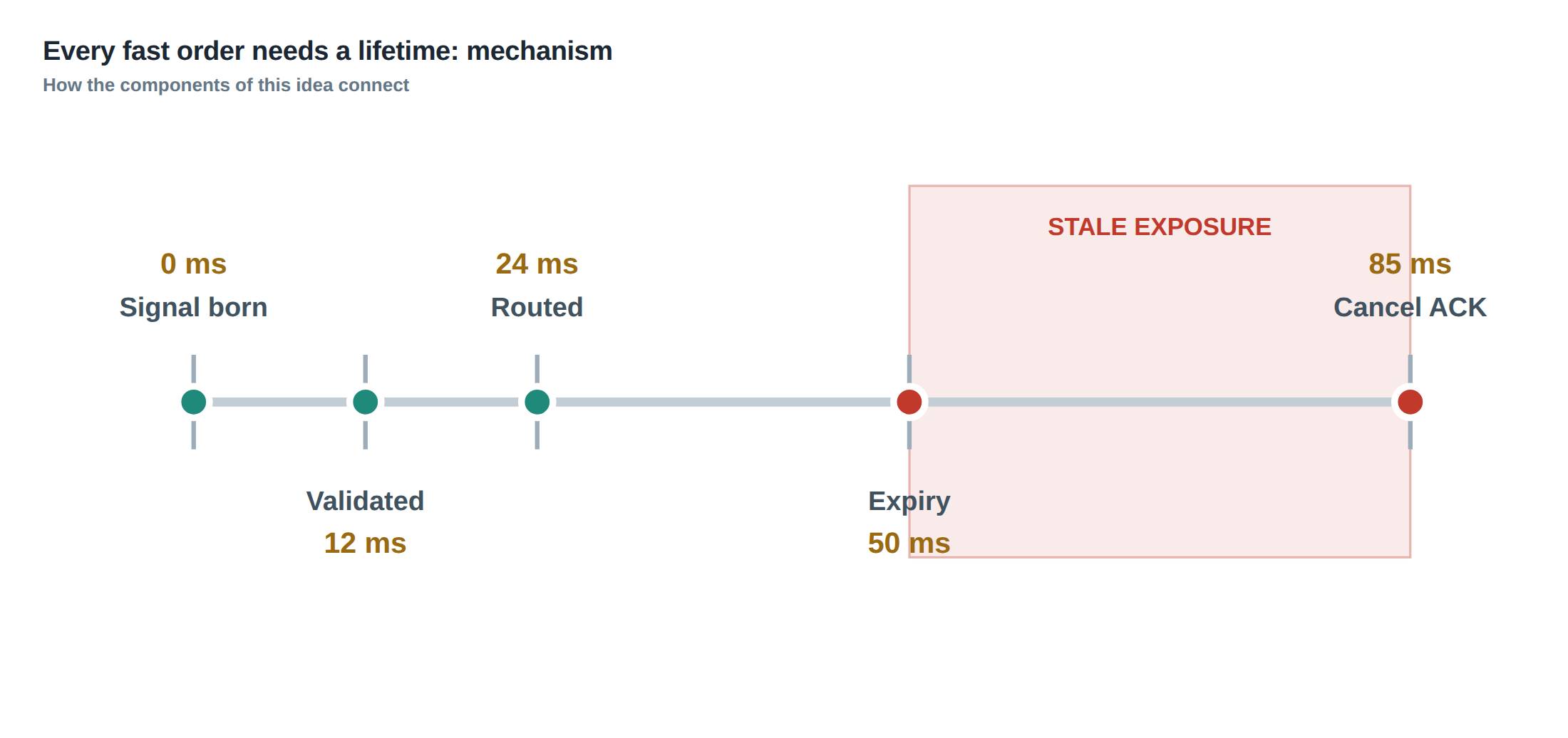
The first step is signal generation. A statistical model flags a micro‑price dislocation and emits a “buy at ask” or “sell at bid” instruction together with a timestamp and a maximum acceptable age, for example 50 ms. The order‑management system (OMS) stamps the order with this expiry and forwards it to the gateway.
At the gateway the packet experiences network propagation, queuing in the OS kernel, and finally reaches the exchange’s matching engine. The exchange inserts the order into its limit‑order book according to price‑time priority. At this point the order acquires a queue position that is itself a function of the time elapsed since the signal and the rate at which new orders are arriving.
If the market moves unfavourably before the order is filled, the OMS may issue a local cancel request. The request is sent back through the same network path, but the exchange only acknowledges cancellation after it has removed the order from the book. Until that acknowledgement arrives the order remains alive, exposing the portfolio to the original adverse‑selection risk. The system must therefore distinguish a “local cancel issued” state from a “venue‑confirmed cancellation” state and act accordingly.
A worked example with real numbers
Consider a mean‑reversion signal that identifies a 0.3 % spread between the best bid and the best ask on a liquid equity. The model estimates that the spread will decay within 50 ms, offering an expected profit of 0.12 % after transaction costs. The OMS creates a limit order to buy at the ask for 10 000 shares, stamps it with a maximum age of 50 ms, and sends it to the exchange.
Network latency from the data centre to the exchange is 12 ms one‑way, and the exchange’s internal matching engine adds another 5 ms before the order appears in the queue. By the time the order is visible to other participants, 17 ms have elapsed, leaving 33 ms of signal life. Within those 33 ms the order sits at the back of a queue that, on average, clears in 20 ms under normal flow. However, a sudden surge in order flow adds 15 ms of additional waiting time. At this point the order has been in the book for 32 ms, and the remaining signal life is only 18 ms.
The OMS detects that the remaining lifetime is below a safety threshold (e.g., 20 ms) and issues a cancel request. The cancel packet takes another 12 ms to reach the exchange, and the exchange needs 3 ms to process it. By the time the venue sends the cancellation acknowledgement back, 47 ms have passed since the original signal. The acknowledgement arrives at the OMS at 60 ms, well beyond the signal’s expiry. The order has therefore been alive for 47 ms while the signal was already stale, exposing the portfolio to a potential adverse‑selection loss of the full 0.3 % spread. The example illustrates why a fifty‑millisecond opportunity should not leave an order working seconds later simply because the cancel path stalled.
Where it breaks in live markets
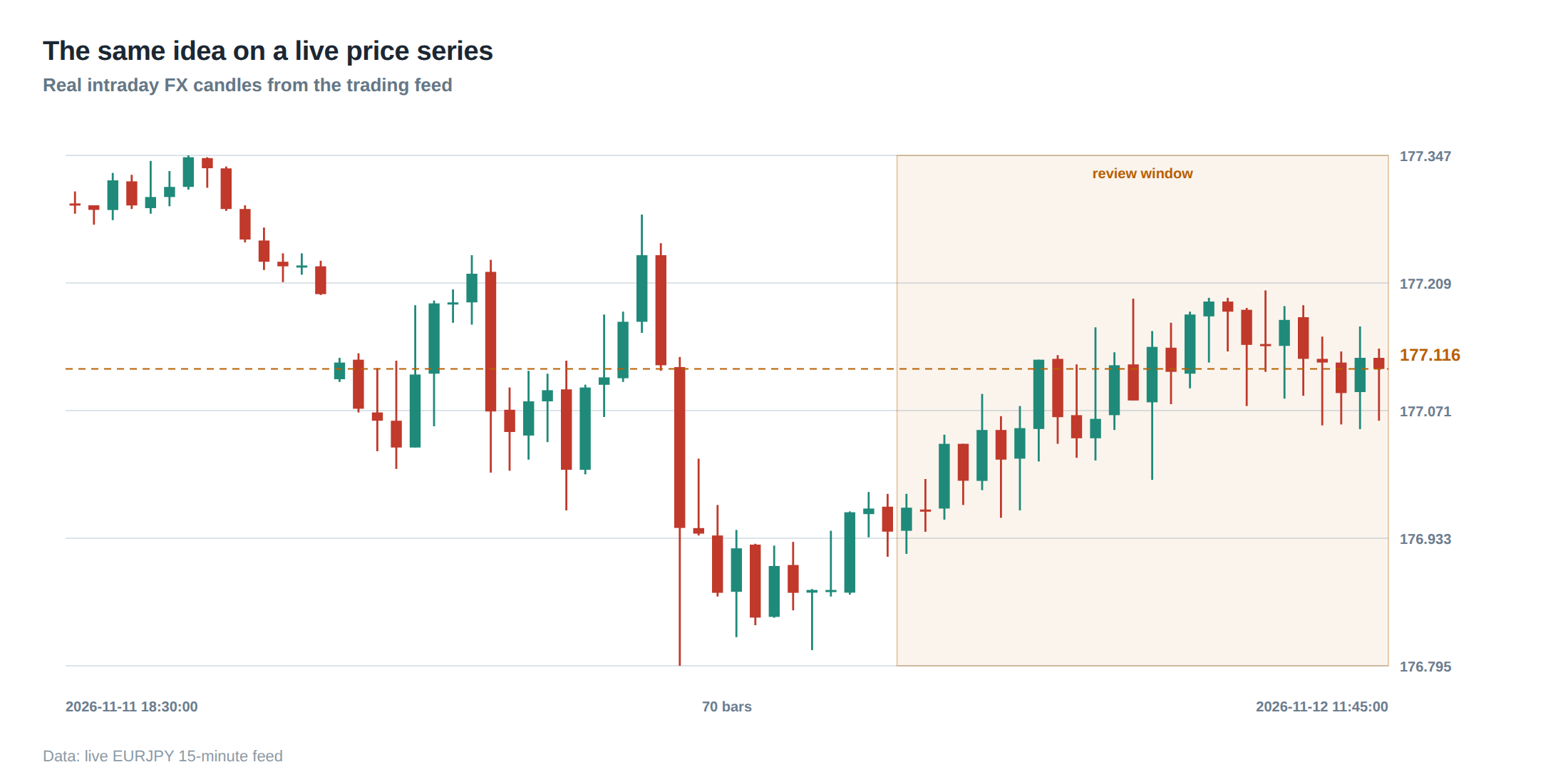
In practice the idealised timings above are rarely achieved. Network congestion, hardware interrupts, and occasional software pauses can add tens of milliseconds to each leg of the round‑trip. When a venue experiences a temporary overload, order acknowledgements may be delayed by hundreds of milliseconds, and cancellation confirmations can be queued behind higher‑priority system messages.
Moreover, many proprietary strategies operate multiple sub‑microsignal streams simultaneously. A “replacement storm” can be triggered when a single signal expires but the OMS continues to send amendment messages in the hope of catching a later price move. If acknowledgements lag, the storm can flood the exchange with stale orders, inflating the queue position and increasing the probability of unintended fills.
The most common failure mode is the assumption that a local cancel request is sufficient. In reality the order remains in the venue’s book until the cancel is confirmed. Traders who rely only on the local state may believe they have removed exposure, while the exchange still holds the order, ready to be matched at the next tick. This mismatch between perceived and actual exposure is the hidden source of many micro‑losses.
The operating path, stage by stage
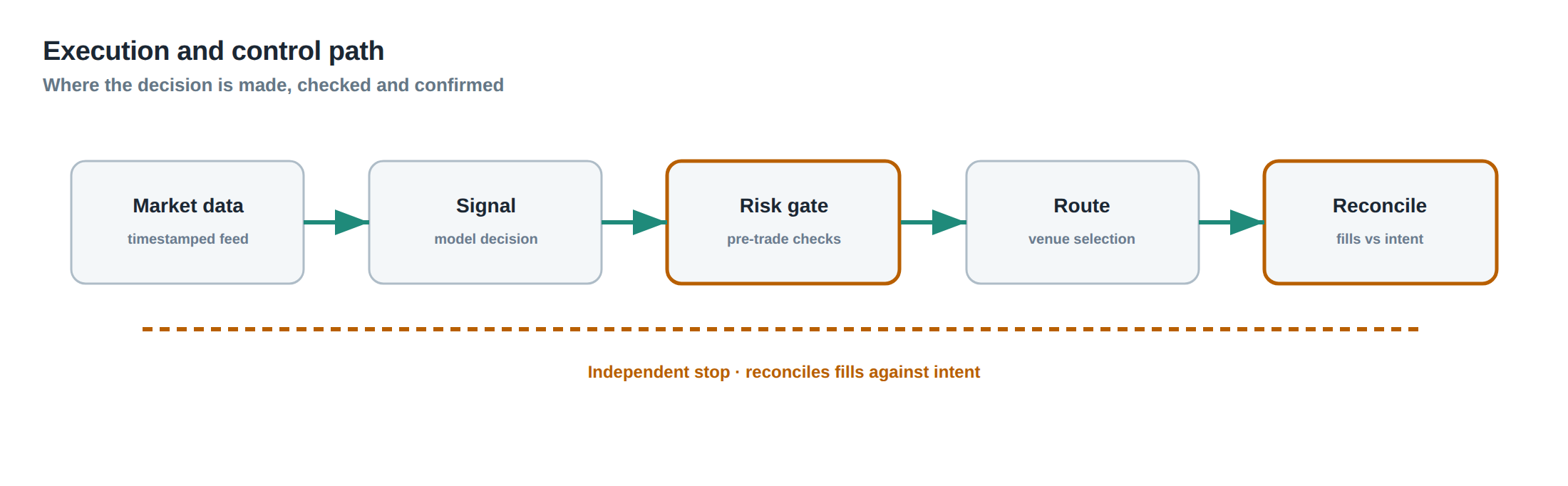
The full lifecycle can be divided into six discrete stages. First, the signal is produced and stamped with a timestamp and a maximum age. Second, the order is encoded and handed to the gateway, where it joins the outbound network queue. Third, the packet traverses the physical link and arrives at the exchange’s edge router. Fourth, the exchange’s matching engine inserts the order into the limit‑order book, assigning a queue position that evolves with incoming traffic. Fifth, if the signal expires or market conditions change, the OMS issues a cancel request that follows the same network path in reverse. Sixth, the exchange processes the cancel, removes the order, and sends an acknowledgement back to the OMS.
At each stage the system can measure elapsed time, compare it against the signal’s remaining lifetime, and decide whether to continue, amend, or abort the order. The critical decision points are after stage three (pre‑book entry) and after stage five (post‑cancel request). If the remaining lifetime is below a pre‑defined safety margin, the OMS must either let the order sit out or issue an aggressive market‑order replacement that guarantees immediate execution, depending on the strategy’s risk appetite.
A flow diagram that captures these stages clarifies where latency accumulates and where control logic can intervene. By visualising the path, developers can pinpoint bottlenecks, such as a gateway that serialises outbound messages, or a venue that batches cancellations, and redesign the architecture to respect the order‑lifetime constraint.
Controls that act before the damage
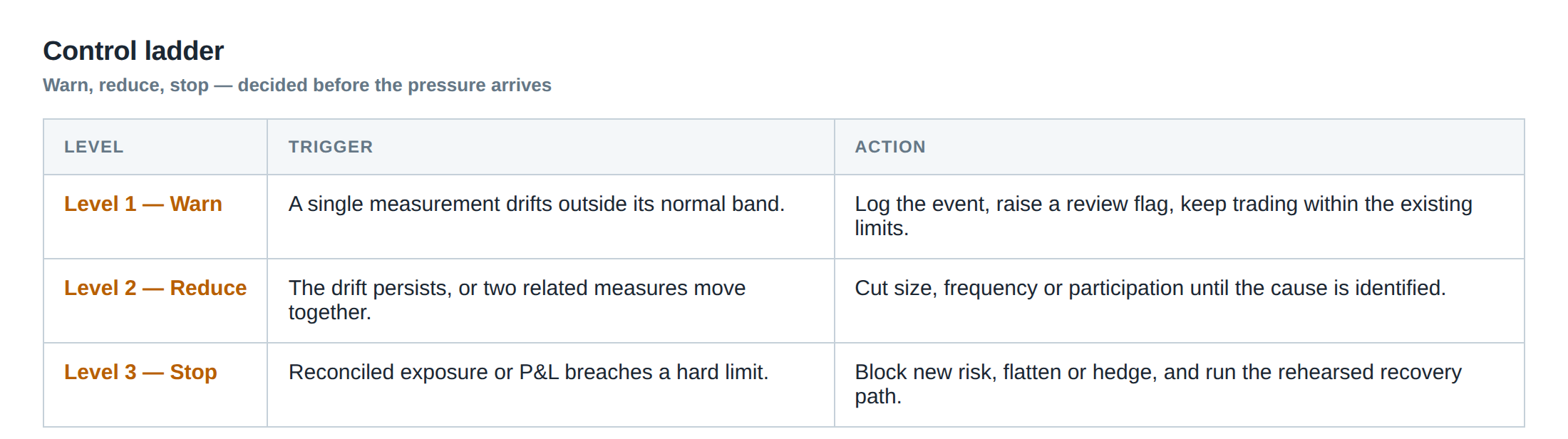
Preventative controls should be embedded at three levels: signal, order, and venue. At the signal level the model must output not only a price target but also a hard expiry, expressed in milliseconds, that reflects the statistical decay of the edge. The OMS should enforce a “maximum age” field that cannot be overridden downstream.
At the order level the system should maintain two timestamps: the moment the order left the OMS and the moment a cancellation was acknowledged by the venue. If the acknowledgement does not arrive within a configurable “ack window” (for example 30 ms), the order is automatically flagged for forced termination, either by sending a higher‑priority market‑order cancel or by disconnecting the gateway to avoid further stale traffic.
At the venue level the OMS should monitor the round‑trip acknowledgement latency for each exchange. When a venue’s average cancel‑ack latency exceeds a threshold, the system can temporarily suspend new order flow to that venue or switch to a backup route with lower latency. A ladder of safeguards—signal expiry, order‑age enforcement, and venue‑latency monitoring—creates a hierarchy that stops a stale order before it can cause loss.
How to measure whether it is working
The primary metric is “exposure time”, defined as the interval between the signal timestamp and the venue‑confirmed cancellation timestamp. By aggregating exposure time across all orders, the desk can compute the average and tail‑percentile values. A well‑tuned system should keep the 95th percentile exposure below the signal’s maximum age, ideally by a comfortable margin.
Secondary metrics include “cancel‑ack latency”, “order‑to‑fill latency”, and “replacement‑storm frequency”. Monitoring the distribution of these latencies in real‑time allows the risk team to spot degradation before it translates into financial loss. Anomalies, such as a sudden spike in cancel‑ack latency, should trigger an automatic alarm that forces a temporary halt of the affected strategy.
Finally, a post‑trade analysis should compare the realised P&L of each order against the expected P&L derived from the signal’s edge and the observed exposure time. The discrepancy quantifies the cost of stale exposure and provides a feedback loop for adjusting the maximum‑age parameters.
The portfolio view
When every fast order is treated as a time‑bounded instrument, the portfolio’s risk profile becomes a function of the aggregate “order‑lifetime exposure”. In a multi‑strategy environment, the total exposure is the sum of the individual exposures, weighted by the size of each order. If several strategies simultaneously generate short‑lived signals, the combined exposure can exceed the desk’s risk limits even though each individual order respects its own lifetime.
Consequently, the risk engine should enforce a portfolio‑level cap on concurrent exposure time, expressed as a percentage of total notional. This cap can be dynamically adjusted based on market conditions, such as increased volatility or known venue latency spikes. By integrating order‑lifetime controls into the broader portfolio risk framework, the desk ensures that the micro‑risk of stale orders does not accumulate into a macro‑risk that jeopardises capital.
The discipline of attaching a lifetime to every fast order, monitoring its state through the full operating path, and measuring exposure in real time transforms a subtle implementation flaw into a quantifiable risk factor. It aligns the technical execution chain with the statistical decay of the underlying signal, preserving the edge that the model seeks to capture.
Do you currently enforce a hard expiry on every micro‑order, and if not, how might that change the way your desk manages stale‑order risk?
About the research behind this lesson
The seminar frames electronic markets as price-time-priority queues. It separates queue value into spread capture versus adverse-selection cost and the option value of retaining a place in line.
Applied to this lesson: An order lifetime therefore cannot be based on elapsed time alone: the system must reassess whether its queue position, expected spread and adverse-selection risk still justify keeping the order alive.
Two live systems, one desk
PULSE-X — power-packed HFT: high-frequency momentum on XAUUSD and EURUSD. System details · Live account
NIC-X — ultra-low drawdown: displaced-print arbitrage for large capital. System details · Live account
Start now: leave your email and request a free trial — we will send the pricing, the connection route and the trial terms. Pricing
Join the market discussion: Telegram @squawklive
Source: High-Frequency Trading and Modern Market Microstructure
Educational content only. Trading leveraged products involves risk.
Chat with XTRSK
Chat ready
Start a chat and the XTRSK team will be notified immediately.