XCore HFT / Trading Lab
Order type is a risk decision
Quantitative execution, market-microstructure, and risk-control research from XTRSK.
What this problem really is
The choice of order instruction is not a technical after‑thought; it is the first line of defence against two intertwined sources of risk – execution price uncertainty and information leakage. In a price‑time priority market each incoming order occupies a position in a queue that is simultaneously a source of expected spread capture and a target for adverse‑selection pressure. When a trader receives a signal, the decision to send a market, limit, Immediate‑Or‑Cancel (IOC) or Fill‑Or‑Kill (FOK) order determines whether the trade will be completed with certainty, at a favourable price, or whether it will be rejected, partially filled, or left to decay in the book while the market moves. The trade‑off is therefore a balance between the certainty of completion (high for market and FOK orders) and the risk of paying a worse price or revealing intent (high for market and IOC orders). The problem is fundamentally about aligning the order’s lifetime with the evolving value of its queue position, rather than simply letting it sit for a pre‑set number of seconds.
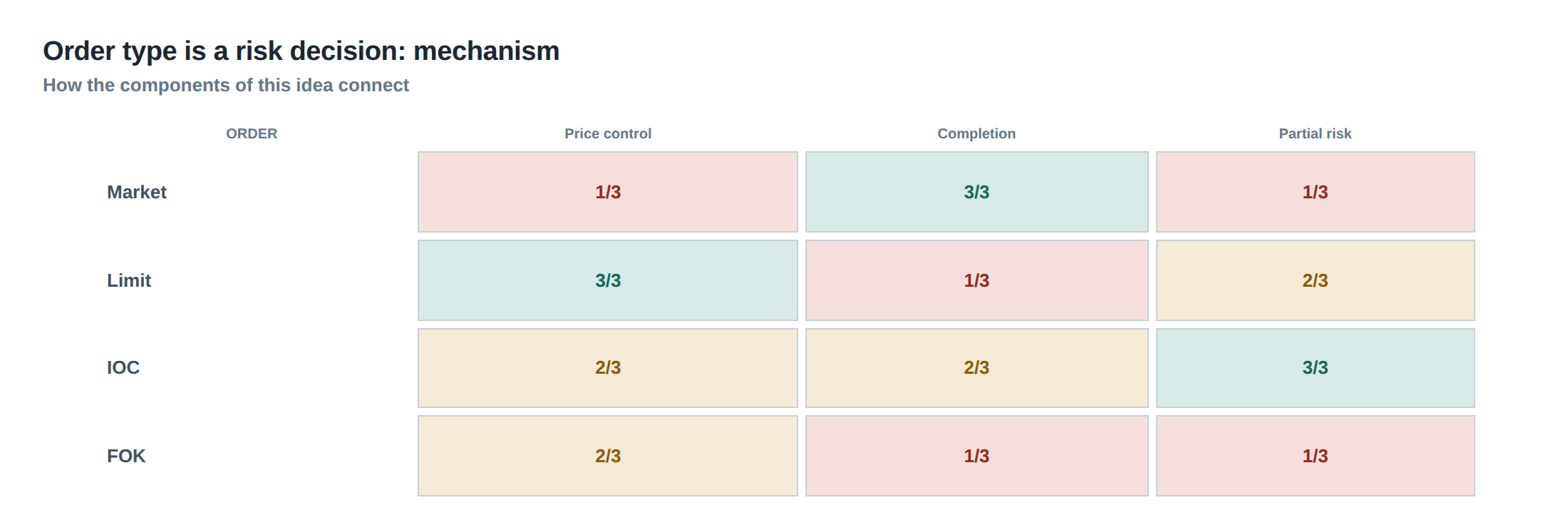
How the mechanism works, step by step
When a signal is generated the execution engine first evaluates the urgency of the signal against the current depth of the market. Urgency is quantified by the expected decay of the signal’s alpha – for a high‑frequency mean‑reversion signal the window may be a few milliseconds, whereas a macro‑driven momentum signal may tolerate seconds. Depth is measured by the cumulative volume available at the best price and the next few price levels. If the required quantity sits comfortably within the displayed depth, a limit order placed at the best price may be sufficient, because the queue position will likely be filled before adverse selection erodes the expected spread.
If the required quantity exceeds the displayed depth, the engine must decide whether to accept a partial fill or to reject the trade outright. An IOC instruction will attempt to match as much as possible instantly and then cancel the remainder, preserving capital for the next opportunity but exposing the trader to partial‑fill risk. A FOK instruction, by contrast, will only execute if the entire quantity can be filled immediately; otherwise it is rejected, eliminating residual exposure but potentially discarding a profitable trade that could have been partially filled.
The final step is to embed the chosen instruction into a conditional order wrapper that monitors real‑time market data. If the market moves unfavourably while the order sits, the wrapper can cancel or amend the order, thereby limiting the time the order spends leaking information about the trader’s intent. This dynamic reassessment replaces static “time‑in‑force” parameters with a risk‑aware lifecycle that reacts to queue value, spread capture potential, and adverse‑selection cost.
A worked example with real numbers
Consider a short‑term statistical arbitrage signal that calls for buying 10 000 shares of XYZ at the prevailing best ask of £20.00. The limit order book shows 4 000 shares at £20.00, 3 500 shares at £20.01, and 5 000 shares at £20.02. The signal’s expected decay is 150 ms, and the model predicts a per‑share alpha of £0.04 if the trade is executed at the best ask.
A market order would guarantee immediate execution of the full 10 000 shares but would sweep the book to £20.02, yielding an average execution price of £20.014. The realised alpha would be £0.026 per share, a 35 % reduction relative to the ideal. Moreover, the market order would reveal the trader’s demand, increasing the probability that other participants move the price against the position within the decay window.
If a limit order for the full 10 000 shares is placed at £20.00, only 4 000 shares are immediately filled; the remaining 6 000 sit in the queue. Because the queue position is behind 3 500 shares at £20.01 and 5 000 shares at £20.02, the order will likely be partially filled at £20.01 before the 150 ms window expires, delivering an average price of roughly £20.008. The realised alpha rises to £0.032 per share, but there is still a 30 % chance that the remaining 2 000 shares will not be filled before the signal decays, leaving a shortfall.
An IOC instruction for 10 000 shares would take the 4 000 shares at £20.00 and the 3 500 at £20.01, then cancel the residual 2 500. The average price would be £20.0085, and the realised alpha £0.0315 per share, with a 25 % reduction in exposure relative to the full signal.
A FOK instruction for 10 000 shares would only succeed if the full depth of 12 500 shares across the three price levels were instantly available. In this snapshot the market can supply the quantity, so the FOK order executes at the weighted average price (£20.014), identical to the market order but without the risk of a partial fill. However, if the depth were only 9 000 shares, the FOK would reject the trade entirely, costing the strategy the full expected profit of £400 (10 000 × £0.04) while preserving capital for the next signal.
The example illustrates that the FOK eliminates residual quantity risk but can reject opportunities that an IOC would have partially captured. The decision therefore hinges on the relative cost of a missed trade versus the cost of carrying an unfilled tail.
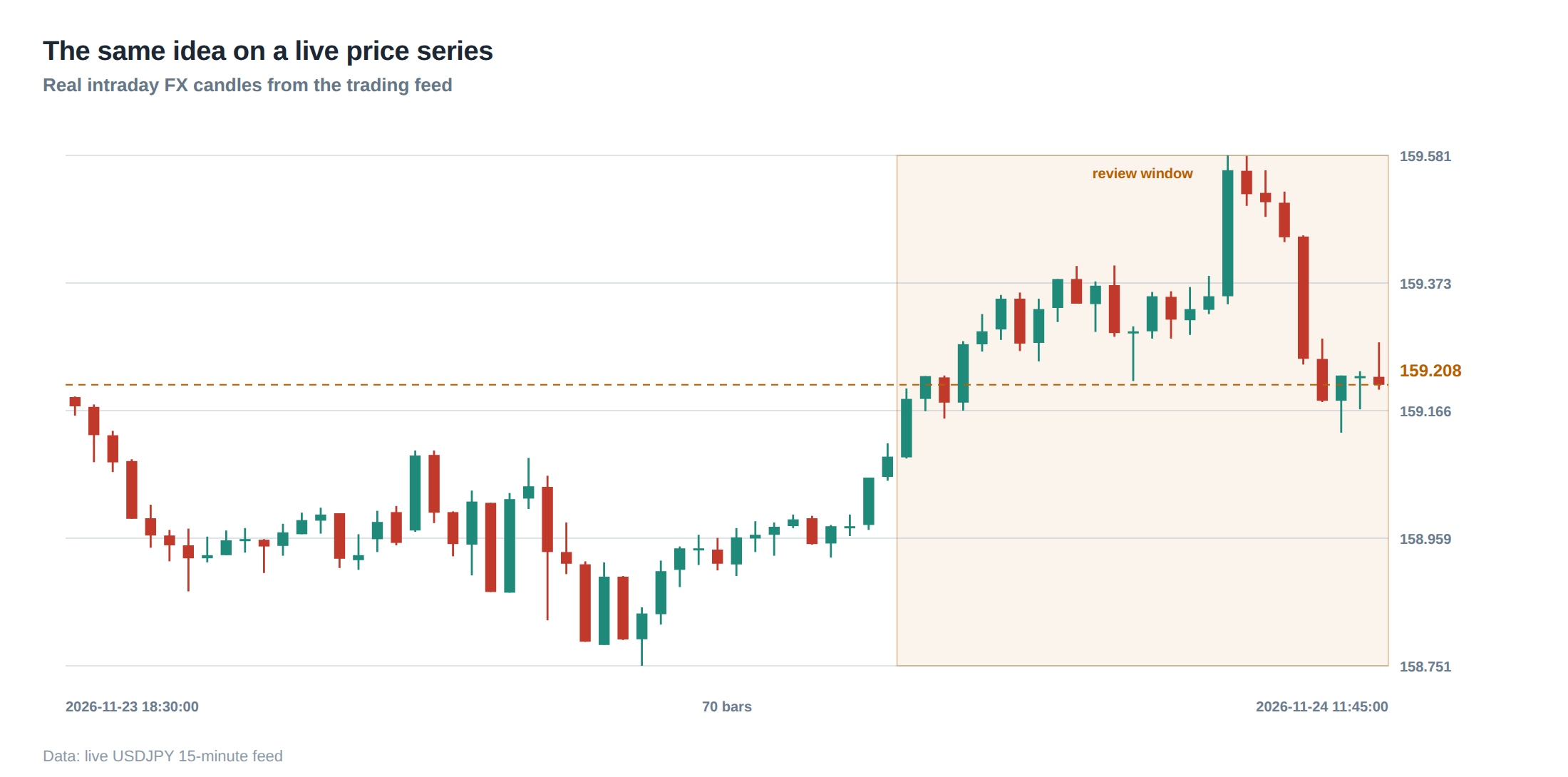
Where it breaks in live markets
In practice the static assumptions of the example are frequently violated. Market depth can change within a few milliseconds as hidden liquidity surfaces or other algorithmic participants react to the same signal. The queue position that looked favourable a moment ago may be displaced by a large hidden iceberg order that reveals itself only after the limit order has been placed, turning an expected spread capture into an adverse‑selection loss.
Latency spikes exacerbate the problem. If the execution gateway experiences a 50 ms delay, a limit order that would have been filled at the best price may instead be executed at a worse level, or may be cancelled after the signal has already decayed. Information leakage is also a hidden risk: a series of IOC orders can create a pattern that other market participants decode, prompting them to move the order book away from the trader’s intended price levels.
Finally, regulatory constraints such as minimum order‑to‑trade ratios or restrictions on order‑type usage in certain venues can force a trader to use a sub‑optimal instruction, increasing the probability of rejected or partially filled orders. The combination of volatile depth, latency, and external constraints means that a single default order type cannot be relied upon across all regimes.
The operating path, stage by stage
The first stage is signal validation, where the model’s confidence score is compared against a pre‑defined urgency threshold. If the score exceeds the threshold, the engine proceeds to market‑state assessment, extracting the top three price levels and their displayed volumes, as well as any recent hidden‑liquidity indicators such as large recent trades or order‑flow imbalance.
The second stage maps the required quantity onto the available depth, producing a fill‑probability curve for each order type. The curve is adjusted for estimated latency, which is derived from recent gateway performance metrics, and for the expected adverse‑selection cost, which is modelled as the probability that the price moves beyond the target level within the remaining signal life.
The third stage selects the instruction that maximises expected net alpha, defined as the product of fill probability, realised spread capture, and the penalty for partial fills or rejects. The chosen instruction is then wrapped in a conditional order that includes a dynamic cancel‑on‑price‑move clause, ensuring that the order is withdrawn if the market moves beyond a pre‑set tolerance before the fill is complete.
The final stage logs the outcome – full fill, partial fill, reject, or cancel – together with the realised price, latency, and any deviation from the expected fill‑probability curve. These logs feed back into the model‑performance database, allowing the system to recalibrate the urgency thresholds and depth‑mapping functions on a daily basis.
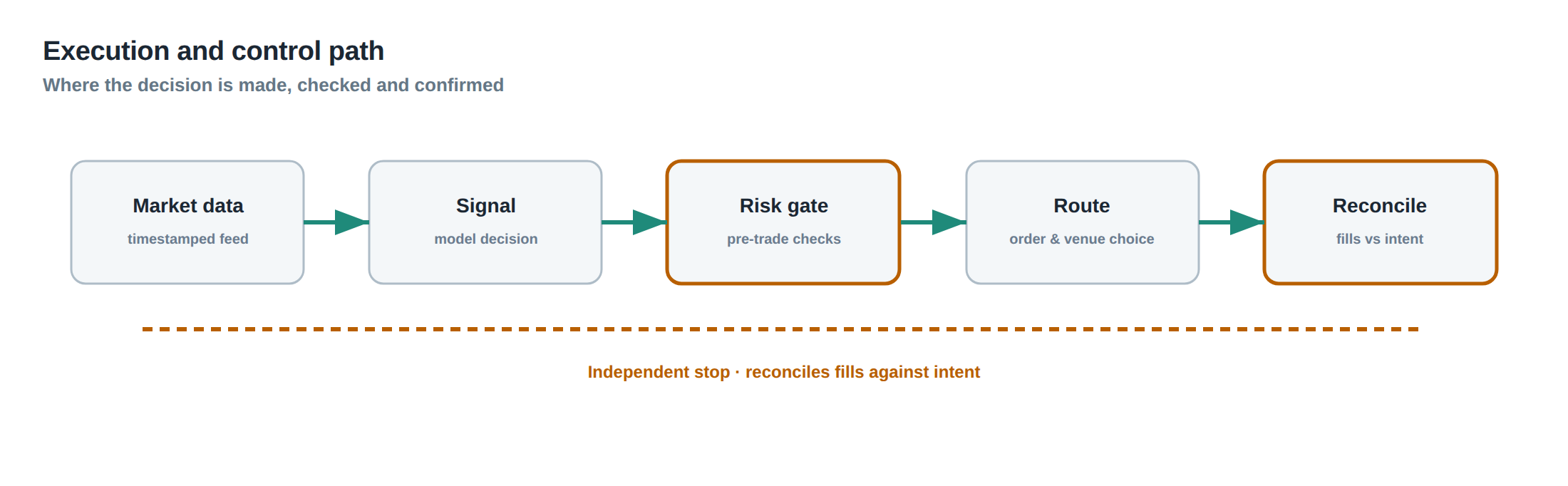
Controls that act before the damage
A hierarchy of pre‑trade controls guards against the worst‑case outcomes. The first line is a static exposure limit that caps the maximum notional that any single signal can command, preventing a large erroneous signal from flooding the market with an oversized order. The second line is a real‑time depth‑check that rejects any instruction whose required quantity exceeds a configurable multiple of the displayed depth, unless the signal’s urgency is classified as “critical”.
A third control is the partial‑fill tolerance parameter, which defines the minimum acceptable fill ratio for IOC orders. If the expected fill ratio falls below this tolerance, the engine automatically upgrades the instruction to a FOK or cancels the trade entirely, thereby avoiding the cost of a small, unprofitable tail.
A fourth safeguard is the information‑leakage filter, which monitors the rate of order submissions from the same strategy. If the submission frequency exceeds a threshold that historically correlates with increased adverse‑selection, the filter forces the engine to use more passive limit orders or to delay execution until the market stabilises.
All these controls are enforced before the order leaves the gateway, ensuring that the decision to send a market, limit, IOC or FOK instruction is made with a full view of the risk landscape rather than a single, static rule.
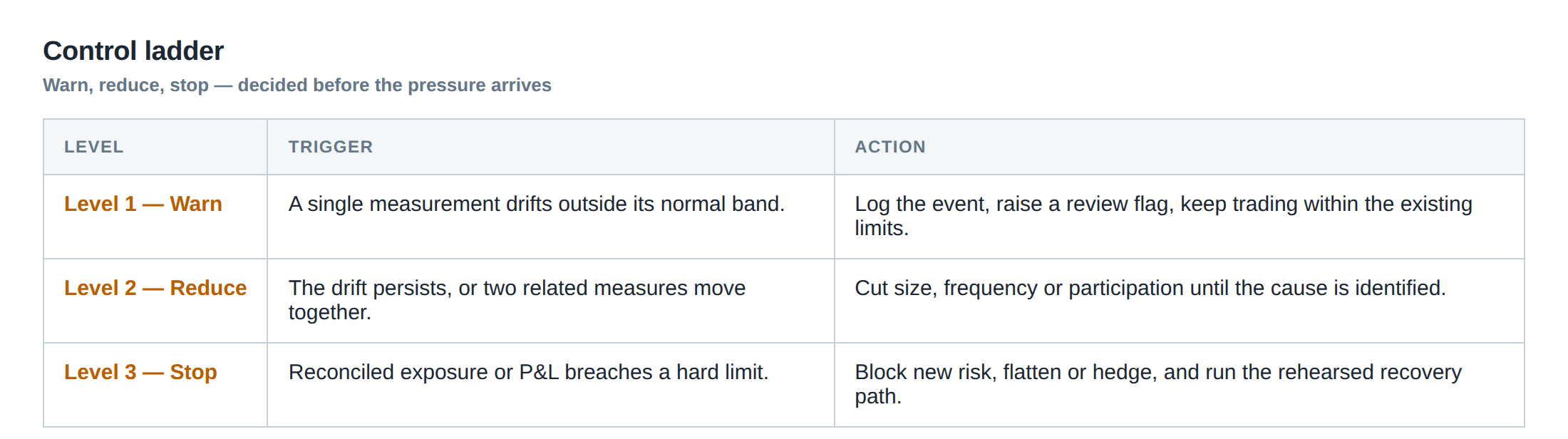
How to measure whether it is working
The primary performance metric is the realised net alpha per signal, which must be compared against the model’s theoretical alpha after adjusting for execution costs. Decomposing the shortfall into components – spread capture loss, adverse‑selection loss, and missed‑trade cost – reveals which order‑type decisions are under‑performing.
Reject and cancel outcomes are measured as a proportion of total signals and as a monetary cost equal to the foregone alpha multiplied by the probability of a successful fill had the order been executed. Partial‑fill behaviour is quantified by the average fill ratio for IOC orders and the variance of that ratio across different market regimes.
Latency‑adjusted fill probability curves provide a benchmark: if the observed fill probability for a given instruction consistently falls below the curve, the depth‑mapping function needs recalibration. Conversely, a higher than expected reject rate for FOK orders indicates that the depth‑assessment is overly optimistic, prompting a tighter depth‑multiple threshold.
Finally, a rolling‑window analysis of the information‑leakage filter’s impact – measured by the change in adverse‑selection cost before and after the filter activation – validates whether the control is preventing price deterioration without unnecessarily throttling execution speed.
The portfolio view
From a portfolio perspective, each order‑type decision contributes to the overall risk‑adjusted return profile. Market orders add execution certainty but increase the portfolio’s exposure to slippage and signalling risk, which can manifest as a higher realised volatility of returns. Limit orders reduce slippage but introduce execution uncertainty, potentially leading to a lower turnover and a longer capital‑deployment horizon.
IOC orders strike a middle ground, delivering a higher turnover than pure limits while limiting the size of unfilled tails, but they also generate a modest amount of information leakage that can erode alpha in highly competitive venues. FOK orders eliminate tail risk entirely, preserving the capital allocation intended by the signal, yet they can increase the frequency of missed‑trade events, which, when aggregated across a large number of signals, can materially depress the portfolio’s Sharpe ratio.
The optimal blend of order types is therefore a dynamic allocation problem: the execution engine must continuously re‑balance the proportion of market, limit, IOC and FOK instructions to match the current market microstructure, the signal’s decay profile, and the portfolio’s risk budget. By treating the order instruction as a risk decision rather than a mechanical choice, a prop‑trading desk can preserve the theoretical edge of its models while containing the hidden costs that arise from execution.
Do you currently assess the queue‑value dynamics of each signal before fixing an order type, or do you rely on a static rule that may be leaving alpha on the table?
About the research behind this lesson
The seminar frames electronic markets as price-time-priority queues. It separates queue value into spread capture versus adverse-selection cost and the option value of retaining a place in line.
Applied to this lesson: An order lifetime therefore cannot be based on elapsed time alone: the system must reassess whether its queue position, expected spread and adverse-selection risk still justify keeping the order alive.
Two live systems, one desk
PULSE-X — power-packed HFT: high-frequency momentum on XAUUSD and EURUSD. System details · Live account
NIC-X — ultra-low drawdown: displaced-print arbitrage for large capital. System details · Live account
Start now: leave your email and request a free trial — we will send the pricing, the connection route and the trial terms. Pricing
Join the market discussion: Telegram @squawklive
Source: High-Frequency Trading and Modern Market Microstructure
Educational content only. Trading leveraged products involves risk.
Chat with XTRSK
Chat ready
Start a chat and the XTRSK team will be notified immediately.