
XCore HFT / Trading Lab
XCore HFT Trading Lab: Pre-trade risk should be layered
Quantitative execution, market-microstructure, and risk-control research from XTRSK.
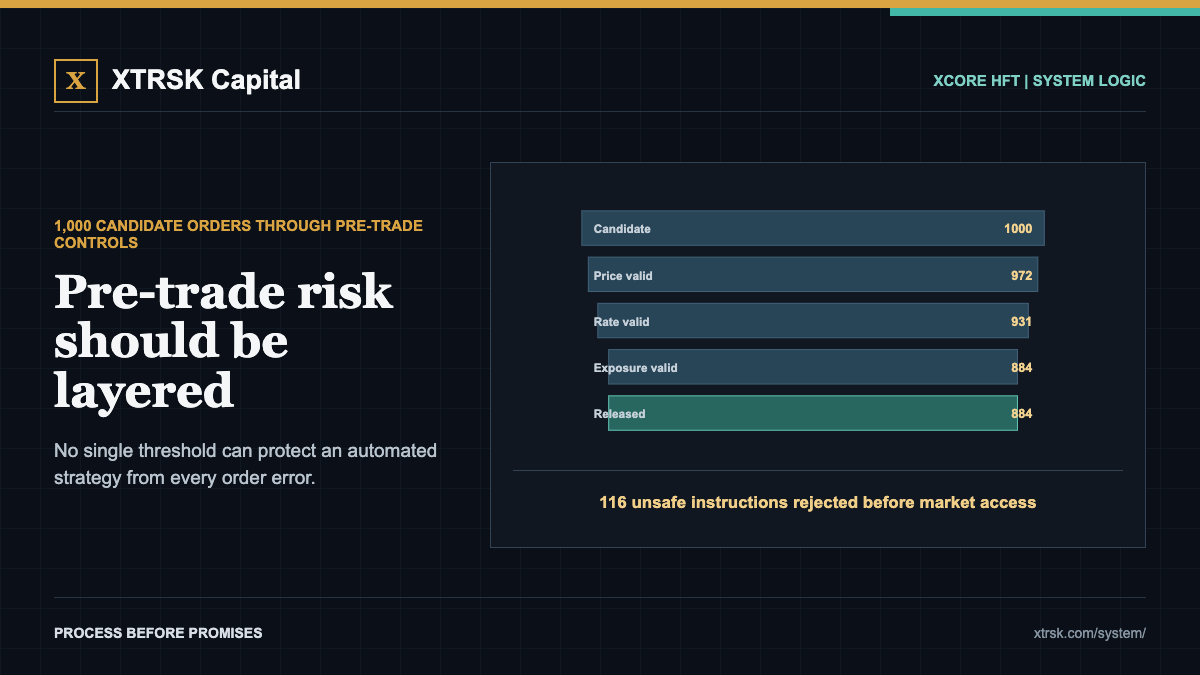
A clean backtest can hide a messy execution problem. Live markets expose the difference immediately. Pre-trade risk should be layered.
The system becomes understandable only when data, decision, execution and capital are measured together. No single threshold can protect an automated strategy from every order error. Limit message frequency and repeated submissions. Cap strategy, instrument, account and firm-wide exposure. What matters operationally is the link between drawdown, proof, control and failure path.
Put a boundary around the claim. An order can pass a lot limit yet still be dangerous because correlated positions have already consumed the portfolio risk budget. The example is not a forecast or a promise; it shows which variable must be measured before the apparent opportunity can be treated as usable.
A compact operating checklist is: 1) reject stale signals and orders created from stale market data; 2) make every rejection observable to operations; 3) check maximum order quantity, notional value and price distance. Add hard exposure ceilings, observable rejection reasons and an event trail that lets operations reconstruct the decision without guessing. Control sequence: 1 signal, 1 order path, 1 reconciled risk state.
Averages make the system look orderly. Tail events reveal whether the controls were designed for live markets. Review the median, the stressed tail and the failure path separately. A result that survives only in quiet sessions, tiny size or perfect data is a research result, not yet a production capability.
Individual controls answer whether one instruction is permitted. Portfolio controls answer whether the firm can absorb all permitted instructions together. The objective is not to remove uncertainty. It is to size uncertainty, detect when assumptions break and preserve the ability to stop without creating a second problem.
Where is the largest gap between the risk your model reports and the risk your account can actually realise?
#RiskManagement #AlgoTrading
The research behind this lesson
This paper explains The seminar frames electronic markets as price-time-priority queues. It separates queue value into spread capture versus adverse-selection cost and the option value of retaining a place in line.
Applied to this XCore lesson: An order lifetime therefore cannot be based on elapsed time alone: the system must reassess whether its queue position, expected spread and adverse-selection risk still justify keeping the order alive.
Explore XCore HFT: System details
PULSE XCORE HFT live account: Verify the live account on FX Blue
Live chat and updates: Telegram @xtrskhft
Source: High-Frequency Trading and Modern Market Microstructure
Educational content only. Trading leveraged products involves risk.
Chat with XTRSK
Chat ready
Start a chat and the XTRSK team will be notified immediately.