
XCore HFT / Trading Lab
Pre-trade risk should be layered
Quantitative execution, market-microstructure, and risk-control research from XTRSK.
What this problem really is
The temptation on a prop‑trading desk is to protect an algorithm with a single, easy‑to‑monitor threshold – for example a hard cap on order size or a maximum notional value. In practice that approach is brittle because the risk of an order is a function of many interacting variables: the current portfolio composition, the distance of the order price from the prevailing market, the frequency with which the same strategy re‑submits identical messages, and the freshness of the market data that generated the signal. When any one of those dimensions is ignored, an apparently compliant order can still generate a loss that far exceeds the intended risk budget. The problem is therefore not a lack of limits but a lack of layers – a hierarchy of checks that together enforce the true economic exposure of the trade before it ever reaches the exchange.
How the mechanism works, step by step
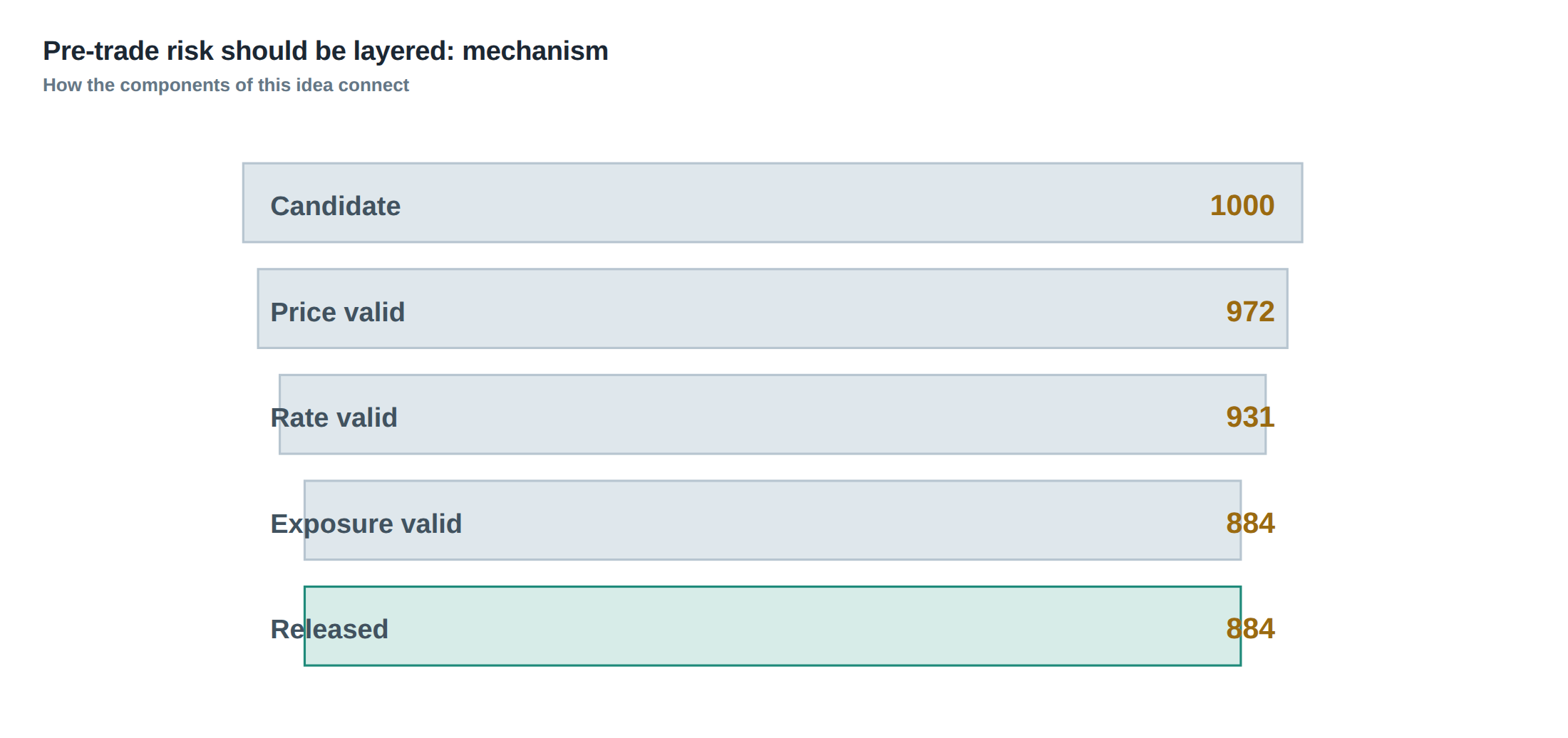
The first layer inspects the raw order parameters. It verifies that the absolute quantity does not exceed a per‑instrument ceiling, that the notional value (price × quantity) stays within a predefined band, and that the limit price is no more than a calibrated distance from the mid‑price or best bid/offer. The second layer monitors the messaging cadence; a rapid burst of identical submissions from the same strategy triggers a throttle that forces a pause and a review of the underlying signal. The third layer aggregates exposure across the entire strategy, the instrument class, the account and finally the firm. If the new order would push any of those aggregates beyond its allocated budget, the order is rejected. The fourth layer validates data freshness: timestamps on market data, order book snapshots and signal timestamps must be within a tight window; otherwise the order is treated as stale and discarded. Finally, every rejection is emitted as a structured event that is captured by the operations dashboard, ensuring that the risk team can trace the decision path and adjust parameters if systematic rejections appear.
A worked example with real numbers
Consider a desk with a $100 million capital base that has allocated a 1 % risk budget to a statistical arbitrage strategy, i.e. $1 million of potential loss. The current portfolio holds correlated long positions in three equities that together have already consumed $800 000 of that budget, as measured by the realised volatility‑scaled exposure model. A new signal suggests buying 1 000 shares of a fourth stock at $100 per share, giving a notional of $100 000. The per‑instrument quantity limit is 2 000 shares, and the price distance rule allows a limit price up to 0.5 % away from the mid‑price, which the order satisfies. The message frequency rule is also clear – this is the first submission from the strategy in the last 30 seconds. However, when the exposure aggregation layer adds the prospective position, the model projects an incremental VaR of $250 000 because the new stock is highly correlated with the existing trio. Adding that to the $800 000 already used would breach the $1 million budget by $50 000. The system therefore rejects the order despite it passing the first two layers.
Where it breaks in live markets
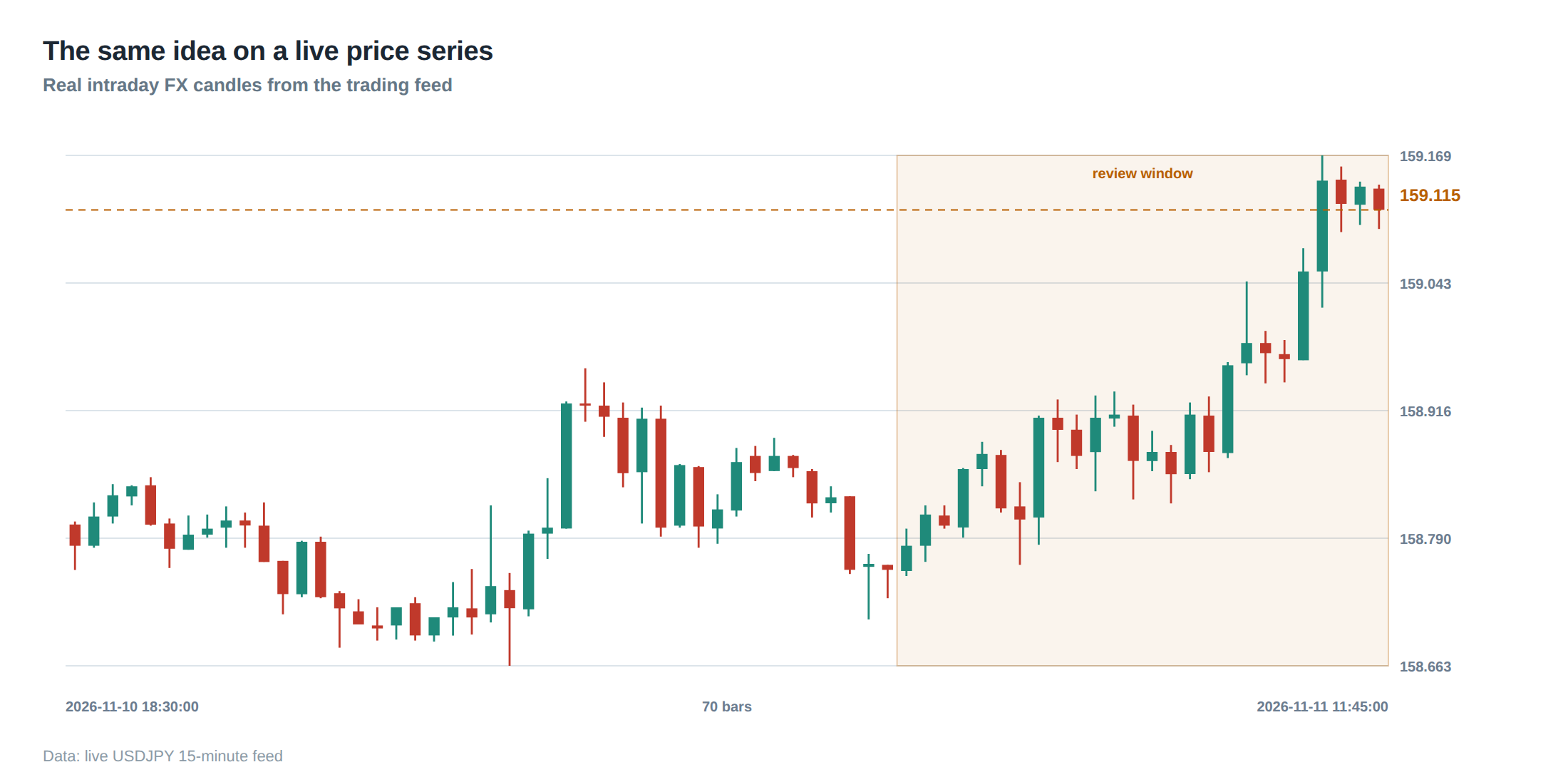
Even a well‑designed layered pre‑trade guard can be undermined by market realities. Latency spikes can cause market data to become stale between the moment a signal is generated and the moment the order reaches the risk engine, meaning the price‑distance check is performed on an outdated mid‑price. Rapid price moves can also erode the assumed spread capture, turning an order that would have earned a modest rebate into a costly adverse‑selection trade. Moreover, the queue dynamics of modern limit‑order books mean that an order’s expected lifetime is not simply a function of wall‑clock time; the value of retaining a place in line depends on the probability of execution before the queue is displaced by faster participants. If the system only uses elapsed time to decide when to cancel, it may keep an order alive long after its expected spread capture has vanished, exposing the portfolio to unnecessary risk.
The operating path, stage by stage
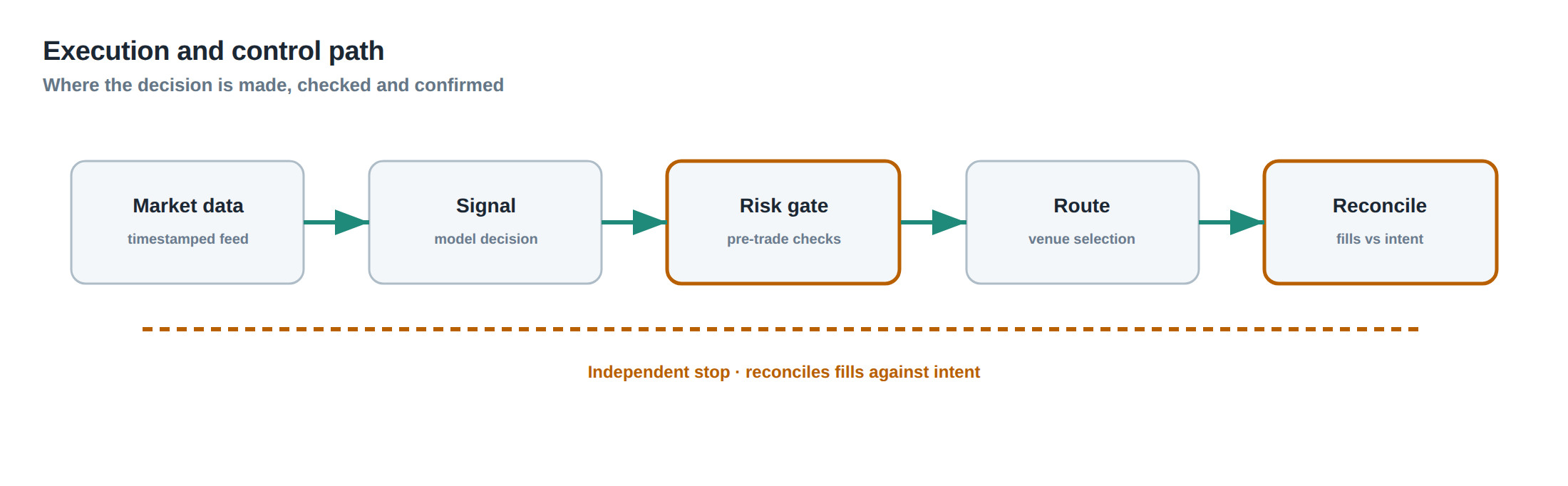
Signal generation is the first stage, where the algorithm consumes market data and produces a trade idea with an attached confidence metric. The idea then passes into the pre‑trade risk engine, where the layered checks described earlier are applied in a deterministic order: raw parameter validation, messaging cadence, exposure aggregation, data freshness, and finally observability tagging. If the order survives, it is handed to the order gateway, which translates the internal representation into the exchange‑specific protocol and submits it to the market. A monitoring subsystem watches the order’s state in the exchange queue, re‑evaluating the spread capture and adverse‑selection risk at regular intervals; if the expected value falls below a threshold, a cancellation request is issued. Throughout the lifecycle every state transition – acceptance, rejection, amendment, cancellation – is logged to a central audit store that the operations team can query in real time.
Controls that act before the damage
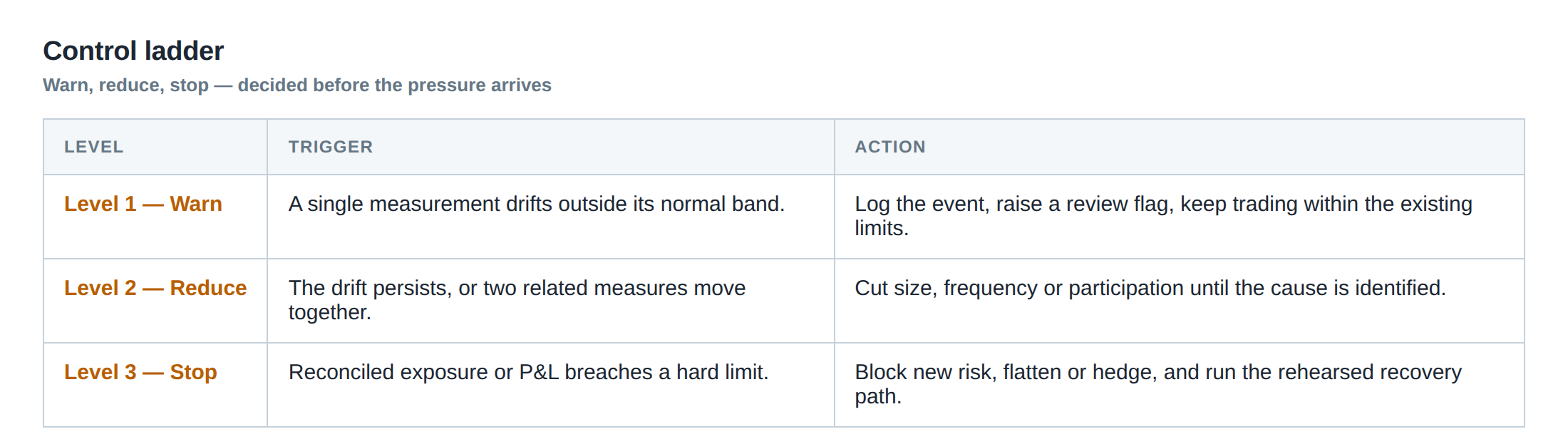
The first rung of the ladder is the static rule set: hard caps on quantity, notional and price distance that are instrument‑specific and reviewed quarterly. The second rung introduces dynamic throttling, where the system tracks the rate of identical messages per strategy and imposes exponential back‑off when a burst is detected. The third rung is the exposure aggregation engine, which continuously recomputes VaR, stress‑scenario loss and concentration metrics for each hierarchical bucket – strategy, instrument class, account and firm – and rejects any order that would breach a bucket’s limit. The fourth rung is the data‑freshness filter, which discards any order whose underlying market snapshot is older than a configurable latency threshold, typically 50 ms for equities and 100 ms for futures. The final rung is the observability layer: every rejection is emitted as a structured event with fields for rule identifier, offending parameter, timestamp and originating strategy, and is displayed on the operations dashboard alongside a running tally of rejections per hour. This ladder ensures that the most permissive checks are applied first, while the most protective ones sit at the top, preventing a single point of failure from compromising the entire chain.
How to measure whether it is working
Effectiveness is gauged by a suite of quantitative metrics. The primary indicator is the breach‑rate: the proportion of trading intervals in which the realised portfolio loss exceeds the pre‑defined risk budget; a downward trend signals that the layered pre‑trade guard is containing exposure. A complementary metric is the false‑positive rate, measured as the fraction of rejected orders that, in hindsight, would have been profitable and would not have violated any exposure limit; an excessively high false‑positive rate suggests over‑conservatism. Latency of rejection – the time between order creation and the emission of a rejection event – must remain well below the market‑data update interval to guarantee that stale signals are never acted upon. Finally, the distribution of rejection reasons provides insight into which layer is most active; a balanced spread indicates that each layer is contributing, whereas concentration in a single layer may reveal a mis‑tuned parameter.
The portfolio view
From a portfolio perspective, the layered approach enables the desk to enforce both micro‑ and macro‑level constraints without sacrificing the agility of individual strategies. By aggregating exposure across correlated instruments, the system recognises that a seemingly innocuous order can tip the overall risk profile when the portfolio is already near its limit. Firm‑wide caps ensure that a runaway algorithm cannot consume all capital, while strategy‑level caps protect the intellectual property of each model from being eroded by a single outlier trade. Stress‑testing frameworks feed hypothetical market moves into the exposure engine, confirming that the layered checks would still reject orders that would cause a breach under extreme conditions. This holistic view, combined with the real‑time observability of rejections, gives risk managers the confidence to allow automated strategies to operate at scale while keeping the tail risk within acceptable bounds.
Will your current pre‑trade controls survive the next market shock, or will a single unchecked order expose the desk to a loss that could have been avoided?
About the research behind this lesson
The seminar frames electronic markets as price-time-priority queues. It separates queue value into spread capture versus adverse-selection cost and the option value of retaining a place in line.
Applied to this lesson: An order lifetime therefore cannot be based on elapsed time alone: the system must reassess whether its queue position, expected spread and adverse-selection risk still justify keeping the order alive.
Two live systems, one desk
PULSE-X — power-packed HFT: high-frequency momentum on XAUUSD and EURUSD. System details · Live account
NIC-X — ultra-low drawdown: displaced-print arbitrage for large capital. System details · Live account
Start now: leave your email and request a free trial — we will send the pricing, the connection route and the trial terms. Pricing
Join the market discussion: Telegram @squawklive
Source: High-Frequency Trading and Modern Market Microstructure
Educational content only. Trading leveraged products involves risk.
Chat with XTRSK
Chat ready
Start a chat and the XTRSK team will be notified immediately.