
XCore HFT / Trading Lab
XCore HFT Trading Lab: Volatility changes the meaning of one lot
Quantitative execution, market-microstructure, and risk-control research from XTRSK.
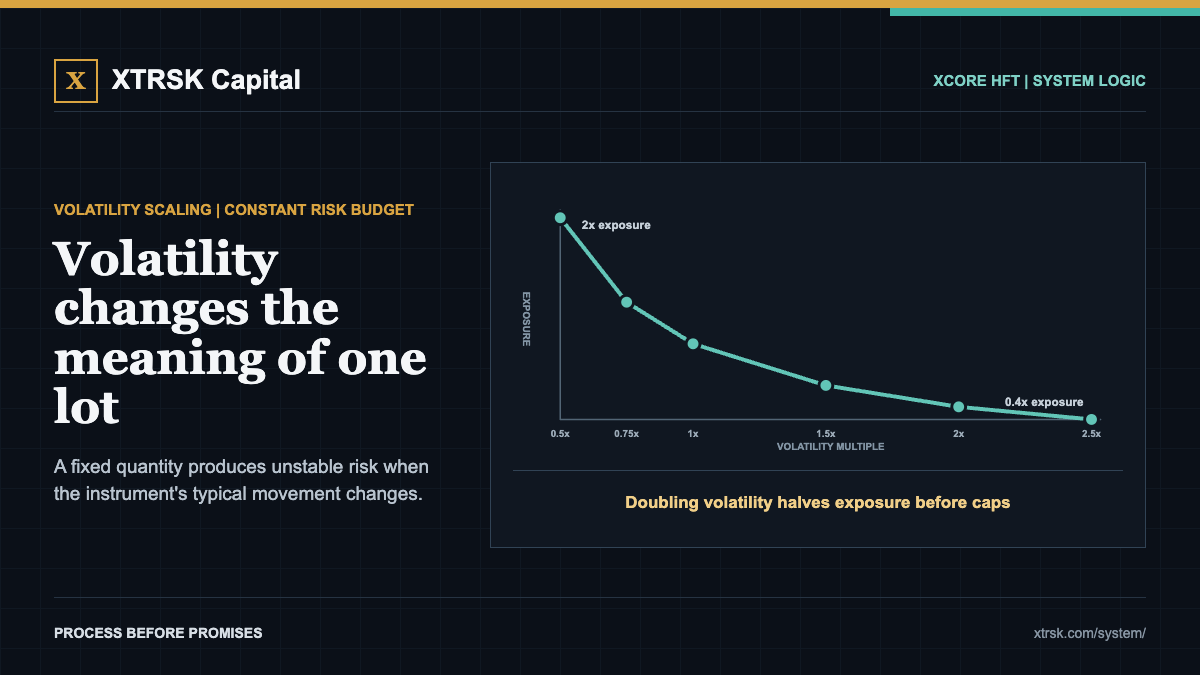
Most automated-trading failures begin as small mismatches: stale data, incomplete fills, delayed controls or misunderstood exposure. Volatility changes the meaning of one lot.
The system becomes understandable only when data, decision, execution and capital are measured together. A fixed quantity produces unstable risk when the instrument's typical movement changes. Apply floors and caps so estimates cannot create extreme sizes. Reduce size during unreliable or discontinuous markets. Strip away the slogan and the operating words are certainty, exposure, risk and drawdown.
Put a boundary around the claim. If estimated volatility doubles while the risk budget is unchanged, a simple inverse-volatility rule would halve exposure. The example is not a forecast or a promise; it shows which variable must be measured before the apparent opportunity can be treated as usable.
A compact operating checklist is: 1) measure realised risk after scaling; 2) scale exposure from a defined volatility estimate; 3) choose a lookback that balances responsiveness and turnover. Add hard exposure ceilings, observable rejection reasons and an event trail that lets operations reconstruct the decision without guessing. Control sequence: 1 signal, 1 order path, 1 reconciled risk state.
The misleading shortcut is to treat an individual pass as proof that aggregate risk is acceptable. Review the median, the stressed tail and the failure path separately. A result that survives only in quiet sessions, tiny size or perfect data is a research result, not yet a production capability.
Local optimisation can worsen the whole book. A faster fill or tighter stop is not automatically a better portfolio outcome. The objective is not to remove uncertainty. It is to size uncertainty, detect when assumptions break and preserve the ability to stop without creating a second problem.
How does your desk distinguish a temporary execution problem from evidence that the underlying edge has changed?
#PositionSizing #QuantTrading
The research behind this lesson
This paper explains Andrew Lo's lectures build risk analysis from return distributions and statistical measures, rather than treating one realised result as a complete description of risk.
Applied to this XCore lesson: For a fast strategy, median latency or average fill quality is not enough. The review has to include tail delays, stale-order frequency and the loss distribution when cancellation or routing behaves abnormally.
Explore XCore HFT: System details
PULSE XCORE HFT live account: Verify the live account on FX Blue
Live chat and updates: Telegram @xtrskhft
Source: Risk and Return
Educational content only. Trading leveraged products involves risk.
Chat with XTRSK
Chat ready
Start a chat and the XTRSK team will be notified immediately.