
XCore HFT / Trading Lab
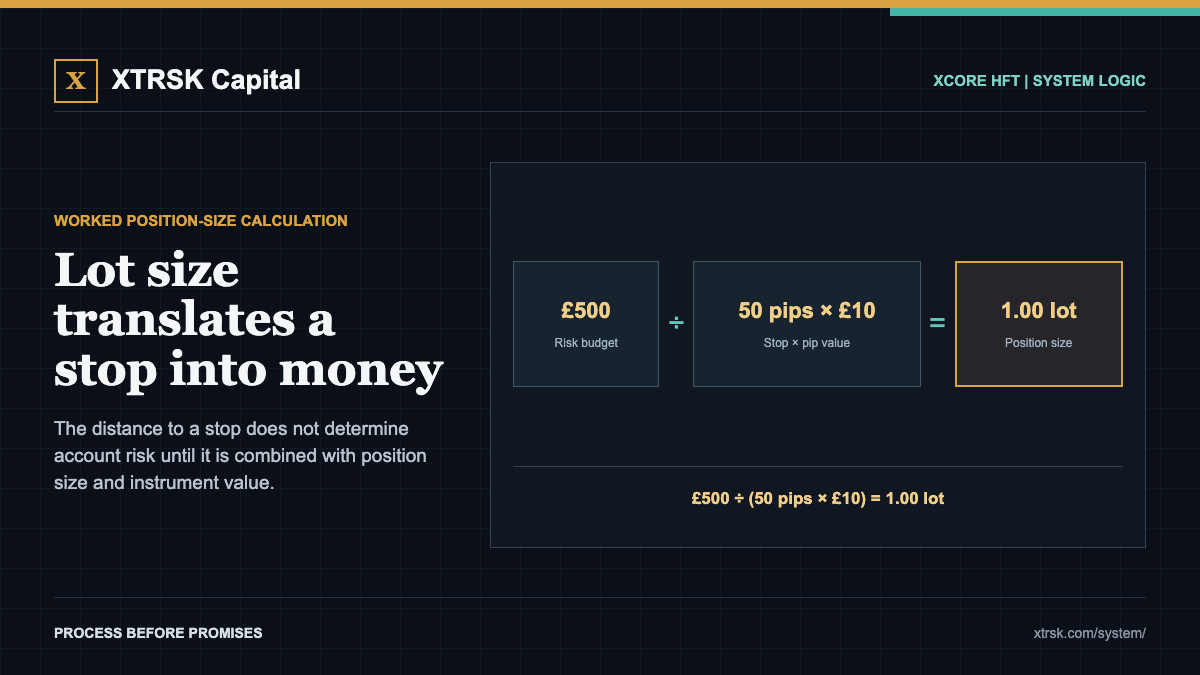
XCore HFT Trading Lab: Lot size translates a stop into money
Quantitative execution, market-microstructure, and risk-control research from XTRSK.
The dangerous trading system is not always the slow one. It is often the fast one whose risk state is wrong. Lot size translates a stop into money.
The useful analysis follows each state transition from observation to final exposure. The distance to a stop does not determine account risk until it is combined with position size and instrument value. Round down to the venue lot increment. Include spread and expected slippage. What matters operationally is the link between certainty, exposure, risk and drawdown.
Put a boundary around the claim. With a five-hundred-pound risk budget, a stop twice as wide normally requires roughly half the position size before costs. The example is not a forecast or a promise; it shows which variable must be measured before the apparent opportunity can be treated as usable.
A compact operating checklist is: 1) recalculate when the stop or volatility changes; 2) start with an account risk budget; 3) convert price distance through contract size, tick value and currency. Add hard exposure ceilings, observable rejection reasons and an event trail that lets operations reconstruct the decision without guessing. Control sequence: 1 signal, 1 order path, 1 reconciled risk state.
The common mistake is to optimise the visible number and ignore the conditions that produced it. Review the median, the stressed tail and the failure path separately. A result that survives only in quiet sessions, tiny size or perfect data is a research result, not yet a production capability.
The account experiences combined profit, loss and liquidity demand, even when models are monitored in separate dashboards. The objective is not to remove uncertainty. It is to size uncertainty, detect when assumptions break and preserve the ability to stop without creating a second problem.
What would make you reduce risk first: worse execution, weaker signal quality or rising portfolio concentration?
#PositionSizing #RiskManagement
The research behind this lesson
This paper explains Andrew Lo's lectures build risk analysis from return distributions and statistical measures, rather than treating one realised result as a complete description of risk.
Applied to this XCore lesson: For a fast strategy, median latency or average fill quality is not enough. The review has to include tail delays, stale-order frequency and the loss distribution when cancellation or routing behaves abnormally.
Explore XCore HFT: System details
PULSE XCORE HFT live account: Verify the live account on FX Blue
Live chat and updates: Telegram @xtrskhft
Source: Risk and Return
Educational content only. Trading leveraged products involves risk.
Chat with XTRSK
Chat ready
Start a chat and the XTRSK team will be notified immediately.