XCore HFT / Trading Lab
Leverage converts market noise into account risk
Quantitative execution, market-microstructure, and risk-control research from XTRSK.
What this problem really is
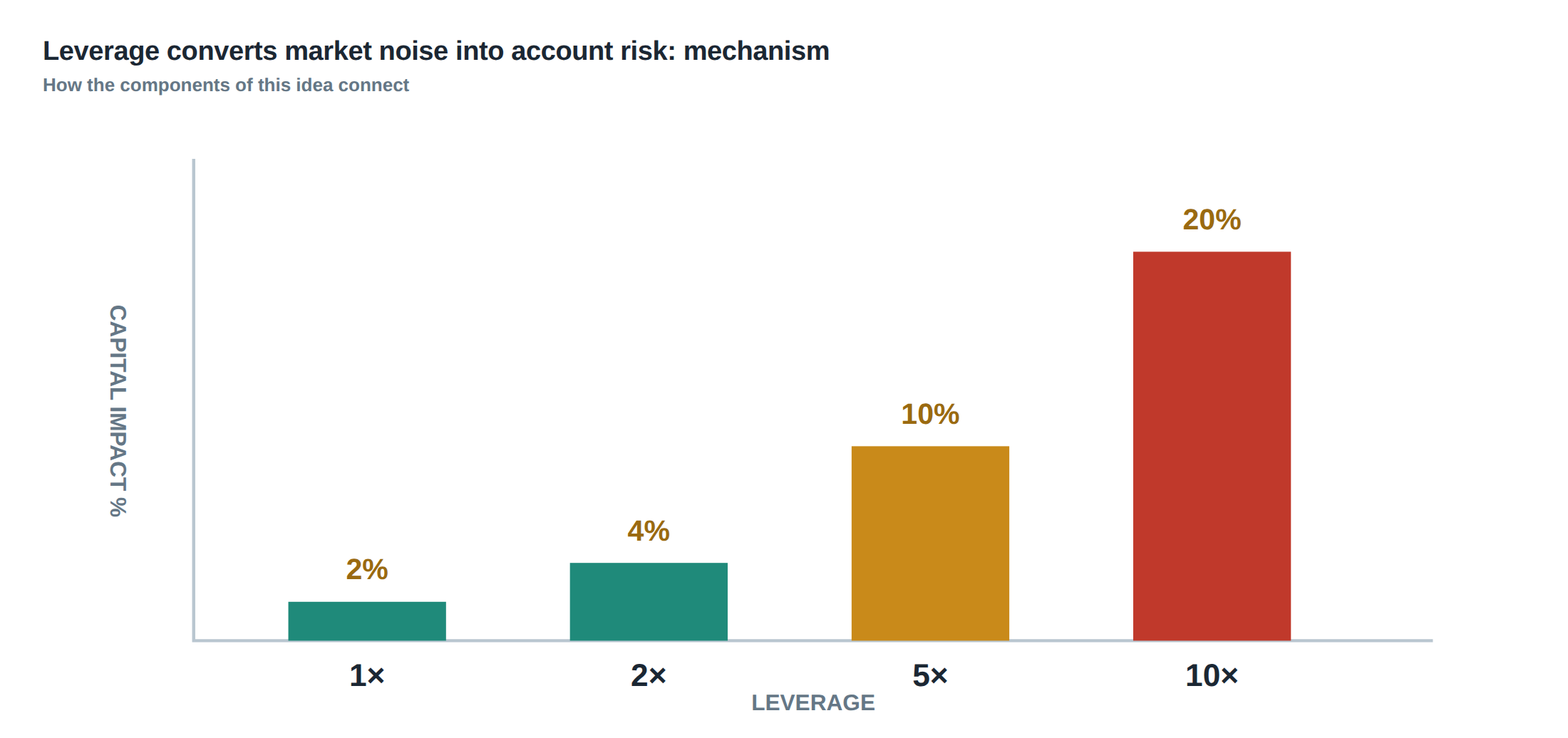
Leverage is often presented as a simple multiplier of capital, but the reality is that it converts the stochastic “noise’’ of the market into a deterministic drain on the account. When a trader scales a strategy to five‑times exposure, a price move that would otherwise be a modest 2 % swing becomes a 10 % hit to the underlying capital before commissions, slippage or financing are even considered. The distinction between gross exposure – the notional amount of contracts, shares or futures held – and the capital that is truly at risk is therefore essential. A desk that measures risk solely by the maximum margin allowed by the clearing house is blind to the fact that the same notional can be funded by a thin pool of liquid cash, leaving the firm vulnerable to any sudden liquidity shock.
The core thesis is that position sizing must be driven by an assessment of plausible adverse price movements and the firm’s ability to meet variation‑margin calls, not by the ceiling of permitted leverage. This requires a disciplined separation of the balance‑sheet notion of “gross exposure’’ from the cash‑flow reality of “capital at risk’’ and a systematic accounting of how market microstructure can amplify that risk.
In practice, the problem manifests whenever a trader treats a calm‑volatility estimate as the sole input to a leverage decision. The market, however, is a mixture of frequent small moves and rare but severe spikes. Ignoring the tail of the distribution means that the leverage applied today may become a levered loss tomorrow when the noise turns into a shock.
How the mechanism works, step by step
First, the desk defines the notional exposure it wishes to hold for a given strategy. This figure is multiplied by the leverage factor – for example five – to obtain the gross exposure. At this stage the calculation is purely arithmetic; no cash is moved, no margin is posted.
Second, the risk‑management team translates the gross exposure into a required margin buffer. The buffer is not the exchange‑mandated initial margin alone; it also incorporates an estimate of the worst‑case variation‑margin drawdown that could arise from a gap, a rapid spread widening, or a sudden change in the clearing house’s margin policy. The buffer is expressed in cash or highly liquid assets that can be called upon instantly.
Third, the desk checks the liquidity of the buffer against the expected timing of cash outflows. If the buffer is tied up in assets that would need to be sold at a discount during stress, the effective leverage is higher than the nominal factor. The final step is to compare the buffer size to the firm’s total capital at risk. If the buffer consumes more than a pre‑agreed proportion of capital – say 20 % – the position must be scaled back, regardless of how much leverage the exchange permits.
A worked example with real numbers
Consider a market‑making desk that wishes to trade a liquid equity future. The desk’s capital allocation for the strategy is £2 million, and the internal policy caps the capital‑at‑risk component at 15 % of that allocation, i.e. £300 000. The trader proposes a five‑times leveraged exposure, meaning a gross notional of £10 million.
If the future price moves against the desk by 2 % – a movement that occurs in normal intraday volatility – the notional loss is £200 000. Because the exposure is five‑times, the loss translates directly into a 10 % reduction of the original £2 million capital, leaving £1.8 million before any transaction costs. The £300 000 risk buffer is therefore insufficient; the loss alone would consume two‑thirds of the allowed capital‑at‑risk.
Adding realistic costs – a 0.05 % commission, a 0.1 % slippage component, and a 0.02 % financing charge for the leveraged notional – raises the total outflow to roughly £350 000. The desk would breach its own risk limit in a single price move that is well within the historical volatility range, proving that the leverage multiplier has turned ordinary market noise into a material capital event.
Where it breaks in live markets
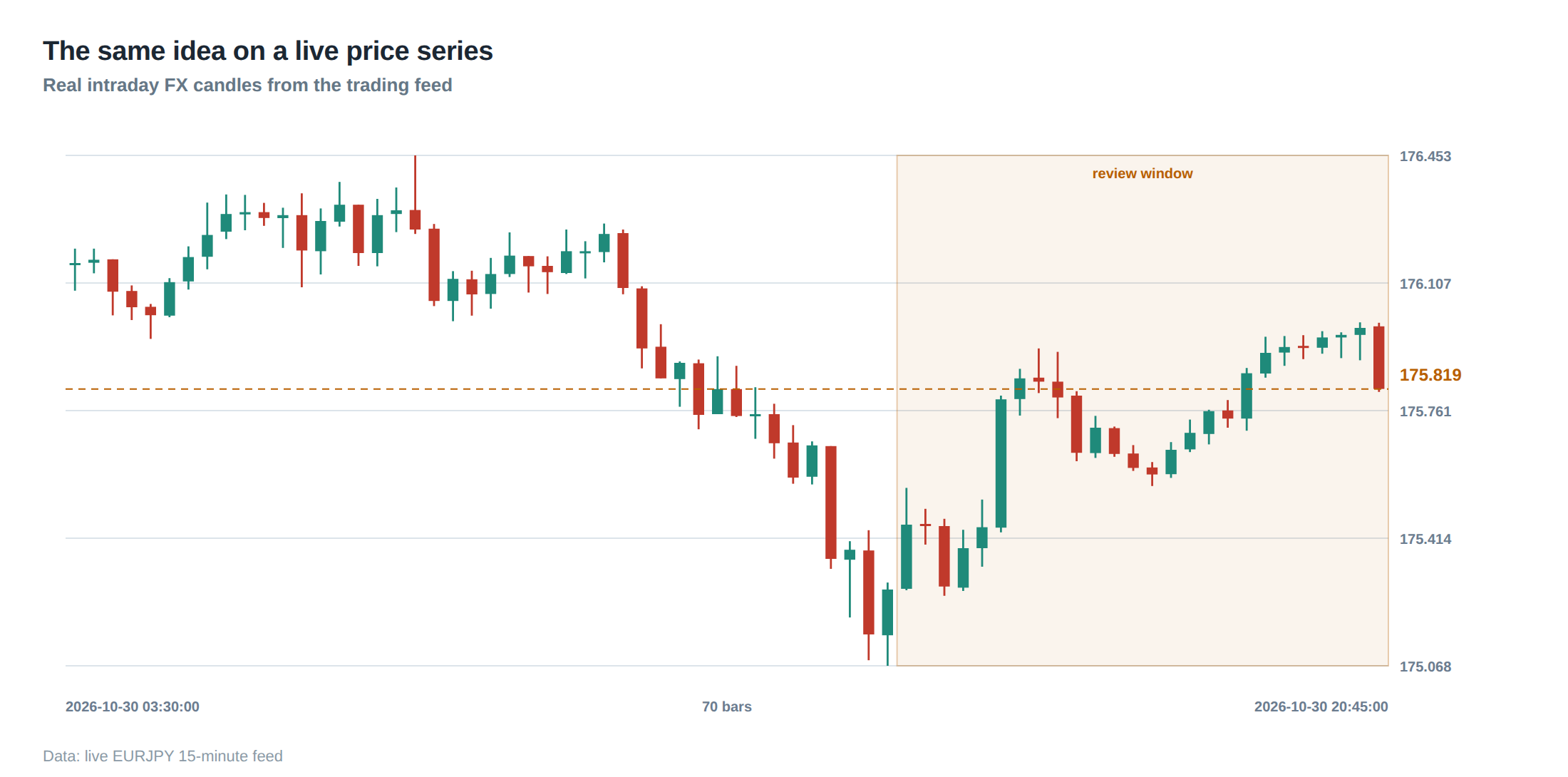
The theoretical framework collapses when the market deviates from the assumed statistical regularities. Gaps can appear at open, after macro announcements or during a flash‑crash, delivering price moves that are orders of magnitude larger than the 2 % used in the example. Spread expansion is another common failure mode: a normally tight bid‑ask can widen to several ticks, turning a trade that would have been executed at the mid‑price into a costly fill at the worst‑available quote.
Margin regimes are not static. Clearing houses may raise initial or variation margin requirements overnight in response to heightened systemic risk, instantly eroding the liquidity buffer that the desk believed was sufficient. In such a scenario, the cash needed to satisfy the new margin call may exceed the liquid assets held, forcing the desk to liquidate positions at adverse prices and creating a feedback loop that magnifies the loss.
Finally, correlated positions amplify the problem. If the desk holds several strategies that all bet on the same underlying or on highly correlated assets, the aggregate exposure can be far larger than the sum of the individual gross notions. A single adverse move can therefore trigger multiple margin calls simultaneously, overwhelming the liquidity reserve that was calculated on a per‑strategy basis.
The operating path, stage by stage
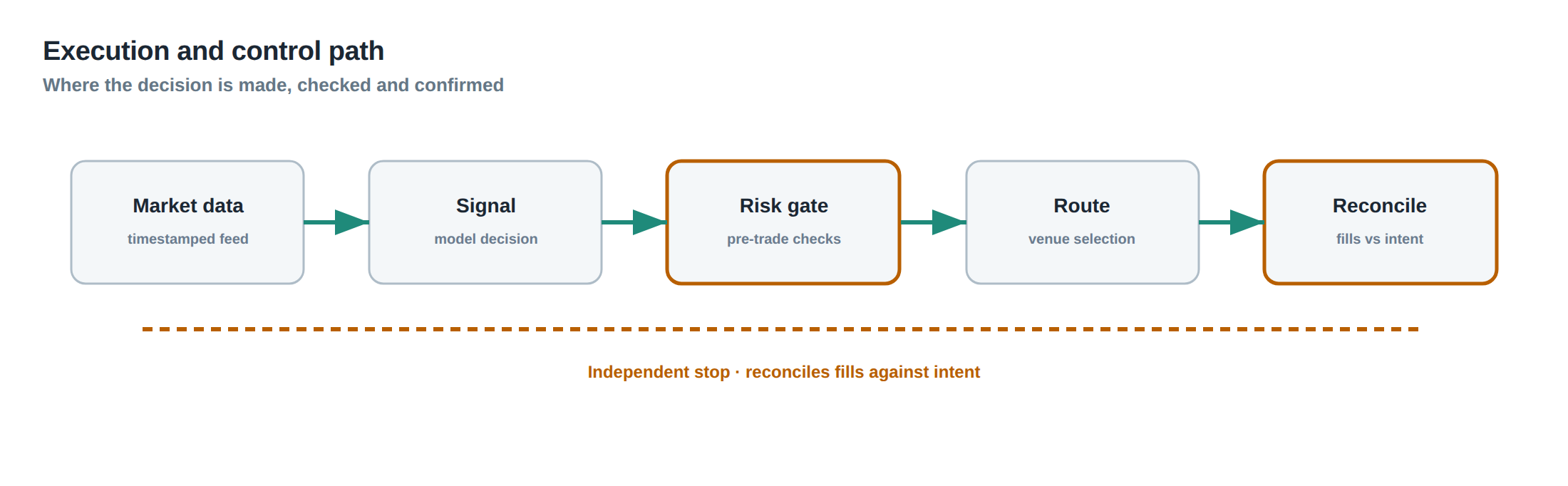
The first stage is data acquisition: market depth, trade‑by‑trade timestamps, and real‑time margin requirements are streamed into a central risk engine. The engine normalises the data and computes the instantaneous gross exposure for each strategy, as well as the portfolio‑wide exposure after accounting for correlation matrices.
The second stage is stress calculation. Using a distribution of historical returns, the engine generates a set of adverse scenarios – for example a 99.5 % VaR move, a 5‑minute gap of 3 %, and a spread widening of 10 ticks. For each scenario it calculates the resulting variation‑margin call, the cash needed to cover the call, and the potential loss after transaction costs.
The third stage is liquidity matching. The required cash from the stress tests is compared against the liquid asset pool, which includes cash, Treasury bills, and any collateral that can be re‑hypothecated without penalty. If the pool is insufficient, the engine flags the position for reduction or for a hedge that can be executed with minimal market impact.
The final stage is execution control. When a trade is about to be sent, the system checks the current buffer against the projected post‑trade buffer. If the trade would breach the buffer, the order is either rejected or routed through a pre‑approved hedge that reduces net exposure. This closed‑loop process ensures that leverage never exceeds the level justified by the available liquidity.
Controls that act before the damage
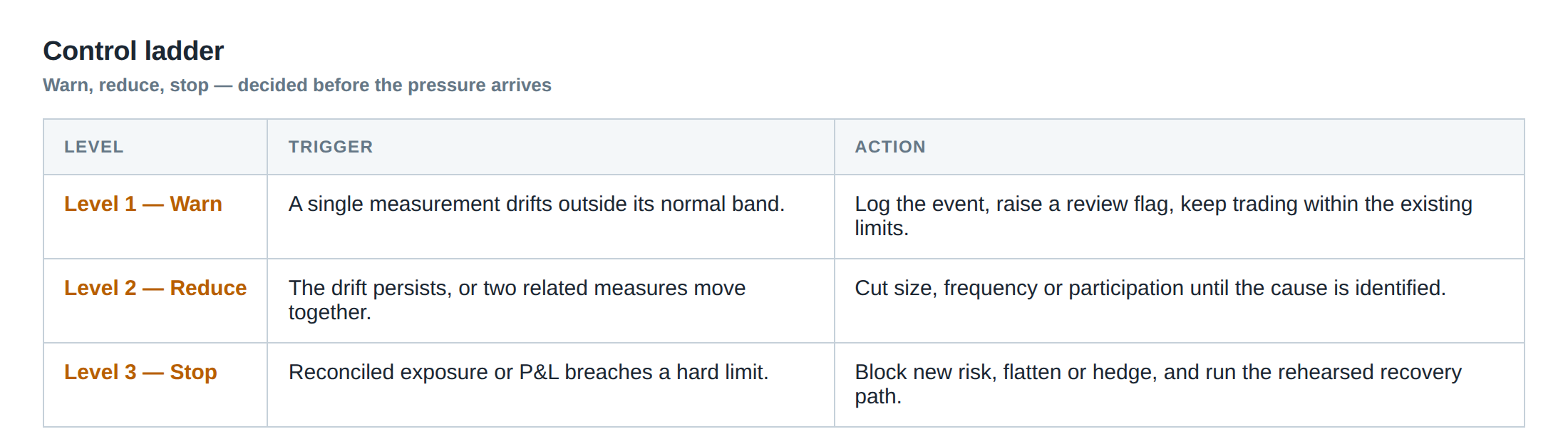
A ladder of preventative controls sits atop the operating path. The lowest rung is the pre‑trade limit: each trader’s order size is capped by a factor of the available cash buffer, not by the exchange‑mandated margin. Above that sits a real‑time exposure monitor that aggregates positions across desks, applying a correlation‑adjusted multiplier to prevent hidden concentration.
The next rung is a margin‑stress scheduler that runs every five minutes, recomputing the variation‑margin requirement under a suite of tail‑risk scenarios. If the scheduler detects that the projected requirement exceeds a preset percentage of the liquid asset pool, it automatically reduces the permissible leverage for the next trading window.
Higher up the ladder is a periodic review of the liquidity pool composition. Assets that have shown poor sell‑through in stressed markets are downgraded in the pool’s valuation, reducing the effective buffer. Finally, a governance layer requires senior risk officers to sign off on any increase in the leverage factor beyond the baseline, ensuring that exceptional leverage is justified by a contemporaneous stress‑test that incorporates the latest market microstructure conditions.
These controls are designed to intervene before a price move translates into a cash shortfall. By tying every decision point – from order entry to portfolio rebalancing – to a liquidity‑aware metric, the desk keeps the conversion of market noise into account risk at a manageable level.
How to measure whether it is working
The primary metric is the ratio of realised variation‑margin calls to the pre‑trade liquidity buffer. A stable ratio well below the policy limit indicates that the buffer is sufficiently sized. Complementary to this, the desk tracks the frequency and magnitude of “margin‑breach events’’ – instances where the buffer would have been insufficient under a stress scenario but was avoided because the trade never executed.
A second line of measurement is the realised tail loss versus the expected tail loss derived from the same distribution used in the stress engine. If the realised tail consistently exceeds the expectation, the underlying distribution assumptions are likely stale, prompting a recalibration of the stress scenarios.
Finally, the desk monitors the correlation‑adjusted aggregate leverage over time. A rising trend without a corresponding increase in liquid assets signals that the portfolio is becoming more fragile. By reviewing these three quantitative signals on a daily basis, the risk team can confirm that the leverage‑to‑liquidity discipline is being upheld.
The portfolio view
From a portfolio perspective, leverage must be thought of as a collective property, not as a per‑instrument attribute. When two strategies each run at five‑times exposure but are positively correlated, the portfolio’s effective leverage can be close to ten‑times, dramatically inflating the capital at risk. Conversely, negatively correlated strategies can offset each other, allowing a higher nominal exposure without increasing the true risk.
The portfolio‑level risk model therefore aggregates gross exposures, applies a correlation matrix, and then rescales the result by the available liquidity buffer. The output is a single number – the “effective leverage’’ – that can be compared against a firm‑wide ceiling. This approach prevents the common pitfall of adding up individual leverage limits and assuming safety, a mistake that has historically led to rapid equity drawdowns in many prop‑trading outfits.
In practice, the portfolio view also informs hedging decisions. If the effective leverage approaches the threshold, the desk can introduce low‑beta or cash‑equivalent positions that reduce the net exposure without sacrificing the core alpha source. The key is to treat leverage as a fluid resource that must be allocated according to both market risk and the firm’s liquidity capacity, rather than as a static multiple granted by the exchange.
Do you currently size your positions based on a realistic assessment of adverse moves and the liquidity needed to survive them, or do you still rely primarily on the maximum margin allowed by your broker?
About the research behind this lesson
Andrew Lo's lectures build risk analysis from return distributions and statistical measures, rather than treating one realised result as a complete description of risk.
Applied to this lesson: For a fast strategy, median latency or average fill quality is not enough. The review has to include tail delays, stale-order frequency and the loss distribution when cancellation or routing behaves abnormally.
Two live systems, one desk
PULSE-X — power-packed HFT: high-frequency momentum on XAUUSD and EURUSD. System details · Live account
NIC-X — ultra-low drawdown: displaced-print arbitrage for large capital. System details · Live account
Start now: leave your email and request a free trial — we will send the pricing, the connection route and the trial terms. Pricing
Join the market discussion: Telegram @squawklive
Source: Risk and Return
Educational content only. Trading leveraged products involves risk.
Chat with XTRSK
Chat ready
Start a chat and the XTRSK team will be notified immediately.