
XCore HFT / Trading Lab
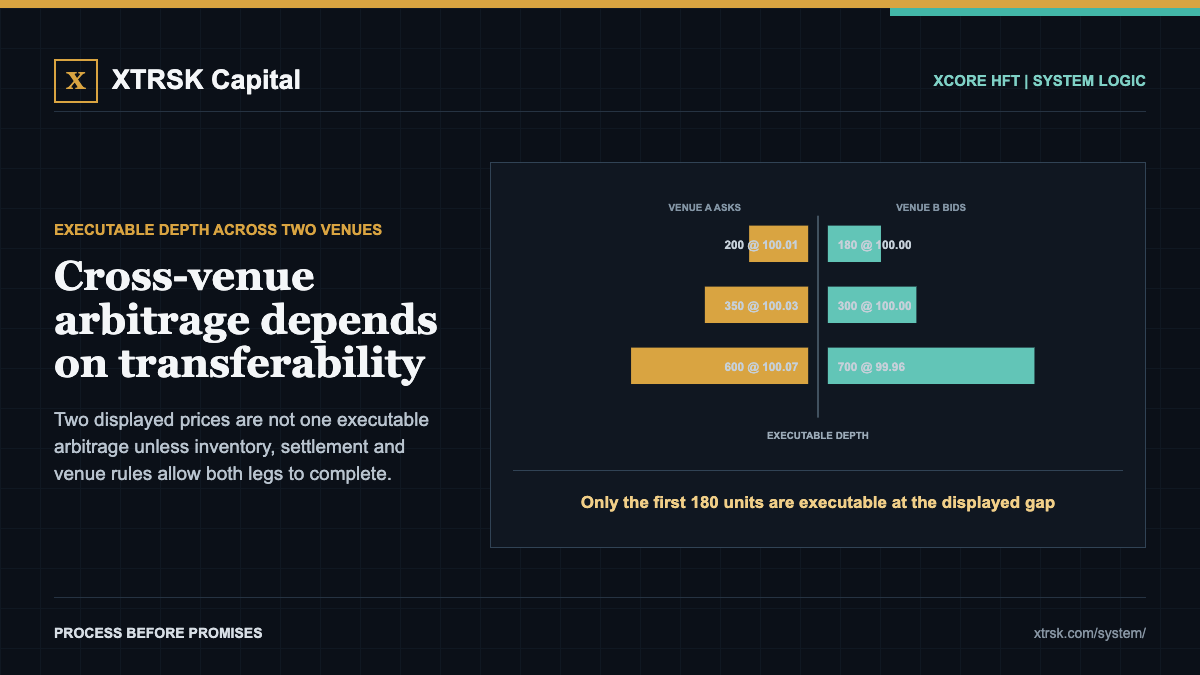
XCore HFT Trading Lab: Cross-venue arbitrage depends on transferability
Quantitative execution, market-microstructure, and risk-control research from XTRSK.
Risk in systematic trading is rarely one number. It is a chain of assumptions that must remain true at the same time. Cross-venue arbitrage depends on transferability.
Professionals separate what the model predicts from what the venue can actually execute. Two displayed prices are not one executable arbitrage unless inventory, settlement and venue rules allow both legs to complete. Model venue outage and counterparty exposure. Compare executable depth rather than top-of-book prints. For traders, this connects slippage, mechanism, friction and exposure in one measurable problem.
Put a boundary around the claim. A quoted price gap can vanish after fees or remain unreachable because capital sits on the wrong venue. The example is not a forecast or a promise; it shows which variable must be measured before the apparent opportunity can be treated as usable.
A compact operating checklist is: 1) include fees, rebates, funding and withdrawal constraints; 2) pre-position inventory when transfer is slower than the opportunity; 3) model venue outage and counterparty exposure. Add hard exposure ceilings, observable rejection reasons and an event trail that lets operations reconstruct the decision without guessing. Control sequence: 1 signal, 1 order path, 1 reconciled risk state.
The common mistake is to optimise the visible number and ignore the conditions that produced it. Review the median, the stressed tail and the failure path separately. A result that survives only in quiet sessions, tiny size or perfect data is a research result, not yet a production capability.
Individual controls answer whether one instruction is permitted. Portfolio controls answer whether the firm can absorb all permitted instructions together. The objective is not to remove uncertainty. It is to size uncertainty, detect when assumptions break and preserve the ability to stop without creating a second problem.
What would make you reduce risk first: worse execution, weaker signal quality or rising portfolio concentration?
#Arbitrage #MarketMicrostructure
Research desk: from MIT theory to trading controls
This section is an original XTRSK synthesis of the cited teaching and research material. MIT is an educational source and does not endorse XTRSK, XCore HFT or PULSE.
High-Frequency Trading and Modern Market Microstructure
What the MIT material establishes: The seminar frames electronic markets as price-time-priority queues. It separates queue value into spread capture versus adverse-selection cost and the option value of retaining a place in line.
Applied to this XCore lesson: An order lifetime therefore cannot be based on elapsed time alone: the system must reassess whether its queue position, expected spread and adverse-selection risk still justify keeping the order alive.
Study the original MIT Operations Research Center seminar
Blockchain and Money: Secondary Markets and Crypto-Exchanges
What the MIT material establishes: The course studies blockchain economics and devotes a session to secondary markets and crypto exchanges, placing tokens inside the practical structure of trading venues, custody and market access.
Applied to this XCore lesson: The same control principle crosses asset classes: venue state, settlement design and fragmented liquidity can outlive a short-lived signal, so speed must remain subordinate to confirmed exposure and executable liquidity.
Study the original MIT OpenCourseWare, Blockchain and Money
Risk and Return
What the MIT material establishes: Andrew Lo's lectures build risk analysis from return distributions and statistical measures, rather than treating one realised result as a complete description of risk.
Applied to this XCore lesson: For a fast strategy, median latency or average fill quality is not enough. The review has to include tail delays, stale-order frequency and the loss distribution when cancellation or routing behaves abnormally.
Study the original MIT OpenCourseWare, Finance Theory I
Further MIT learning path
- FX: Theories of Nominal Exchange Rates and Exchange-Rate Regimes
- Risk: Risk and Return
- HFT: High-Frequency Trading and Modern Market Microstructure
- Crypto: Blockchain and Money: Secondary Markets and Crypto-Exchanges
Explore XCore HFT: System details
PULSE XCORE HFT live account: Verify the live account on FX Blue
Live chat and updates: Telegram @xtrskhft
Educational content only. Trading leveraged products involves risk.
Chat with XTRSK
Chat ready
Start a chat and the XTRSK team will be notified immediately.