XCore HFT / Trading Lab
Every fast order needs a lifetime
Quantitative execution, market-microstructure, and risk-control research from XTRSK.
What this problem really is
In a modern electronic market the moment a predictive model emits a signal, the signal is already subject to decay. The decay is not limited to the statistical half‑life of the underlying price pattern; it also includes the mechanical latency that separates the generation of the order from its arrival at the venue, the time spent waiting in the exchange’s price‑time priority queue, and the interval required for a cancellation request to be acknowledged. If any of those stages take longer than anticipated, the original signal may have lost its edge while the order is still “alive”.
The consequence is a mismatch between the risk that the strategy was calibrated to bear and the actual exposure incurred. A trader may believe that an order will be cancelled within a few milliseconds, yet the network stack, the exchange gateway, or the venue’s own throttling can stretch the effective lifetime to seconds. During that window the order may be filled at a price that no longer reflects the intended spread capture, or it may be hit by an adverse‑selection event that the model never accounted for.
Treating an order simply as a function of elapsed wall‑clock time therefore ignores two crucial dimensions: the state of the order in the venue’s queue and the certainty that a cancellation has been processed. Both must be incorporated into a “lifetime” that is defined not only by how long the order has existed, but also by whether the original signal still justifies its presence in the market.
How the mechanism works, step by step
When a signal is produced, the execution engine stamps it with a maximum permissible age – for example, 30 ms for a high‑frequency scalping signal. The engine then creates the outbound order packet, tags it with the same expiry, and forwards it to the gateway. The packet traverses the network, incurs switch and router latency, and finally reaches the exchange’s matching engine.
At the exchange the order is inserted into a price‑time priority queue. Its position in that queue determines the expected time to execution, which can be expressed as an “expected fill horizon”. If the queue depth at the quoted price is 150 contracts and the average flow is 2 k contracts per second, the order’s expected fill time is roughly 75 ms, well beyond the original 30 ms signal horizon.
If the signal deteriorates – for example because the mid‑price moves away or the spread narrows – the local system issues a cancellation request. The request is sent back through the same gateway, but now the exchange must confirm the cancellation. Until the acknowledgement arrives, the order remains active on the venue, and the trader’s exposure persists. The system therefore distinguishes a local cancel request (the moment the trader decides to withdraw) from a venue‑confirmed cancellation (the moment the exchange sends a “canceled” message).
Only when the venue‑confirmed cancellation is received does the order’s lifetime officially end. If the acknowledgement is delayed, the order may be executed, partially or fully, at a price that no longer matches the original signal’s assumptions.
A worked example with real numbers
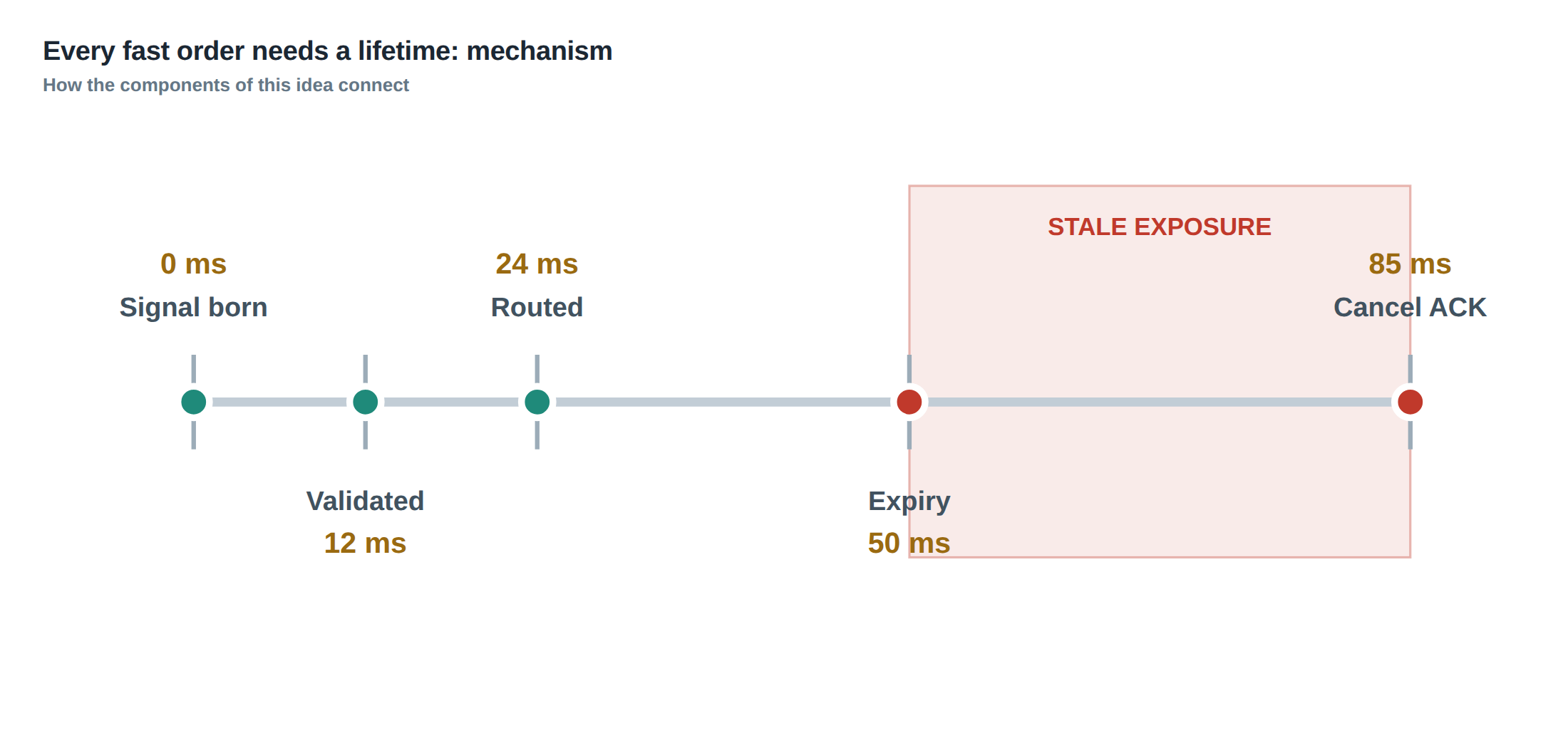
Consider a market‑making strategy that targets a 0.5 tick spread on a futures contract whose tick size is 0.25. The model predicts a fleeting 50 ms window during which the bid‑ask imbalance is favourable. The execution engine therefore creates a limit order to sell at the ask price, attaches a maximum signal age of 30 ms, and a hard order‑expiry of 60 ms.
The order packet experiences 12 ms of network latency to the exchange. Upon arrival the order is placed at the back of a queue that already contains 120 contracts. The average order flow at that price level is 4 k contracts per second, implying an expected fill time of 30 ms (120 ÷ 4 000 ≈ 0.03 s). At this point the order is still within the 60 ms hard expiry, but the remaining time to the signal’s expiry is only 18 ms.
Two milliseconds after the order is queued, the model detects that the imbalance has reversed and issues a cancellation. The local system records the cancel request at t = 14 ms. The cancellation packet then takes another 10 ms to travel back to the exchange. However, the exchange is currently throttling inbound messages due to a burst of traffic, and the cancellation is not processed until t = 28 ms. By then the order has already been partially filled – 25 contracts executed at the original ask price – because the expected fill horizon of 30 ms was reached before the cancellation was acknowledged.
The net result is that an opportunity that was supposed to last 50 ms has left a residual exposure that persisted for 28 ms, and the order was still “alive” for a total of 38 ms after the signal expired. The realised profit from the spread capture is offset by the adverse‑selection cost of being filled after the signal’s decay, and the trader now bears a position that must be unwound later, potentially at a worse price.
This example demonstrates why the order’s lifetime must be bound not only to the original signal age but also to the certainty of cancellation, and why a hard expiry that does not account for queue dynamics can lead to unintended execution.
Where it breaks in live markets
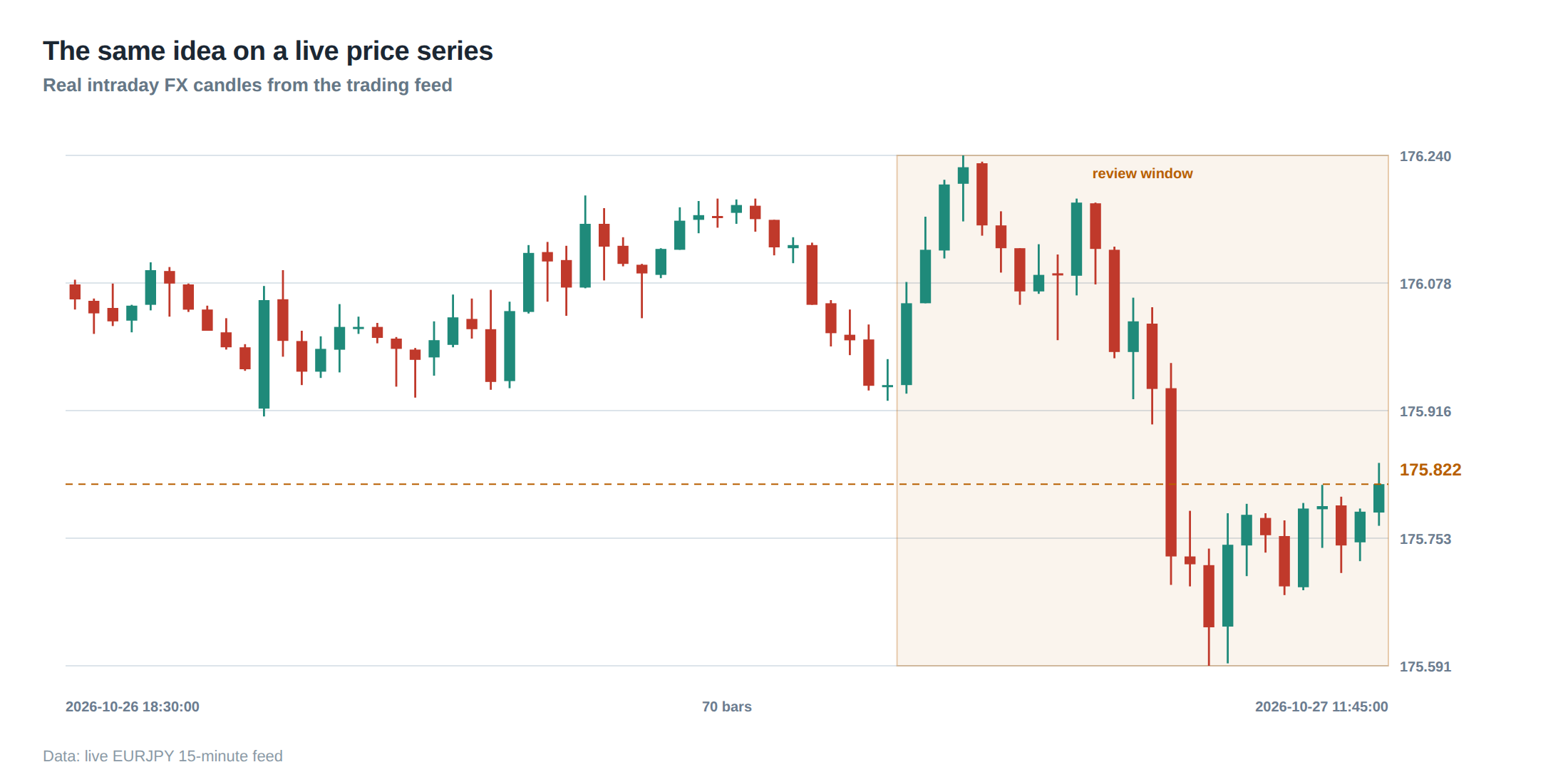
In live trading environments the idealised timeline described above is repeatedly disrupted by three classes of friction. First, network jitter can add a few to several tens of milliseconds to both order and cancel paths, especially when crossing data‑centre boundaries or when the ISP experiences congestion. Second, venue‑level throttling – implemented as per‑client rate limits or as protective back‑pressure during extreme volatility – can delay the processing of inbound messages, turning a sub‑millisecond cancel request into a multi‑millisecond stall. Third, the internal order‑book dynamics can change faster than the model’s refresh rate, meaning that the queue position estimated at the moment of order entry may be obsolete within a few milliseconds.
When any of these frictions extend the interval between the local cancel request and the venue‑confirmed cancellation, the order effectively lives beyond its intended “signal window”. In high‑frequency contexts this can translate into a loss of several basis points per trade, which compounds quickly across the thousands of executions that a prop desk typically generates each day.
Moreover, the problem is amplified during “replacement storms”, where a strategy repeatedly amends or cancels an order in rapid succession. If acknowledgements lag, the exchange may retain multiple pending versions of the same logical order, each with its own queue position, creating a hidden exposure that the local risk engine cannot see. The result is a cascade of fills that were never intended, often at prices that have moved unfavourably.
The operating path, stage by stage
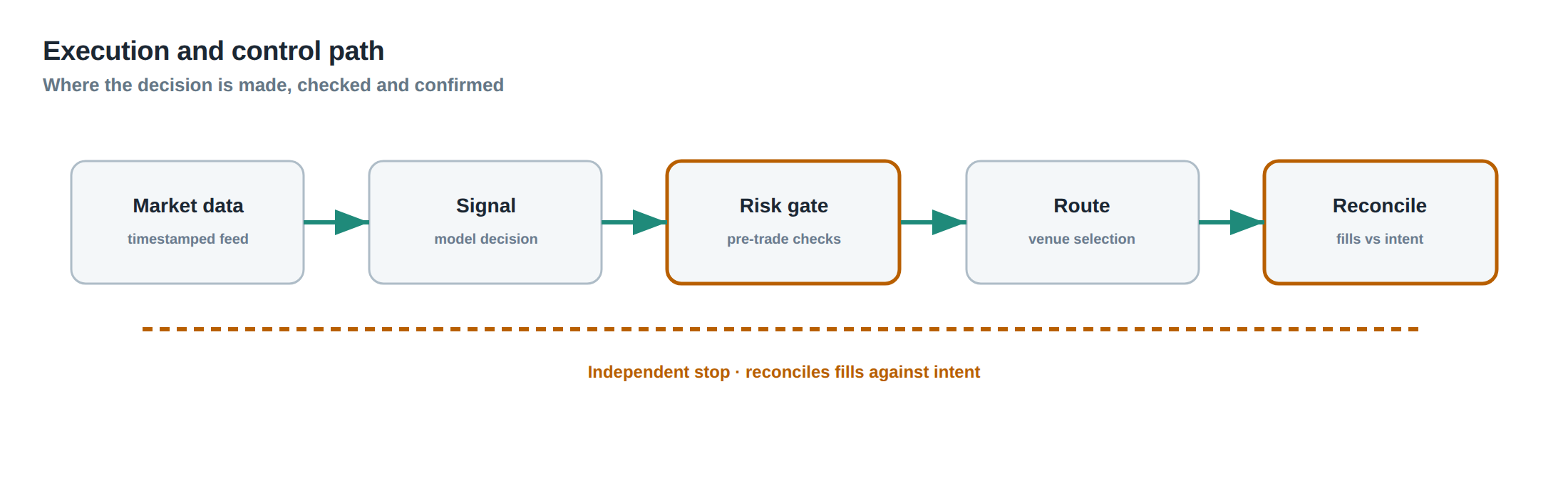
The full lifecycle of a fast order can be broken into six distinct stages. The first stage is signal generation, where the predictive model timestamps the output and assigns a maximum age. The second stage is order construction, during which the order packet is stamped with the same expiry and sent to the gateway. The third stage is network transmission, encompassing outbound latency, possible retransmissions, and any jitter. The fourth stage is venue queue insertion, where the order receives a position in the price‑time priority list and an expected fill horizon is calculated. The fifth stage is cancellation decision, triggered by a change in market conditions or by expiry of the signal’s age. The final stage is cancellation acknowledgement, where the exchange returns a confirmation that the order has been removed from the queue.
Only after the fifth stage does the local system consider the order “inactive”, but true inactivity is only achieved after the sixth stage. If the system proceeds to the next trading decision before the acknowledgement arrives, it may inadvertently double‑count capital, or worse, it may place a new order that conflicts with the still‑active predecessor.
By explicitly modelling each stage and its associated latency distribution, a desk can derive a probabilistic bound on the order’s effective lifetime, and can decide whether to allow the order to survive beyond the signal’s expiry or to enforce a hard kill that forces a market order to unwind any residual exposure.
Controls that act before the damage
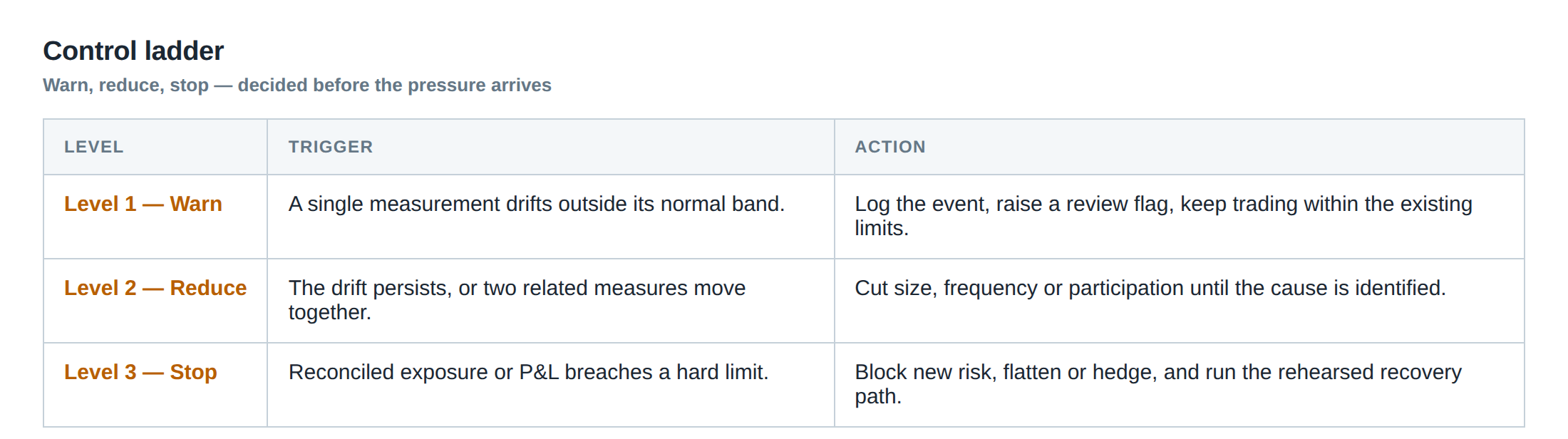
A robust defence against the “order outliving its signal” problem begins with pre‑emptive controls that limit the exposure window. The first control is a maximum signal age that is enforced at the point of order creation; any order whose estimated queue‑time exceeds this age is rejected outright. The second control is a cancellation timeout – a configurable threshold, for example 15 ms, after which the system will automatically issue a market‑order unwind if a venue‑confirmed cancel has not been received.
A third control is the replacement‑storm guard. When a series of amendments is detected within a short interval (e.g., three changes in 20 ms), the guard forces the order to be cancelled and re‑submitted as a fresh order, thereby resetting its queue position and eliminating hidden pending versions. The fourth control is a queue‑position monitor that continuously compares the order’s current position against the expected fill horizon; if the horizon exceeds the remaining signal age, the monitor triggers an early cancel.
These controls can be visualised as a ladder of safety nets, each rung catching a different failure mode. The lower rungs – signal‑age limits and queue‑position checks – act instantly, while the upper rungs – cancellation timeouts and storm guards – intervene only when the lower rungs have been breached. By arranging the safeguards in this hierarchical fashion, the desk can keep the probability of an order surviving beyond its useful life to a negligible level.
How to measure whether it is working
Measurement must be both granular and aggregate. At the micro‑level, the system should log the timestamps of signal generation, order transmission, queue entry, local cancel request, and venue‑confirmed cancel. From these timestamps the effective lifetime of each order can be computed as the interval between signal generation and venue cancellation. The signal‑age breach ratio – the proportion of orders whose effective lifetime exceeds the maximum signal age – provides a direct indicator of the problem’s prevalence.
At the macro‑level, the desk should track the exposure cost associated with late fills. This can be expressed as the average adverse‑selection loss per trade, calculated by comparing the execution price of a late fill with the price that would have been obtained had the order been cancelled on time. The replacement‑storm frequency – the count of orders that required multiple amendments within a defined window – should also be monitored, as it is a leading indicator of throttling or latency issues.
Statistical process control charts can be employed to detect shifts in these metrics. If the breach ratio climbs above a pre‑set control limit, the desk must investigate the underlying cause, whether it be network degradation, venue throttling, or an unexpected surge in order‑book depth. Continuous measurement thus closes the feedback loop between the control mechanisms and the live market environment.
The portfolio view
When every fast order is treated as a time‑bounded instrument, the portfolio’s risk profile becomes a function of the aggregate “alive‑time” of all outstanding orders. The total exposure at any instant can be expressed as the sum of the notional values of orders whose effective lifetime has not yet reached a venue‑confirmed cancel. This aggregate exposure fluctuates not only with market volatility but also with the latency health of the entire execution stack.
If the average effective lifetime drifts upward, the portfolio may inadvertently carry a larger directional bias than intended, eroding the market‑neutral premise of many high‑frequency strategies. Conversely, an overly aggressive hard‑kill policy may increase transaction costs by forcing unnecessary market orders to unwind residual positions, thereby reducing the net spread capture.
Optimising the portfolio therefore requires a balanced calibration: the maximum signal age and cancellation timeout must be set such that the expected spread capture outweighs the expected adverse‑selection loss, while keeping the total “alive‑time” within a predetermined risk budget. By integrating the lifetime metrics into the portfolio’s risk engine, a prop desk can maintain the intended statistical edge without being blindsided by mechanical latency.
Do you have a process in place to verify that every order you send to the market is retired before its predictive signal ceases to be valid?
About the research behind this lesson
The seminar frames electronic markets as price-time-priority queues. It separates queue value into spread capture versus adverse-selection cost and the option value of retaining a place in line.
Applied to this lesson: An order lifetime therefore cannot be based on elapsed time alone: the system must reassess whether its queue position, expected spread and adverse-selection risk still justify keeping the order alive.
Two live systems, one desk
PULSE-X — power-packed HFT: high-frequency momentum on XAUUSD and EURUSD. System details · Live account
NIC-X — ultra-low drawdown: displaced-print arbitrage for large capital. System details · Live account
Start now: leave your email and request a free trial — we will send the pricing, the connection route and the trial terms. Pricing
Live chat and updates: Telegram @xtrskhft
Source: High-Frequency Trading and Modern Market Microstructure
Educational content only. Trading leveraged products involves risk.
Chat with XTRSK
Chat ready
Start a chat and the XTRSK team will be notified immediately.